Our Plants and Animals
Our Mammals
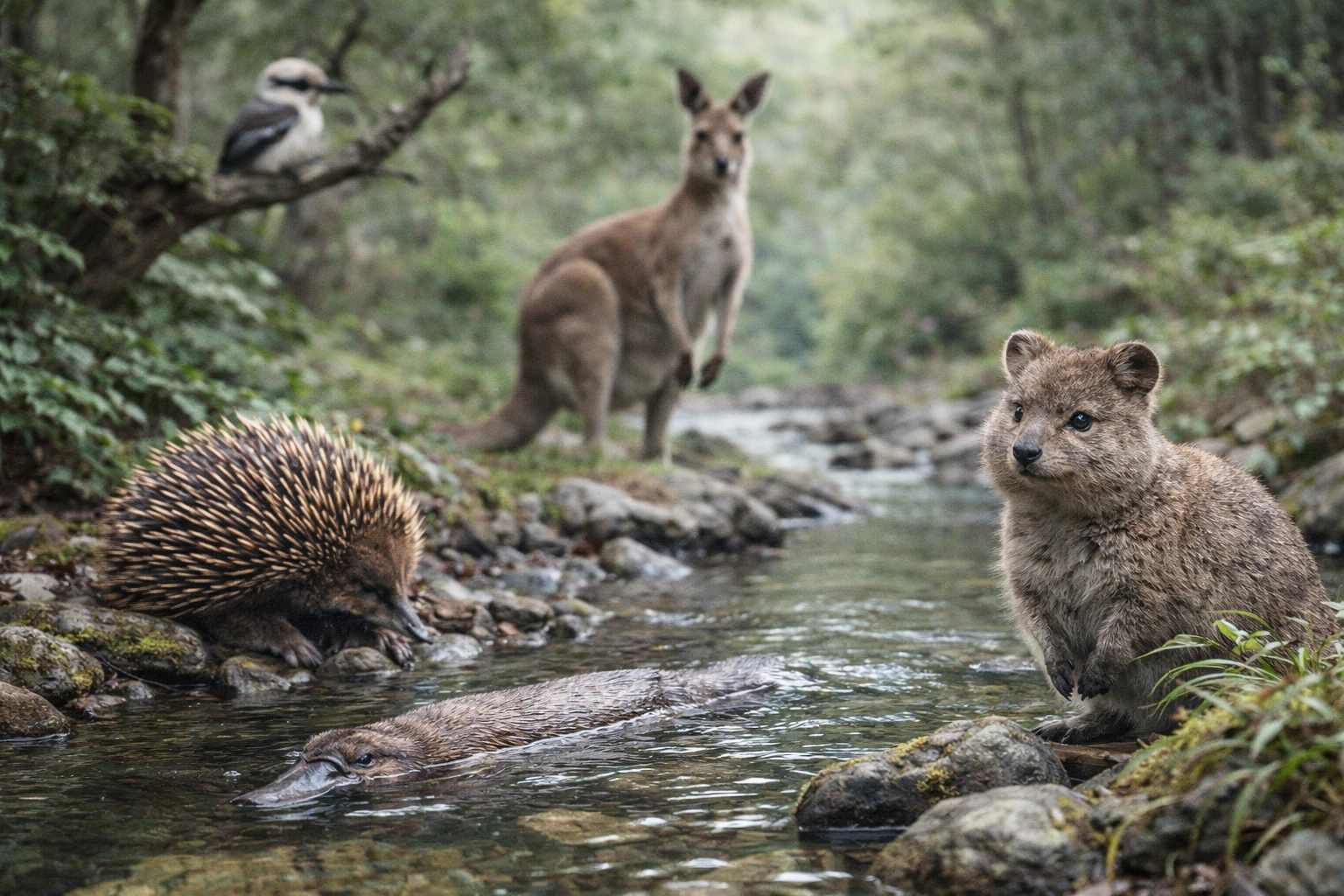
Australia’s animals are as unique as the land itself — from hopping kangaroos to tree-hugging koalas.Found nowhere else on Earth, they reflect a wild, ancient country full of character and surprise.
Australian mammals are unlike anywhere else in the world because most of them are marsupials — mammals that carry and raise their young in a pouch. Kangaroos, wallabies and wombats are some of the most recognisable, while koalas cling to eucalyptus trees along the east coast. These animals evolved in isolation, which is why Australia’s wildlife feels so different from Africa, Europe or the Americas.
Australia is also home to monotremes — egg-laying mammals — which are incredibly rare globally. The platypus and echidna are the only living examples on Earth. Beyond the famous species, there are also dingoes, flying foxes, bandicoots, quolls and tiny desert marsupials that survive in harsh outback conditions. From prehistoric-looking creatures to iconic pouch-bearing animals, Australian mammals reflect the country’s unique evolutionary history and wild landscapes.
This stylistic image blends elements from multiple themes into one cohesive visual scene.
Koala
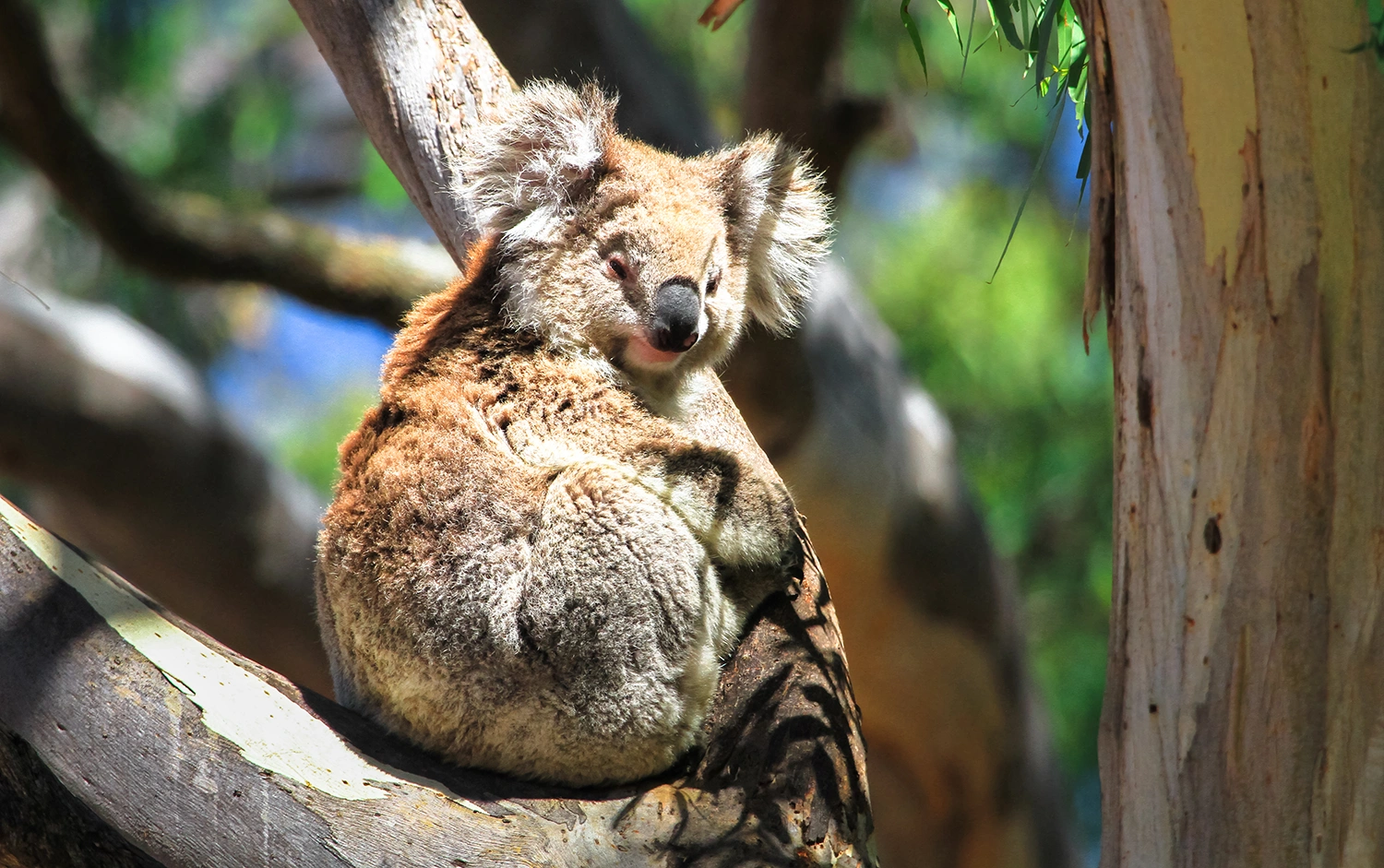
Scientific name: Phascolarctos cinereus
The koala is one of Australia’s most iconic animals, known for its fluffy grey fur, large nose, and calm, sleepy nature as it rests in eucalyptus trees for up to 18–20 hours a day. Native to eastern Australia, koalas feed almost exclusively on eucalyptus leaves, which are low in nutrients and mildly toxic, making their slow metabolism essential for survival. Despite their cuddly appearance, koalas are solitary, strong climbers with sharp claws, and they play an important role in forest ecosystems while holding deep cultural significance for Aboriginal Australians.
Red Kangaroo
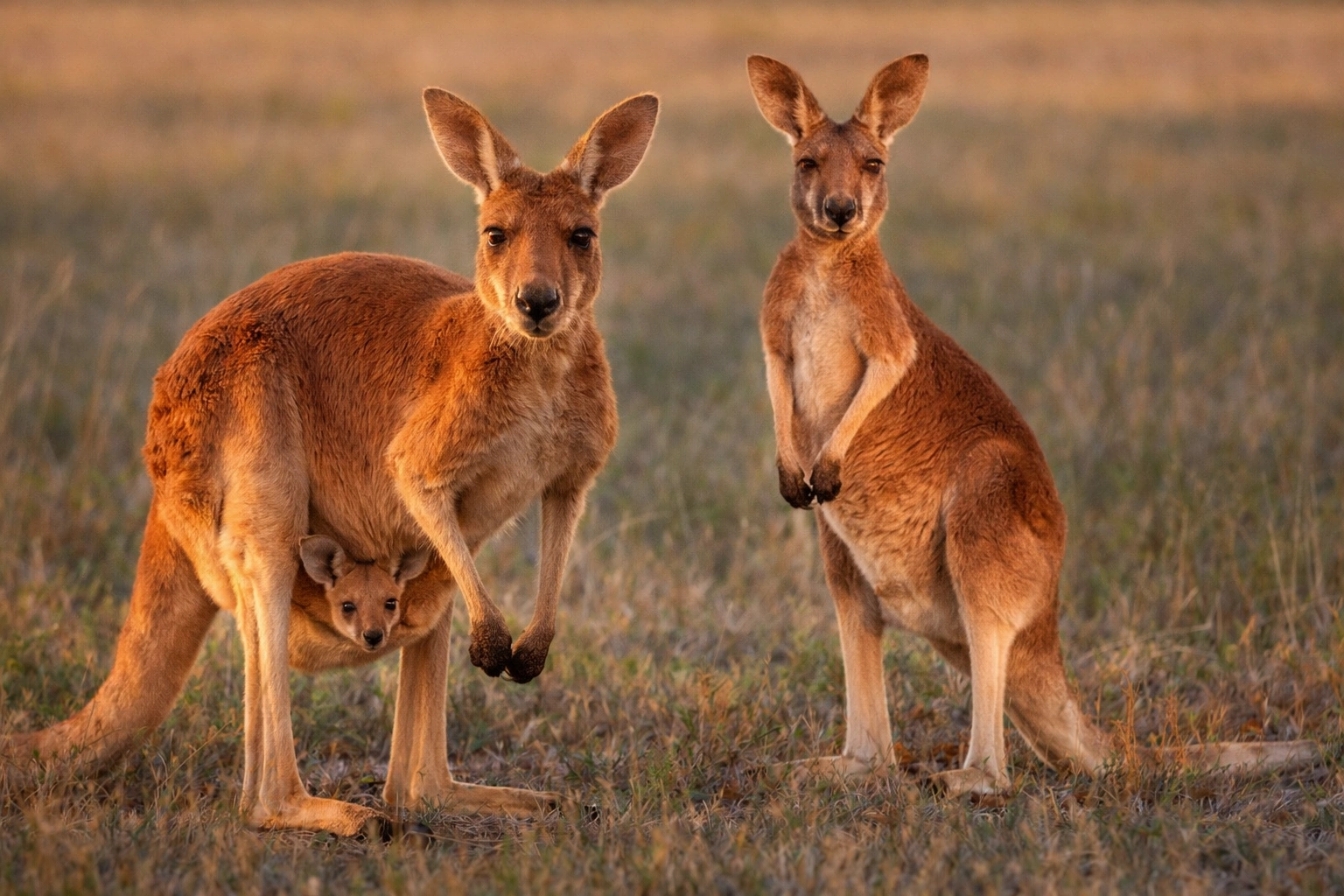
Scientific name: Osphranter rufus
The Red Kangaroo is Australia’s largest land mammal and the biggest marsupial on Earth. Big males — often called “boomers” — can stand over 1.8 metres tall and weigh around 90 kilograms. They get their name from the reddish-brown fur seen mainly on males, while females tend to be more bluish-grey. Built for the harsh inland, red kangaroos thrive in the dry centre of Australia where few large animals can survive.
They move in an incredibly efficient way — hopping. Using their powerful hind legs and thick tail for balance, they can cover long distances at speeds up to 60 km/h. What’s wild is that hopping actually conserves energy at higher speeds, making them perfectly adapted to wide open desert plains. They mostly feed on grasses and shrubs and can go long periods without drinking, getting much of their moisture from vegetation.
Like all marsupials, females carry their young (called joeys) in a pouch. A joey is born tiny — about the size of a jellybean — and crawls into the pouch where it continues developing for months. The red kangaroo is such a powerful symbol of Australia that it appears on the national coat of arms alongside the emu, representing a nation that keeps moving forward.
Quokka
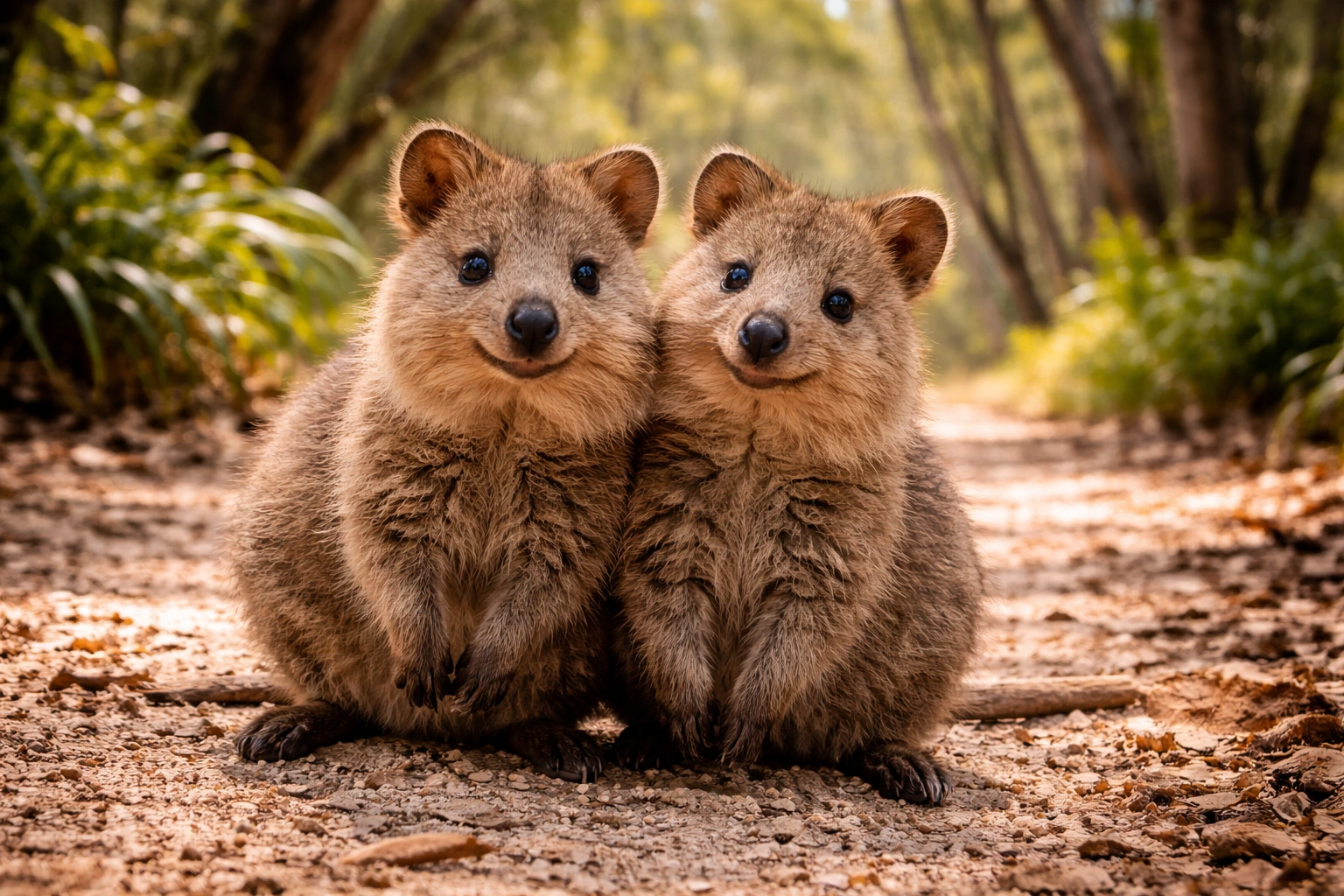
Scientific name: Setonix brachyurus
The quokka is a small marsupial native to Western Australia and is basically the unofficial champion of “cutest animal on Earth.” They’re about the size of a domestic cat, with round ears, short faces, and a permanent upturned mouth that makes them look like they’re grinning in every photo. That’s why they’ve become social media legends — the “selfie animal” of Australia.
Quokkas are most famously found on Rottnest Island near Perth. In fact, Rottnest is one of the best places in the world to see them in the wild. They’re mostly nocturnal, herbivores (grasses, leaves, bark), and like other marsupials, the females carry their babies (called joeys) in a pouch. They’re surprisingly tough too — they can survive in fairly dry conditions and store fat in their tails.
A few important things if you ever meet one:
Don’t feed them (it’s illegal and bad for their health).
Don’t touch them.
Keep your food sealed — they’re cheeky little opportunists.
Fun fact: Early Dutch explorers thought they were giant rats, which is how Rottnest got its name — it comes from “Rattennest” (rat’s nest).
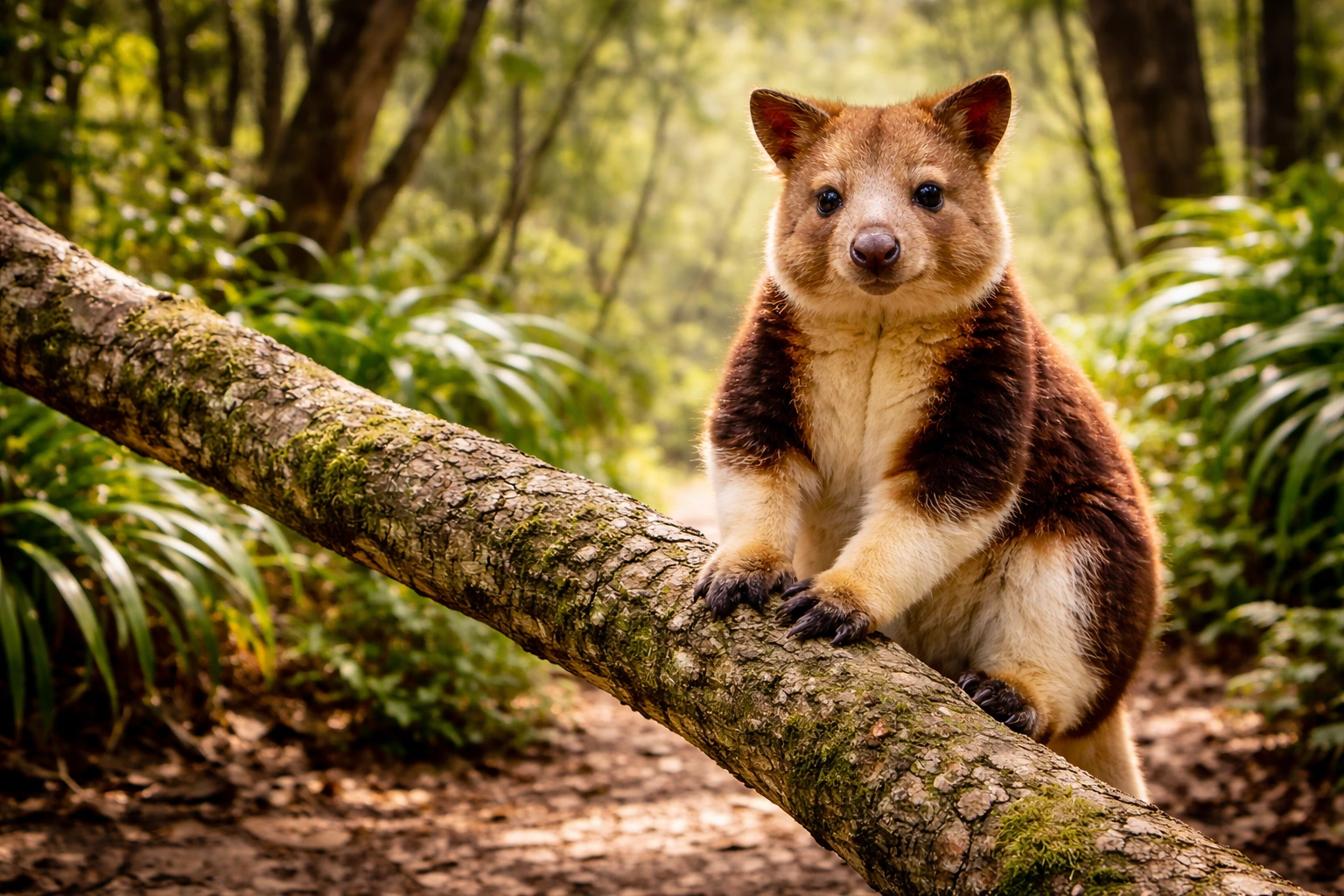
Tree Kangaroo
Scientific Name: Dendrolagus goodfellowi
Tree kangaroos are unique marsupials that live high in the rainforests of northeastern Queensland and New Guinea. They belong to the genus Dendrolagus and have evolved very differently from their ground-dwelling kangaroo relatives. Instead of long powerful legs built for hopping across open plains, tree kangaroos have shorter, stronger limbs, curved claws, and long tails that help them balance and climb. They are surprisingly agile in the canopy and can even leap down from significant heights without injury.
In Australia, the two species found in the wild are Lumholtz's tree-kangaroo and Bennett's tree-kangaroo. Both live in the tropical rainforests of Far North Queensland, including areas such as the Atherton Tablelands and Cape York. They are shy, mostly solitary animals that spend much of their time resting in trees and feeding on leaves, fruit, and flowers. Like other marsupials, females carry their young in a pouch until the joey is developed enough to venture out.
Although they are fascinating and iconic rainforest animals, tree kangaroos are considered vulnerable in Australia. Habitat loss, vehicle strikes, and predation by domestic dogs all threaten their populations. Because they are much rarer than common kangaroos, spotting one in the wild is a special experience and a reminder of the remarkable diversity of Australia’s wildlife.
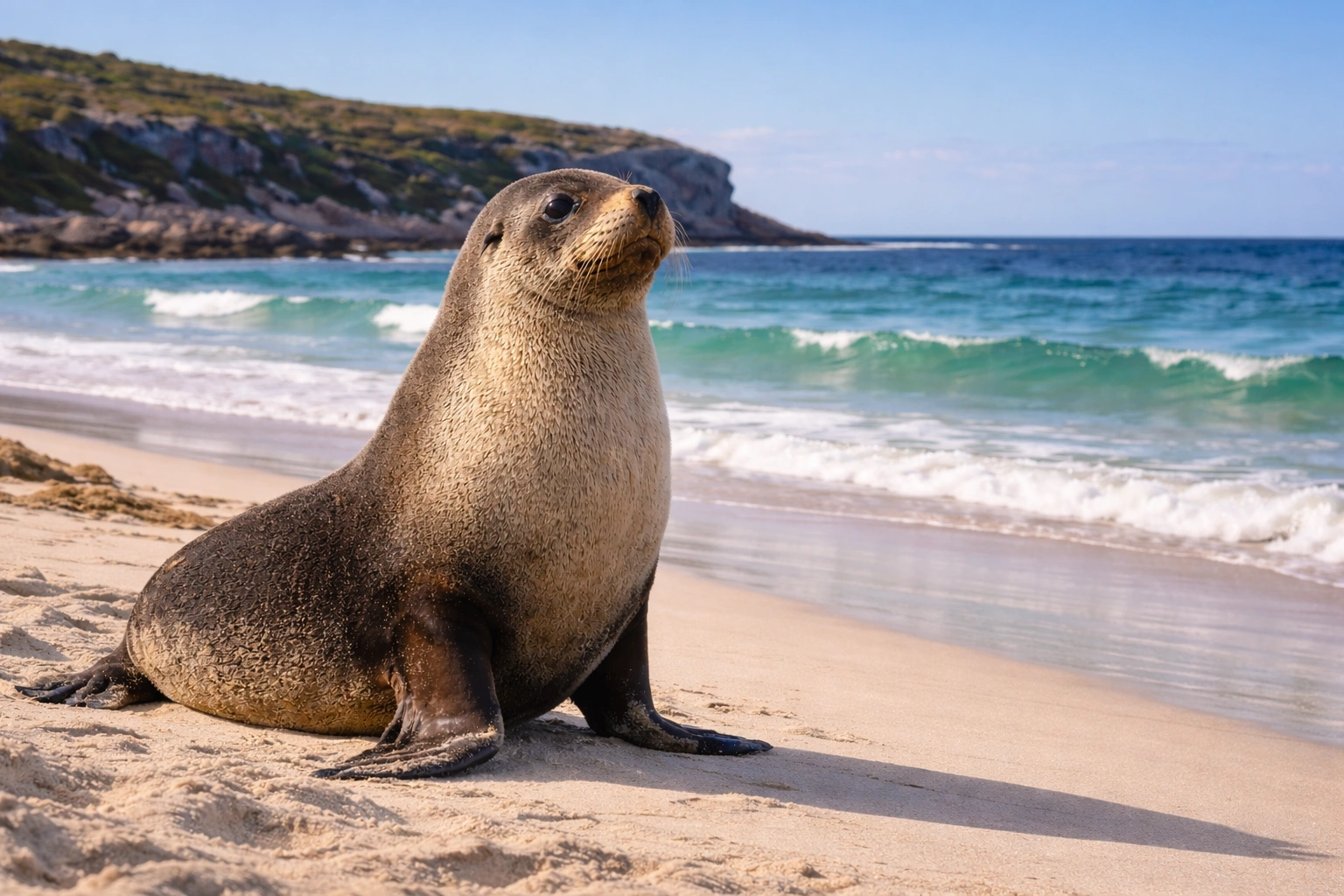
Australian Fur Seal
Scientific name: Arctocephalus pusillus doriferus
The Australian Fur Seal is the largest fur seal species found in Australia, recognised by its thick brown coat, pale creamy chest, pointed muzzle and visible external ear flaps. Males are significantly larger than females and can develop a darker mane around the neck. They are powerful swimmers, feeding mainly on fish, squid and octopus, and are commonly seen along the southern coastline of Australia, particularly around rocky islands and headlands in Victoria, Tasmania and South Australia.
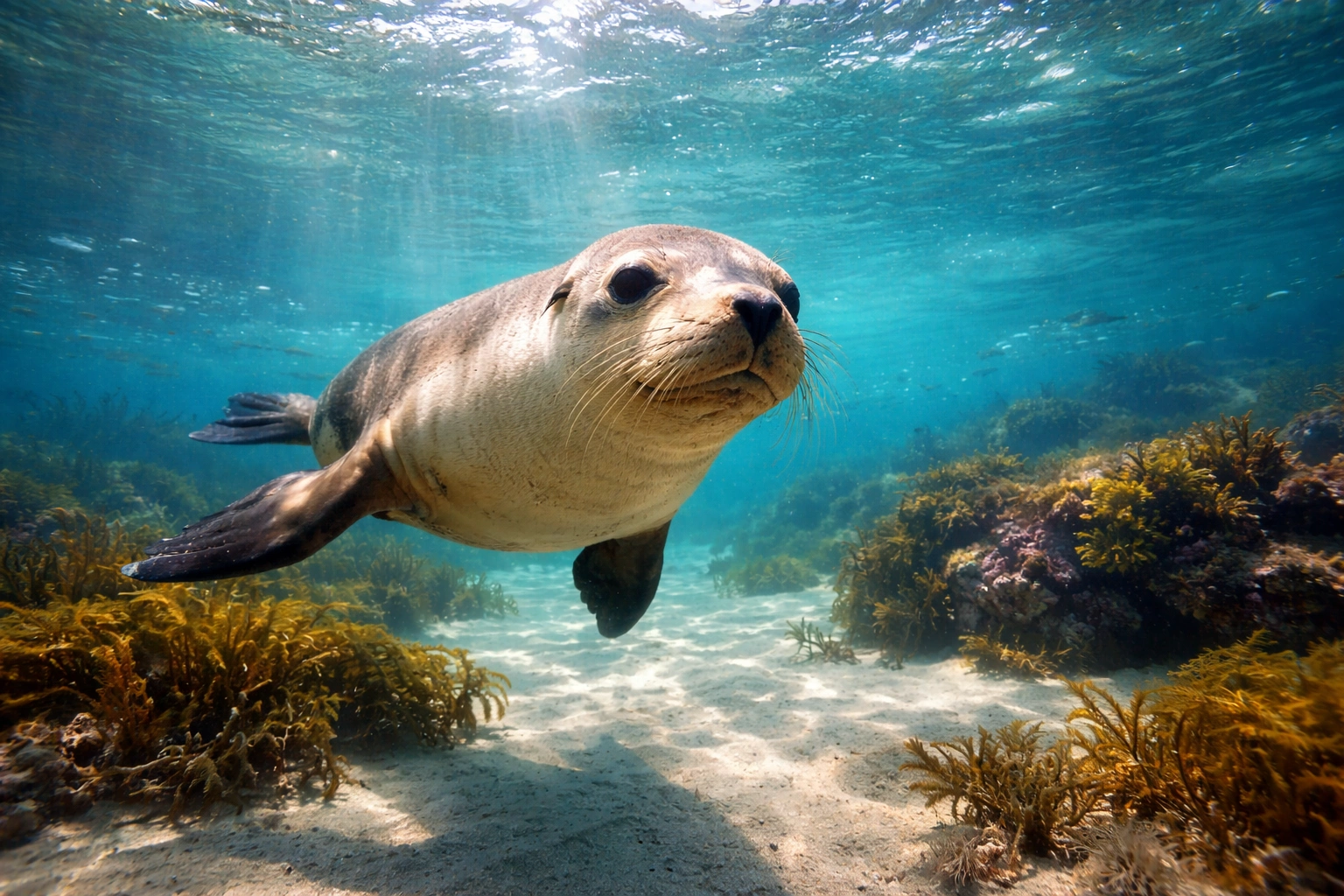
Australian Sea Lion
Scientific name: Neophoca cinerea
The Australian sea lion is one of the rarest sea lion species in the world and is found only along the southern and western coastlines of Australia. They’re chunkier and shorter-faced than fur seals, with a blunt snout and visible external ear flaps. Adult males are much larger than females and develop a creamy mane around their necks, while females are generally silvery-grey on top with a pale underside.
They hang out around rocky islands and sheltered bays, especially off South Australia and Western Australia. Unlike many other sea lions, they have an unusually long breeding cycle — about 17–18 months — which makes population recovery slower. They feed on fish, squid and octopus, diving to the seabed rather than just chasing prey near the surface.
They’re playful underwater, surprisingly agile, and often curious around divers — but on land they can look like sleepy beach potatoes.
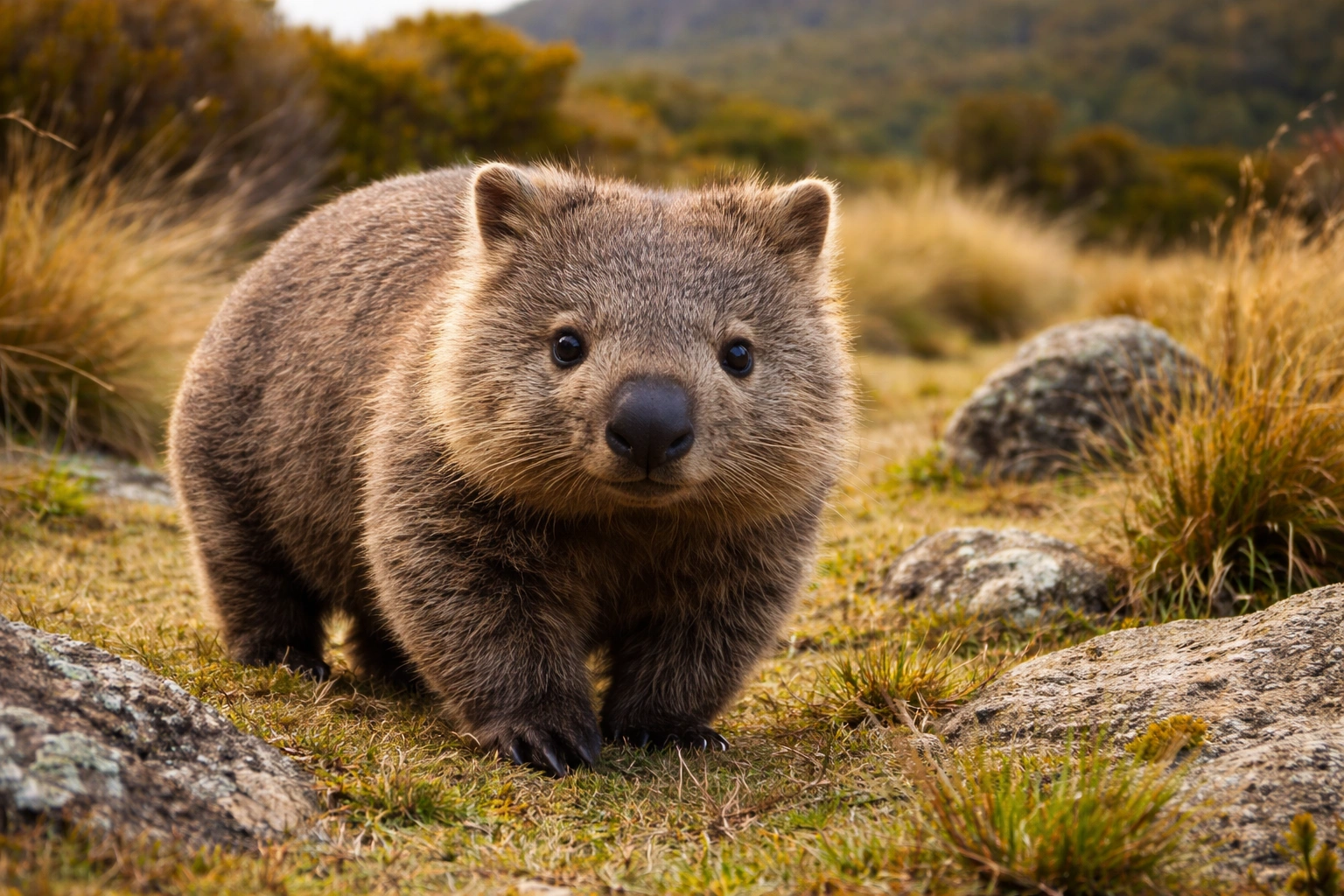
Bare-nosed Wombat
Scientific name: Vombatus ursinus
The Bare-nosed Wombat — also known as the Common Wombat — is a sturdy, burrowing marsupial found in south-eastern Australia and Tasmania. It gets its name from the patch of smooth, hairless skin on its nose, which helps distinguish it from the Southern Hairy-nosed Wombat. Stocky and muscular with short legs, coarse grey-brown fur and a surprisingly cute rounded face, they can weigh up to 35 kg — basically a furry brick with attitude.
They are mostly nocturnal, spending their days in extensive burrow systems and emerging at night to graze on grasses, roots and bark. Their powerful claws are built for digging, and their rear end is reinforced with thick cartilage — handy for blocking burrow entrances from predators. And yes, they’re famous for producing cube-shaped droppings (which helps stop it rolling away when marking territory).
Slow looking? Maybe. But they can sprint up to 40 km/h when they need to. Solid, determined and quietly iconic — very Aussie energy.
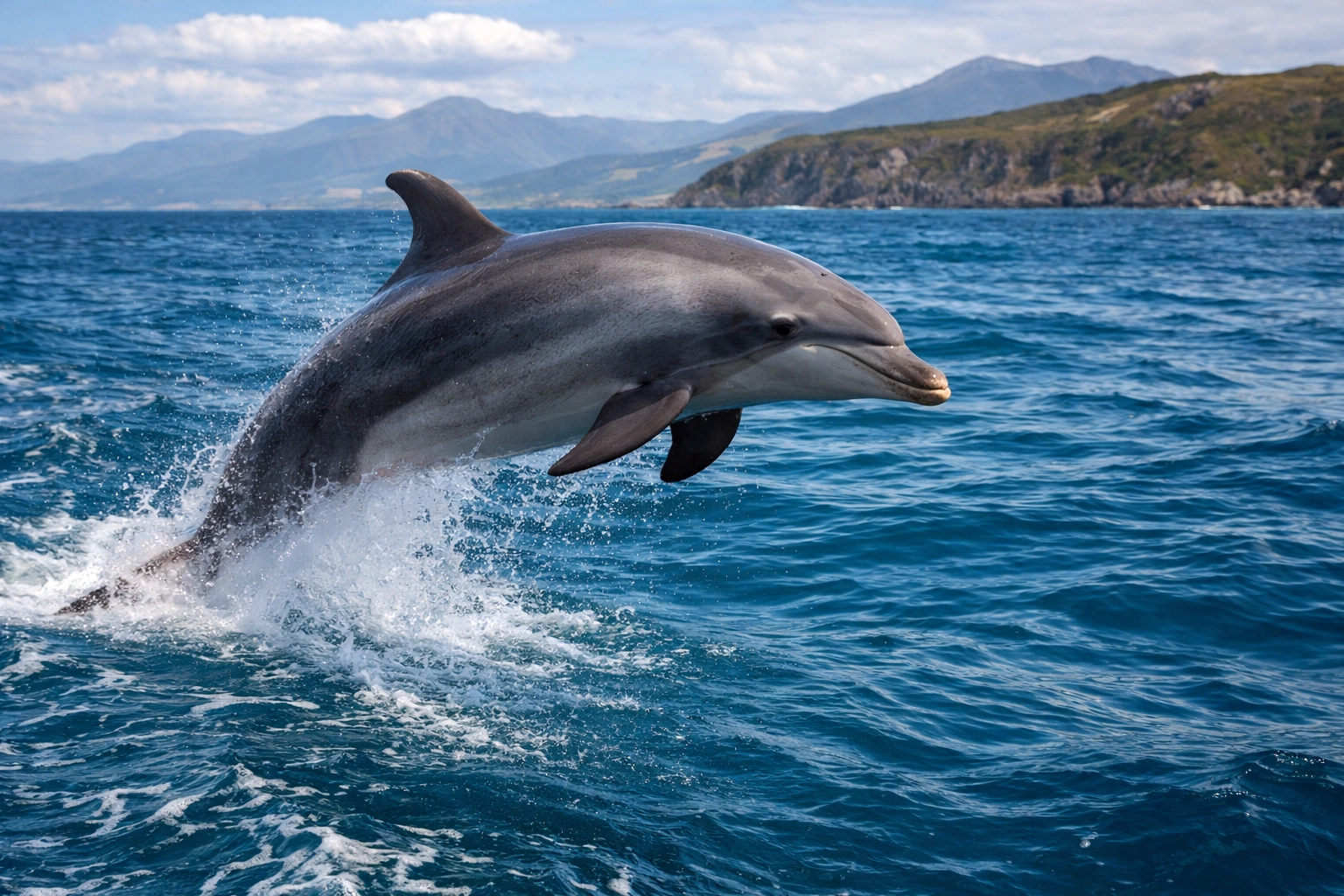
Bottlenose Dolphin
Scientific name: Tursiops truncatus
The Bottlenose Dolphin is one of the most recognisable marine mammals in the world, famous for its curved “smile,” sleek grey body and playful behaviour. Found in warm and temperate oceans globally — including around much of Australia’s coastline — they thrive in both coastal waters and offshore environments.
They’re highly intelligent and social, living in groups called pods that can range from just a few individuals to over a hundred. Bottlenose dolphins use echolocation to hunt, sending out clicking sounds that bounce off prey like fish and squid. Their communication system is complex too — each dolphin develops its own unique “signature whistle,” almost like a name.
Adults typically grow between 2–4 metres long and can weigh up to 600 kg. Despite their friendly reputation, they’re powerful predators and incredibly fast swimmers, reaching speeds of around 30 km/h.
In Australia, you’ll often see them surfing boat wakes, bow-riding and leaping clear of the water — part hunting strategy, part pure dolphin energy.
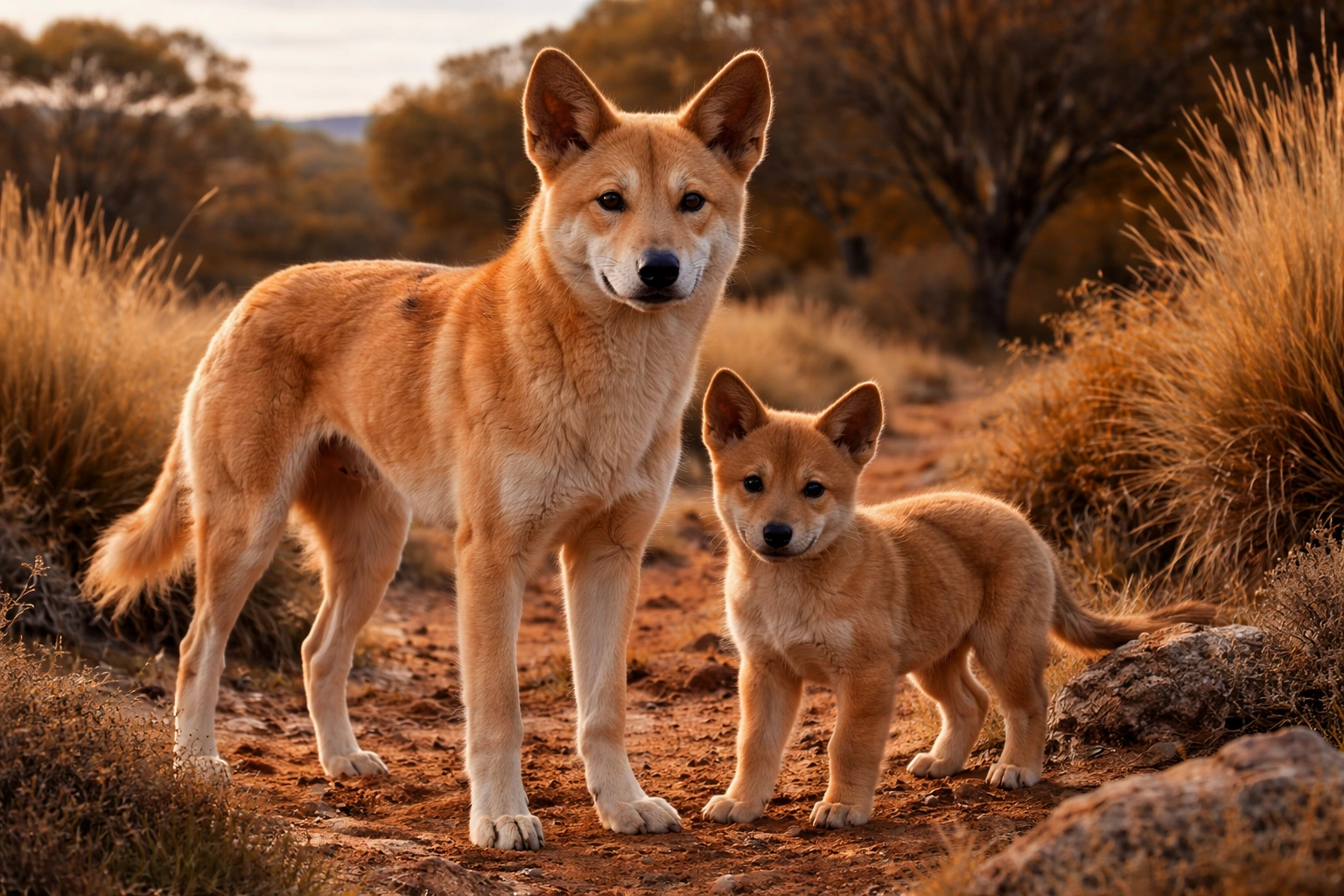
Dingo
Scientific name: Canis familiaris (often classified as Canis lupus dingo)
The dingo is Australia’s native wild dog, thought to have arrived thousands of years ago with seafaring peoples from Asia. Lean, athletic and built for survival, dingoes typically have sandy-gold coats, upright ears and a bushy tail with a white tip. You’ll find them across deserts, grasslands, forests and even alpine regions.
They’re highly adaptable hunters, feeding on small mammals, birds, reptiles and sometimes larger prey like kangaroos. Unlike domestic dogs, dingoes rarely bark — they’re famous for their eerie howls that echo across the outback. Socially, they can live alone or in small family groups.
Their classification is debated. Some scientists treat them as a distinct subspecies (Canis lupus dingo), while others list them as a domestic dog type (Canis familiaris). Either way, they occupy a crucial ecological role as an apex predator, helping control populations of feral animals like rabbits and foxes.
Dingoes are intelligent, cautious and very different from your average backyard dog — they’re wild at heart, even if they share ancestry with domestic breeds.
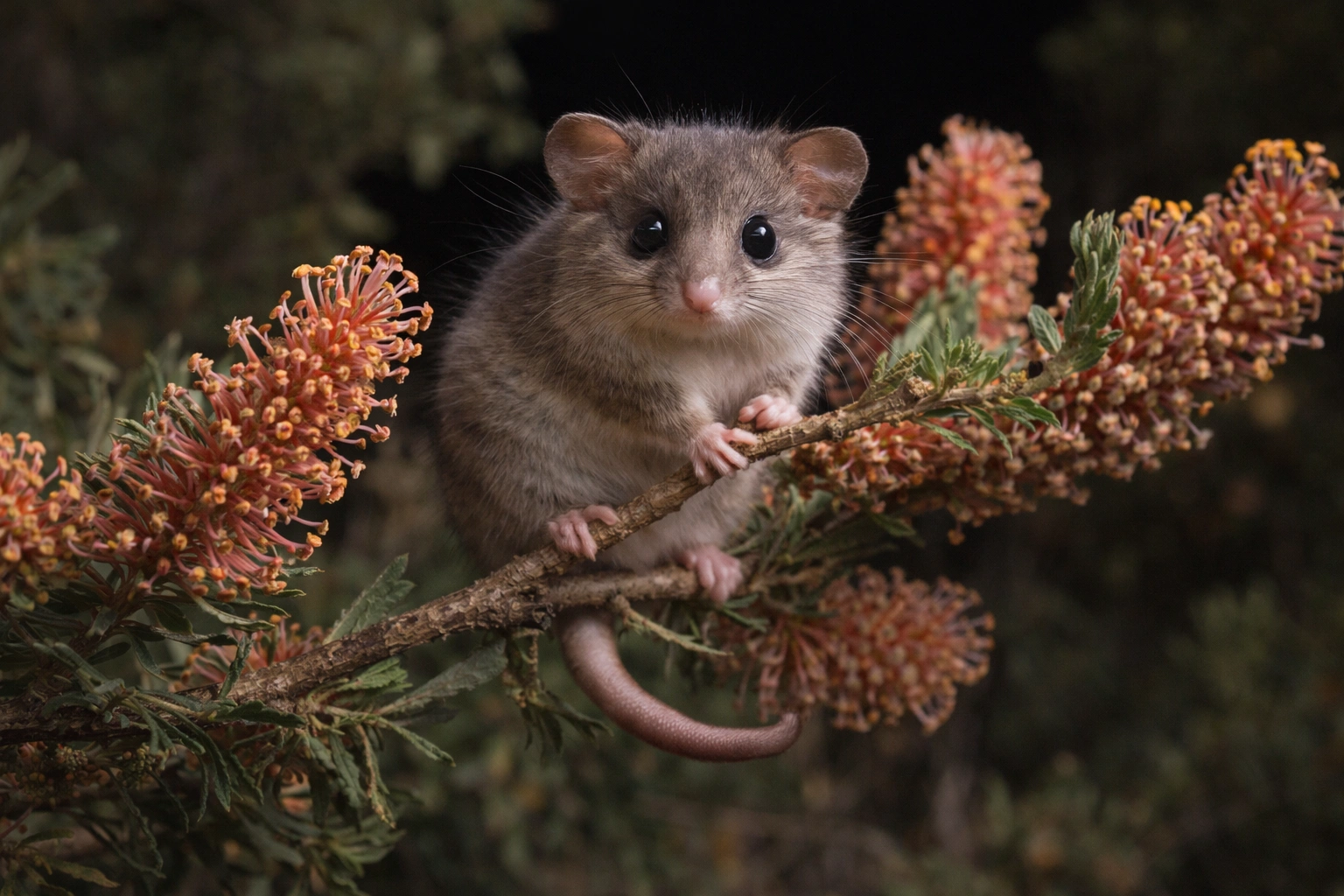
Eastern Pygmy Possum
Scientific name: Cercartetus nanus
The Eastern Pygmy Possum is a tiny, mouse-sized marsupial found along eastern Australia, including Tasmania. Weighing as little as 15–40 grams, it has soft grey-brown fur, a pale belly, large dark eyes adapted for night vision, and a long prehensile tail that acts like a fifth limb when climbing.
These little climbers are nectar specialists. They feed on nectar and pollen from native plants such as banksias, grevilleas and eucalypts, as well as insects and fruit. Their brush-tipped tongue helps them lap up nectar — making them important pollinators in Australian bushland.
They are nocturnal and spend their days sleeping in tree hollows, dense shrubs or even abandoned bird nests. In colder months, they can enter torpor — a short-term hibernation-like state — to conserve energy when food is scarce.
Although small and rarely seen, they play a big ecological role in maintaining healthy native ecosystems through pollination.
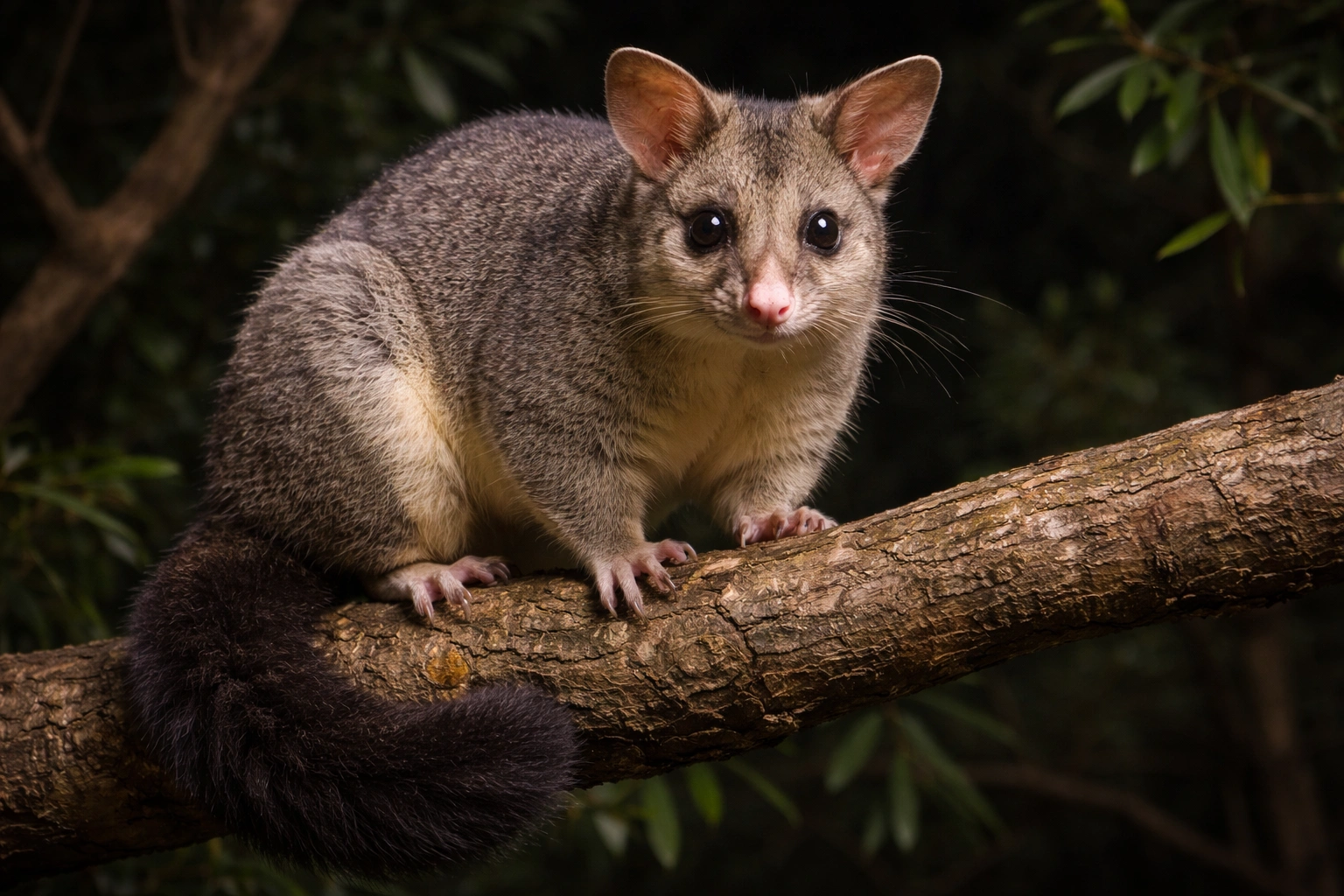
Common Brushtail Possum
Scientific name: Trichosurus vulpecula
The Common Brushtail Possum is one of Australia’s most familiar nocturnal mammals — and quite possibly the one thumping around on your roof at night 🏡🌙. It’s the largest possum species in many parts of Australia, with thick grey-brown fur, a pale underside and a long, bushy prehensile tail that helps it grip branches.
Brushtails are highly adaptable. They live in forests, woodlands and rainforests, but they’ve also mastered suburban life, sheltering in roof cavities, sheds and tree hollows. They’re mostly solitary and territorial, marking their range with scent glands on their chest.
Their diet is varied — leaves, flowers, fruits and occasionally insects or bird eggs. Unlike smaller nectar-feeding possums, Brushtails are more generalist feeders, which partly explains why they thrive in urban areas.
They are strictly nocturnal, with large reflective eyes that shine brightly in torchlight. While they may look cuddly, they can be quite assertive if cornered — this is a wild animal, not a pet.
Interestingly, they were introduced to New Zealand in the 1800s for the fur trade and have since become a major invasive pest there. In Australia, however, they are protected native wildlife.
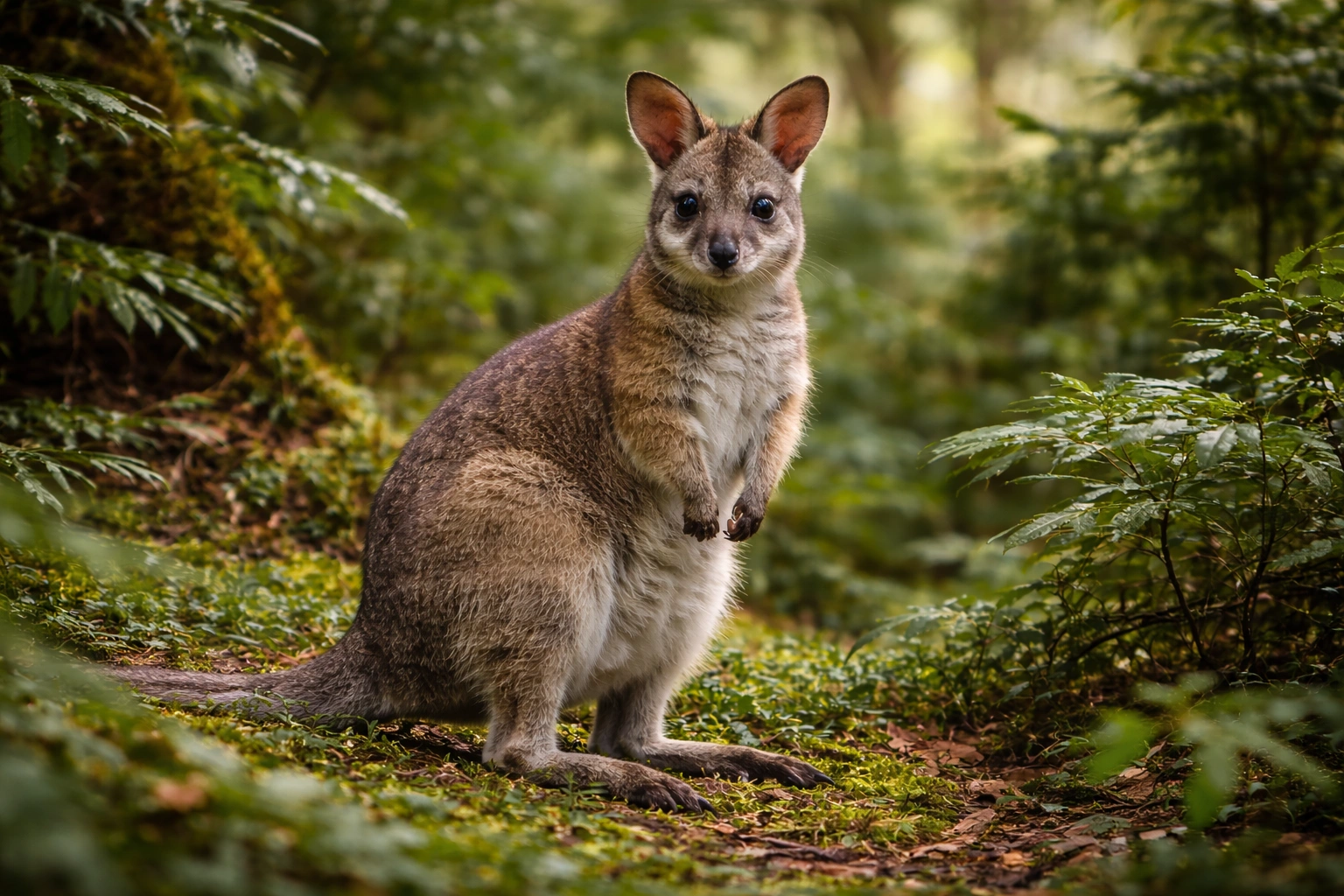
Parma Wallaby
Scientific name: Notamacropus parma
The Parma Wallaby is a small, shy macropod found in dense forests of eastern Australia, particularly in New South Wales. It has soft grey-brown fur, a pale underside, and distinctive white cheek stripes with a dark stripe running from the forehead down to the nose. Adults are relatively small — standing around 50 cm tall — with a long, slender tail for balance.
Here’s the wild part: the Parma Wallaby was thought to be extinct in Australia in the early 20th century. It was only known from museum specimens — until populations were rediscovered in the 1960s in northern New South Wales. Even more surprising, a healthy introduced population had already been thriving in New Zealand. Talk about an accidental insurance policy.
They prefer thick rainforest and wet sclerophyll forest, staying hidden during the day and emerging at night to feed on grasses, leaves and shoots. Unlike the larger kangaroos you see bounding across open plains, Parma Wallabies move quietly through undergrowth, relying on camouflage and cover rather than speed.
They’re nocturnal, solitary or found in small loose groups, and are considered vulnerable due to habitat loss and predation by foxes and cats.
Small, secretive and once “lost” to science — the Parma Wallaby is one of Australia’s more understated wildlife survivors.
Australian mammals are unlike anywhere else in the world because most of them are marsupials — mammals that carry and raise their young in a pouch. Kangaroos, wallabies and wombats are some of the most recognisable, while koalas cling to eucalyptus trees along the east coast. These animals evolved in isolation, which is why Australia’s wildlife feels so different from Africa, Europe or the Americas.
Australia is also home to monotremes — egg-laying mammals — which are incredibly rare globally. The platypus and echidna are the only living examples on Earth. Beyond the famous species, there are also dingoes, flying foxes, bandicoots, quolls and tiny desert marsupials that survive in harsh outback conditions. From prehistoric-looking creatures to iconic pouch-bearing animals, Australian mammals reflect the country’s unique evolutionary history and wild landscapes.
This stylistic image blends elements from multiple themes into one cohesive visual scene.
Koala
Scientific name: Phascolarctos cinereus
The koala is one of Australia’s most iconic animals, known for its fluffy grey fur, large nose, and calm, sleepy nature as it rests in eucalyptus trees for up to 18–20 hours a day. Native to eastern Australia, koalas feed almost exclusively on eucalyptus leaves, which are low in nutrients and mildly toxic, making their slow metabolism essential for survival. Despite their cuddly appearance, koalas are solitary, strong climbers with sharp claws, and they play an important role in forest ecosystems while holding deep cultural significance for Aboriginal Australians.
Red Kangaroo
Scientific name: Osphranter rufus
The Red Kangaroo is Australia’s largest land mammal and the biggest marsupial on Earth. Big males — often called “boomers” — can stand over 1.8 metres tall and weigh around 90 kilograms. They get their name from the reddish-brown fur seen mainly on males, while females tend to be more bluish-grey. Built for the harsh inland, red kangaroos thrive in the dry centre of Australia where few large animals can survive.
They move in an incredibly efficient way — hopping. Using their powerful hind legs and thick tail for balance, they can cover long distances at speeds up to 60 km/h. What’s wild is that hopping actually conserves energy at higher speeds, making them perfectly adapted to wide open desert plains. They mostly feed on grasses and shrubs and can go long periods without drinking, getting much of their moisture from vegetation.
Like all marsupials, females carry their young (called joeys) in a pouch. A joey is born tiny — about the size of a jellybean — and crawls into the pouch where it continues developing for months. The red kangaroo is such a powerful symbol of Australia that it appears on the national coat of arms alongside the emu, representing a nation that keeps moving forward.
Quokka
Scientific name: Setonix brachyurus
The quokka is a small marsupial native to Western Australia and is basically the unofficial champion of “cutest animal on Earth.” They’re about the size of a domestic cat, with round ears, short faces, and a permanent upturned mouth that makes them look like they’re grinning in every photo. That’s why they’ve become social media legends — the “selfie animal” of Australia.
Quokkas are most famously found on Rottnest Island near Perth. In fact, Rottnest is one of the best places in the world to see them in the wild. They’re mostly nocturnal, herbivores (grasses, leaves, bark), and like other marsupials, the females carry their babies (called joeys) in a pouch. They’re surprisingly tough too — they can survive in fairly dry conditions and store fat in their tails.
A few important things if you ever meet one:
Don’t feed them (it’s illegal and bad for their health).
Don’t touch them.
Keep your food sealed — they’re cheeky little opportunists.
Fun fact: Early Dutch explorers thought they were giant rats, which is how Rottnest got its name — it comes from “Rattennest” (rat’s nest).
Tree Kangaroo
Scientific Name: Dendrolagus goodfellowi
Tree kangaroos are unique marsupials that live high in the rainforests of northeastern Queensland and New Guinea. They belong to the genus Dendrolagus and have evolved very differently from their ground-dwelling kangaroo relatives. Instead of long powerful legs built for hopping across open plains, tree kangaroos have shorter, stronger limbs, curved claws, and long tails that help them balance and climb. They are surprisingly agile in the canopy and can even leap down from significant heights without injury.
In Australia, the two species found in the wild are Lumholtz's tree-kangaroo and Bennett's tree-kangaroo. Both live in the tropical rainforests of Far North Queensland, including areas such as the Atherton Tablelands and Cape York. They are shy, mostly solitary animals that spend much of their time resting in trees and feeding on leaves, fruit, and flowers. Like other marsupials, females carry their young in a pouch until the joey is developed enough to venture out.
Although they are fascinating and iconic rainforest animals, tree kangaroos are considered vulnerable in Australia. Habitat loss, vehicle strikes, and predation by domestic dogs all threaten their populations. Because they are much rarer than common kangaroos, spotting one in the wild is a special experience and a reminder of the remarkable diversity of Australia’s wildlife.
Australian Fur Seal
Scientific name: Arctocephalus pusillus doriferus
The Australian Fur Seal is the largest fur seal species found in Australia, recognised by its thick brown coat, pale creamy chest, pointed muzzle and visible external ear flaps. Males are significantly larger than females and can develop a darker mane around the neck. They are powerful swimmers, feeding mainly on fish, squid and octopus, and are commonly seen along the southern coastline of Australia, particularly around rocky islands and headlands in Victoria, Tasmania and South Australia.
Australian Sea Lion
Scientific name: Neophoca cinerea
The Australian sea lion is one of the rarest sea lion species in the world and is found only along the southern and western coastlines of Australia. They’re chunkier and shorter-faced than fur seals, with a blunt snout and visible external ear flaps. Adult males are much larger than females and develop a creamy mane around their necks, while females are generally silvery-grey on top with a pale underside.
They hang out around rocky islands and sheltered bays, especially off South Australia and Western Australia. Unlike many other sea lions, they have an unusually long breeding cycle — about 17–18 months — which makes population recovery slower. They feed on fish, squid and octopus, diving to the seabed rather than just chasing prey near the surface.
They’re playful underwater, surprisingly agile, and often curious around divers — but on land they can look like sleepy beach potatoes.
Bare-nosed Wombat
Scientific name: Vombatus ursinus
The Bare-nosed Wombat — also known as the Common Wombat — is a sturdy, burrowing marsupial found in south-eastern Australia and Tasmania. It gets its name from the patch of smooth, hairless skin on its nose, which helps distinguish it from the Southern Hairy-nosed Wombat. Stocky and muscular with short legs, coarse grey-brown fur and a surprisingly cute rounded face, they can weigh up to 35 kg — basically a furry brick with attitude.
They are mostly nocturnal, spending their days in extensive burrow systems and emerging at night to graze on grasses, roots and bark. Their powerful claws are built for digging, and their rear end is reinforced with thick cartilage — handy for blocking burrow entrances from predators. And yes, they’re famous for producing cube-shaped droppings (which helps stop it rolling away when marking territory).
Slow looking? Maybe. But they can sprint up to 40 km/h when they need to. Solid, determined and quietly iconic — very Aussie energy.
Bottlenose Dolphin
Scientific name: Tursiops truncatus
The Bottlenose Dolphin is one of the most recognisable marine mammals in the world, famous for its curved “smile,” sleek grey body and playful behaviour. Found in warm and temperate oceans globally — including around much of Australia’s coastline — they thrive in both coastal waters and offshore environments.
They’re highly intelligent and social, living in groups called pods that can range from just a few individuals to over a hundred. Bottlenose dolphins use echolocation to hunt, sending out clicking sounds that bounce off prey like fish and squid. Their communication system is complex too — each dolphin develops its own unique “signature whistle,” almost like a name.
Adults typically grow between 2–4 metres long and can weigh up to 600 kg. Despite their friendly reputation, they’re powerful predators and incredibly fast swimmers, reaching speeds of around 30 km/h.
In Australia, you’ll often see them surfing boat wakes, bow-riding and leaping clear of the water — part hunting strategy, part pure dolphin energy.
Dingo
Scientific name: Canis familiaris (often classified as Canis lupus dingo)
The dingo is Australia’s native wild dog, thought to have arrived thousands of years ago with seafaring peoples from Asia. Lean, athletic and built for survival, dingoes typically have sandy-gold coats, upright ears and a bushy tail with a white tip. You’ll find them across deserts, grasslands, forests and even alpine regions.
They’re highly adaptable hunters, feeding on small mammals, birds, reptiles and sometimes larger prey like kangaroos. Unlike domestic dogs, dingoes rarely bark — they’re famous for their eerie howls that echo across the outback. Socially, they can live alone or in small family groups.
Their classification is debated. Some scientists treat them as a distinct subspecies (Canis lupus dingo), while others list them as a domestic dog type (Canis familiaris). Either way, they occupy a crucial ecological role as an apex predator, helping control populations of feral animals like rabbits and foxes.
Dingoes are intelligent, cautious and very different from your average backyard dog — they’re wild at heart, even if they share ancestry with domestic breeds.
Eastern Pygmy Possum
Scientific name: Cercartetus nanus
The Eastern Pygmy Possum is a tiny, mouse-sized marsupial found along eastern Australia, including Tasmania. Weighing as little as 15–40 grams, it has soft grey-brown fur, a pale belly, large dark eyes adapted for night vision, and a long prehensile tail that acts like a fifth limb when climbing.
These little climbers are nectar specialists. They feed on nectar and pollen from native plants such as banksias, grevilleas and eucalypts, as well as insects and fruit. Their brush-tipped tongue helps them lap up nectar — making them important pollinators in Australian bushland.
They are nocturnal and spend their days sleeping in tree hollows, dense shrubs or even abandoned bird nests. In colder months, they can enter torpor — a short-term hibernation-like state — to conserve energy when food is scarce.
Although small and rarely seen, they play a big ecological role in maintaining healthy native ecosystems through pollination.
Common Brushtail Possum
Scientific name: Trichosurus vulpecula
The Common Brushtail Possum is one of Australia’s most familiar nocturnal mammals — and quite possibly the one thumping around on your roof at night 🏡🌙. It’s the largest possum species in many parts of Australia, with thick grey-brown fur, a pale underside and a long, bushy prehensile tail that helps it grip branches.
Brushtails are highly adaptable. They live in forests, woodlands and rainforests, but they’ve also mastered suburban life, sheltering in roof cavities, sheds and tree hollows. They’re mostly solitary and territorial, marking their range with scent glands on their chest.
Their diet is varied — leaves, flowers, fruits and occasionally insects or bird eggs. Unlike smaller nectar-feeding possums, Brushtails are more generalist feeders, which partly explains why they thrive in urban areas.
They are strictly nocturnal, with large reflective eyes that shine brightly in torchlight. While they may look cuddly, they can be quite assertive if cornered — this is a wild animal, not a pet.
Interestingly, they were introduced to New Zealand in the 1800s for the fur trade and have since become a major invasive pest there. In Australia, however, they are protected native wildlife.
Parma Wallaby
Scientific name: Notamacropus parma
The Parma Wallaby is a small, shy macropod found in dense forests of eastern Australia, particularly in New South Wales. It has soft grey-brown fur, a pale underside, and distinctive white cheek stripes with a dark stripe running from the forehead down to the nose. Adults are relatively small — standing around 50 cm tall — with a long, slender tail for balance.
Here’s the wild part: the Parma Wallaby was thought to be extinct in Australia in the early 20th century. It was only known from museum specimens — until populations were rediscovered in the 1960s in northern New South Wales. Even more surprising, a healthy introduced population had already been thriving in New Zealand. Talk about an accidental insurance policy.
They prefer thick rainforest and wet sclerophyll forest, staying hidden during the day and emerging at night to feed on grasses, leaves and shoots. Unlike the larger kangaroos you see bounding across open plains, Parma Wallabies move quietly through undergrowth, relying on camouflage and cover rather than speed.
They’re nocturnal, solitary or found in small loose groups, and are considered vulnerable due to habitat loss and predation by foxes and cats.
Small, secretive and once “lost” to science — the Parma Wallaby is one of Australia’s more understated wildlife survivors.
Our Birds
Australia’s birdlife ranges from colourful parrots and cockatoos to iconic species like the Emu, with hundreds of species thriving across deserts, rainforests, wetlands and coastal regions.
Australia’s native birds are some of the most distinctive and colourful in the world, thanks to millions of years of isolation. From bright parrots like sulphur-crested cockatoos, galahs and rainbow lorikeets to massive outback flocks of budgerigars, parrots dominate much of the landscape. Iconic species like the laughing kookaburra — famous for its human-like call — and the wedge-tailed eagle, with a wingspan over two metres, add to Australia’s bold birdlife personality.
Beyond the forests and suburbs, Australia is home to impressive waterbirds like black swans and pelicans, as well as prehistoric-looking emus and cassowaries. Many native species are perfectly adapted to harsh desert conditions, surviving intense heat and limited water. What truly sets Australian birds apart, though, is the soundscape — from dawn magpie warbles to screeching cockatoos and kookaburra laughter echoing through the bush.
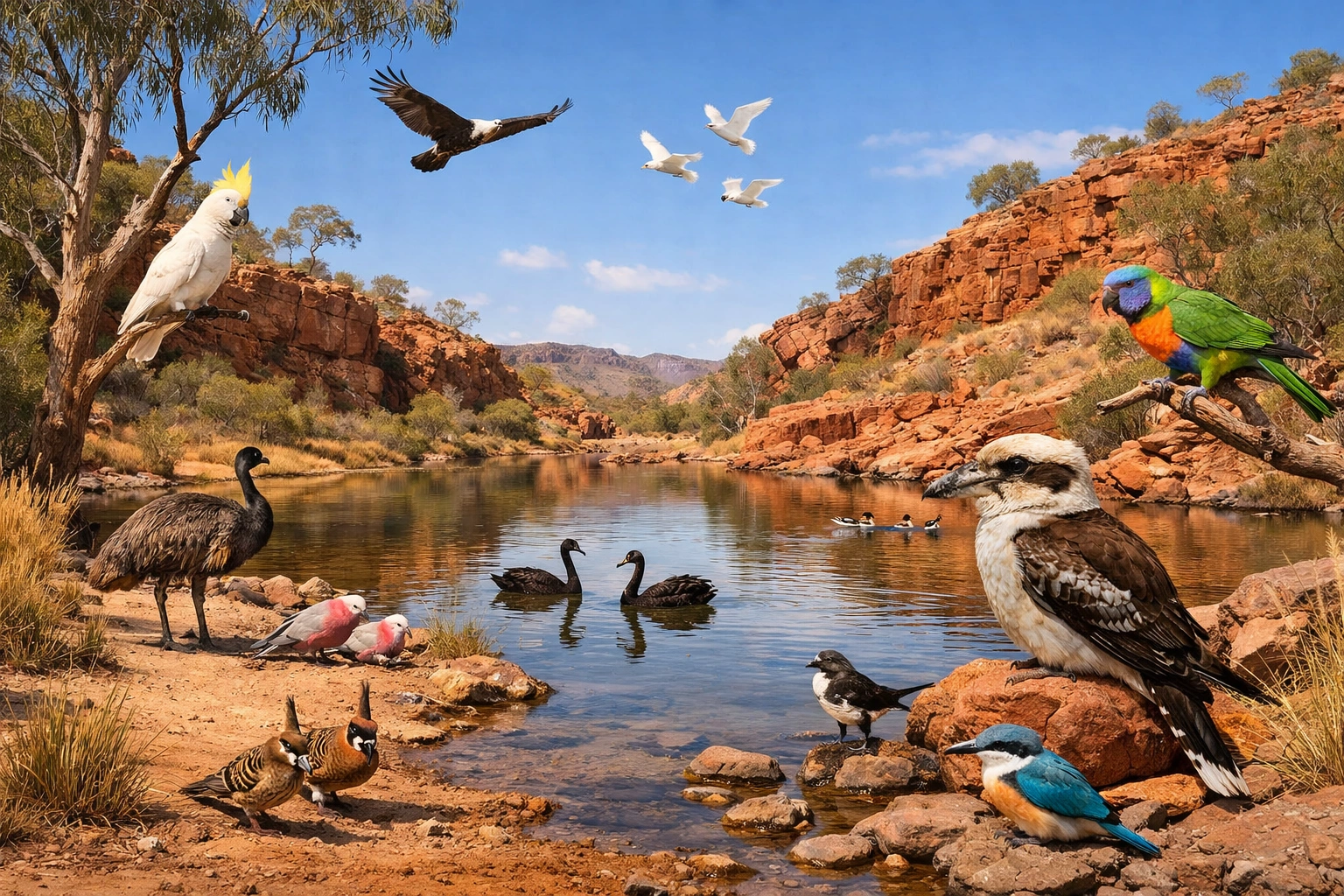
This stylistic image blends elements from multiple themes into one cohesive visual scene.
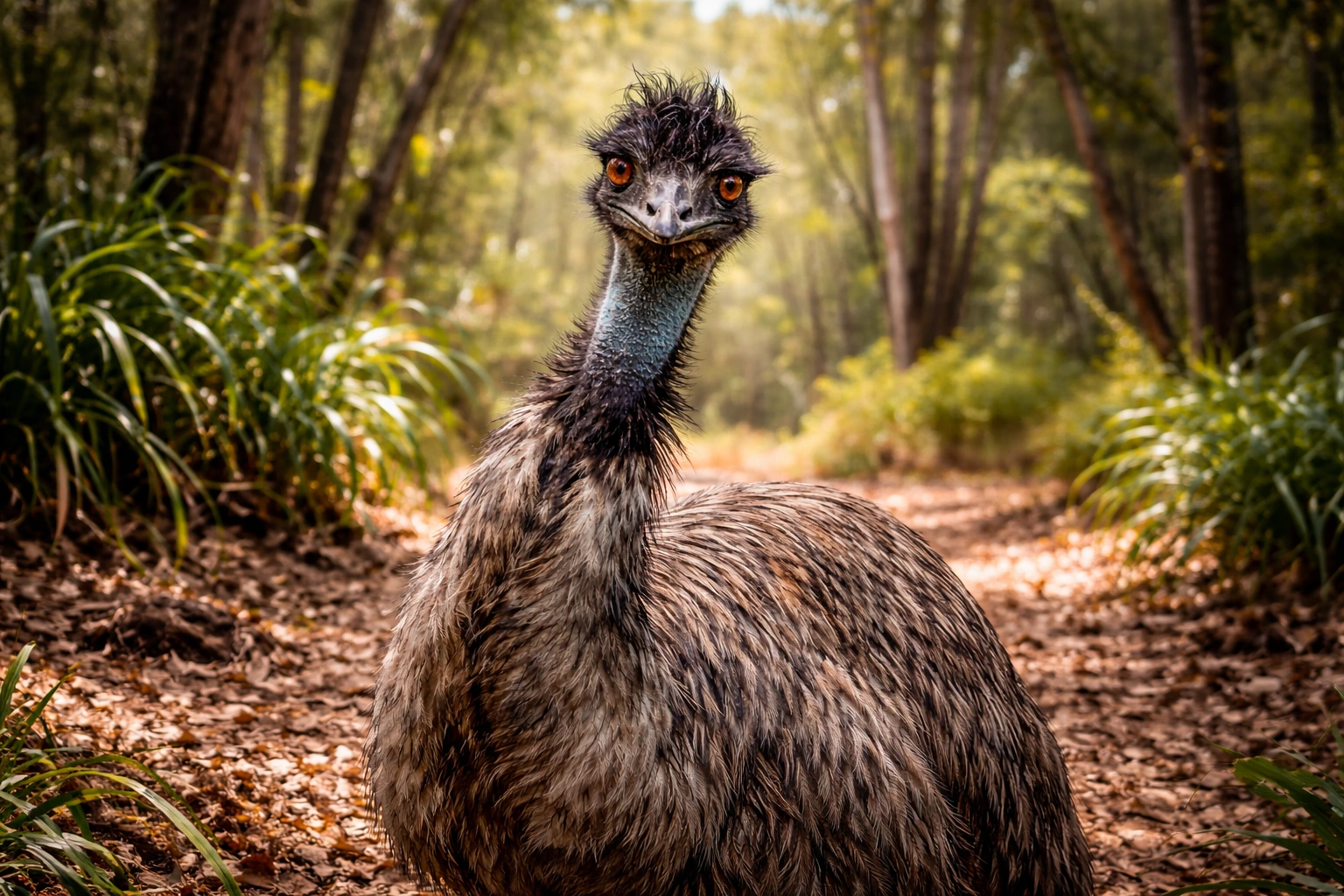
Emu
Scientific name: Dromaius novaehollandiae
The Emu is Australia’s largest native bird and the second-largest bird in the world after the ostrich. Standing up to about 1.9 metres tall, it has long powerful legs built for speed and can sprint at around 50 km/h across open country. Despite being flightless, emus are incredibly mobile and roam vast distances through the Australian outback, woodlands and grasslands in search of food and water. Their shaggy brown feathers help regulate body temperature in Australia’s harsh climate.
Emus are opportunistic feeders, eating seeds, native plants, fruits, insects and even small reptiles when available. They swallow small stones to help grind food in their gizzard, which is a pretty efficient survival trick in dry environments. Unlike many birds, emus don’t form permanent pairs. After the female lays large dark green eggs, the male takes over — and this is where it gets impressive.
The male emu incubates the eggs for about eight weeks without eating, drinking or leaving the nest for long periods, losing a significant amount of body weight in the process. Once the striped chicks hatch, he continues to protect and raise them for several months. The emu is such an iconic symbol of Australia that it appears on the national coat of arms alongside the kangaroo — fitting for a bird that can’t easily walk backwards, symbolising forward progress.
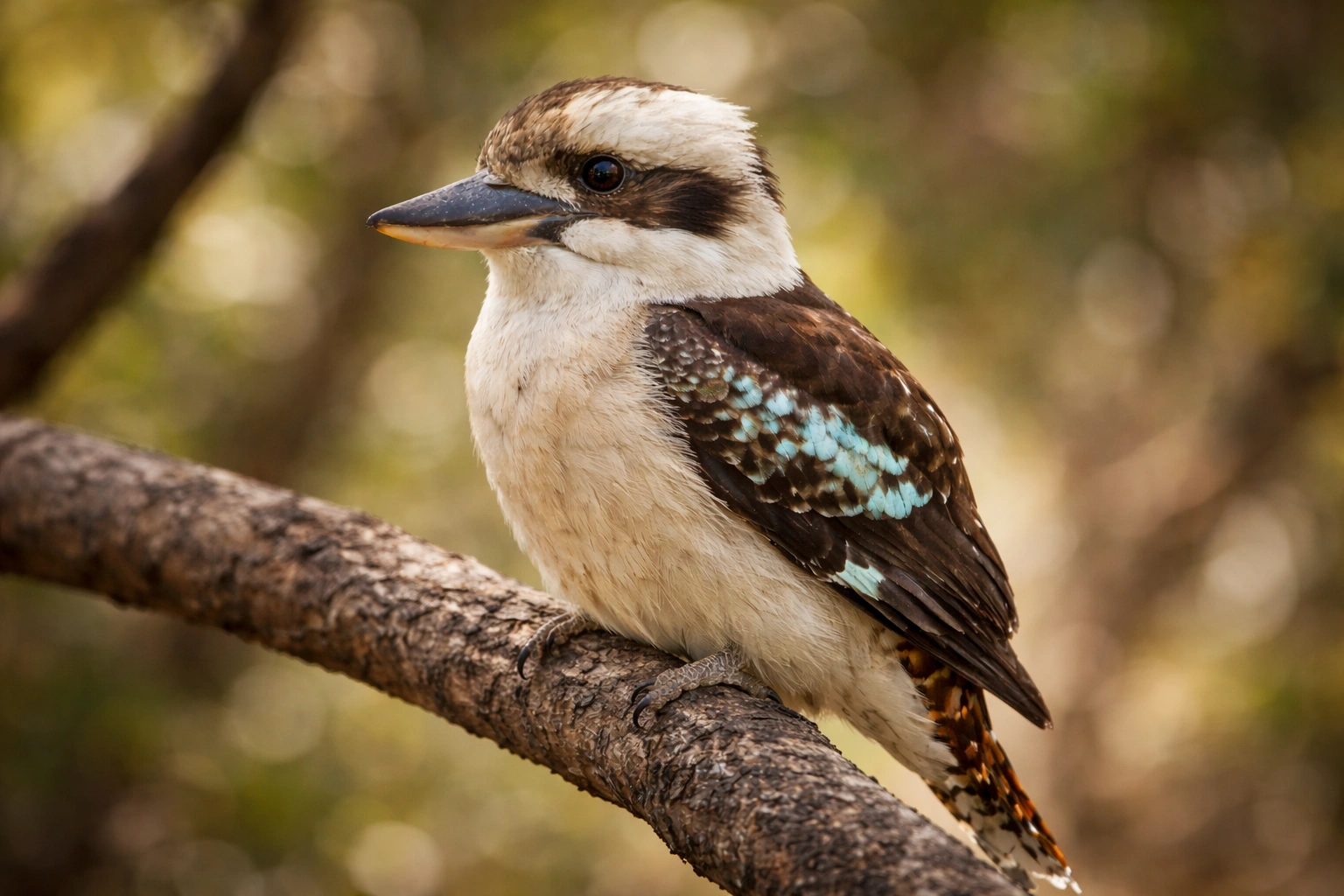
Kookaburra
Scientific name: Dacelo novaeguineae
The kookaburra is one of Australia’s most recognisable birds — famous for its loud, laughing call that echoes through the bush at dawn and dusk. The most common species is the Laughing Kookaburra, found along the east coast and in many suburban areas. With its large head, sturdy body and powerful beak, it looks almost oversized for a kingfisher — which is exactly what it is. Unlike other kingfishers that dive for fish, kookaburras are land hunters.
They feed on insects, small reptiles, frogs and even snakes, often swooping down from a perch to grab prey before returning to a branch to bash it against the wood. They’re territorial and live in family groups, with older offspring sometimes helping raise new chicks. Calm and confident around people, kookaburras have become a true symbol of the Australian bush — equal parts charming and slightly intimidating when that laugh kicks off nearby.
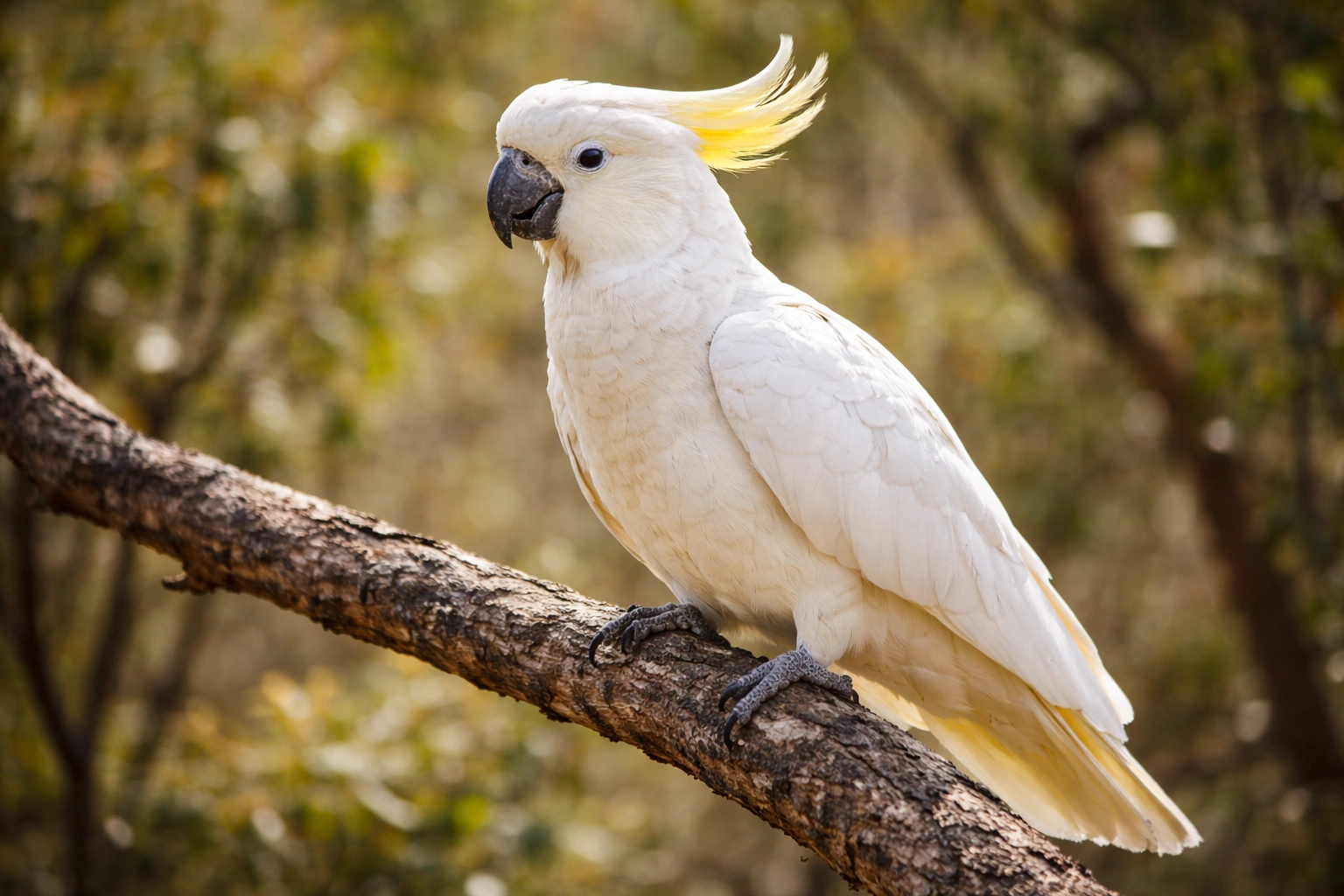
Sulphur-crested Cockatoo
Scientific name: Cacatua galerita
The sulphur-crested cockatoo is one of Australia’s most recognisable and loudest native birds. Brilliant white with a striking yellow crest that fans up when excited or alarmed, they’re hard to miss — and even harder to ignore. Found across eastern and northern Australia, they thrive in bushland, farmland and suburbs, often gathering in noisy flocks that can number in the dozens.
Highly intelligent and incredibly curious, these cockatoos are known for their problem-solving skills (and their talent for getting into mischief). They feed on seeds, nuts, roots and insects, and in urban areas they’ve mastered the art of opening rubbish bins. They form strong social bonds and can live for decades, which helps explain their complex behaviour and bold personalities. Love them or find them a bit chaotic, sulphur-crested cockatoos are pure Australian character with wings.
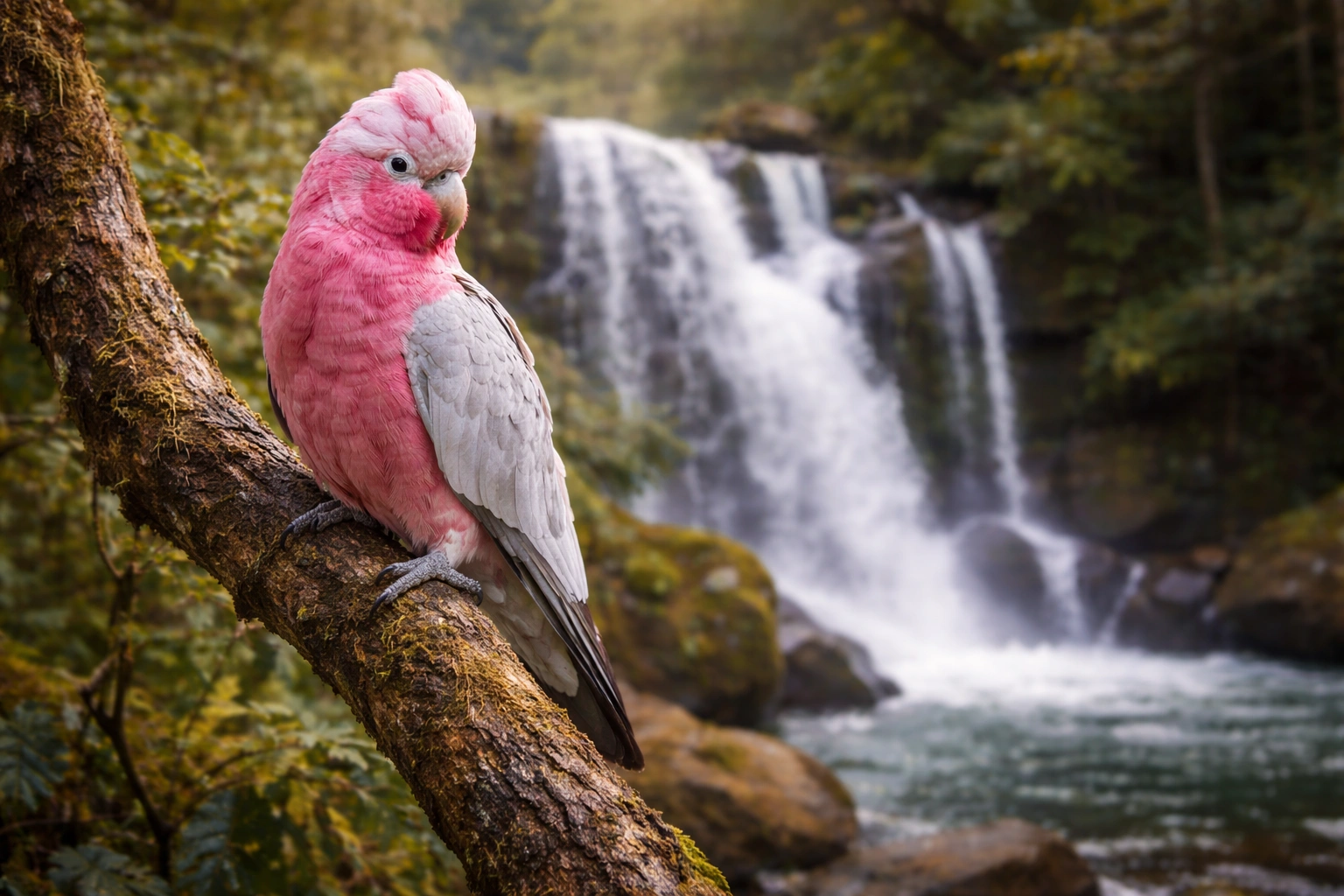
Galah
Scientific name: Eolophus roseicapilla
The galah is one of Australia’s most recognisable parrots, famous for its soft pink chest and face paired with grey wings and back. Also known as the pink and grey cockatoo, it’s found across most of mainland Australia, from inland deserts to farmland and even suburban parks. Galahs are highly social birds, often seen in large, noisy flocks that wheel through the sky together or gather on the ground to feed.
They mainly eat seeds, grasses and grains, which is why they’re commonly spotted in open country. Despite their pretty appearance, galahs are tough and adaptable, thriving in harsh, dry conditions. They form strong pair bonds and are often seen sitting closely together on branches, gently preening each other. Playful and full of personality, the galah has become a true symbol of the Australian landscape.
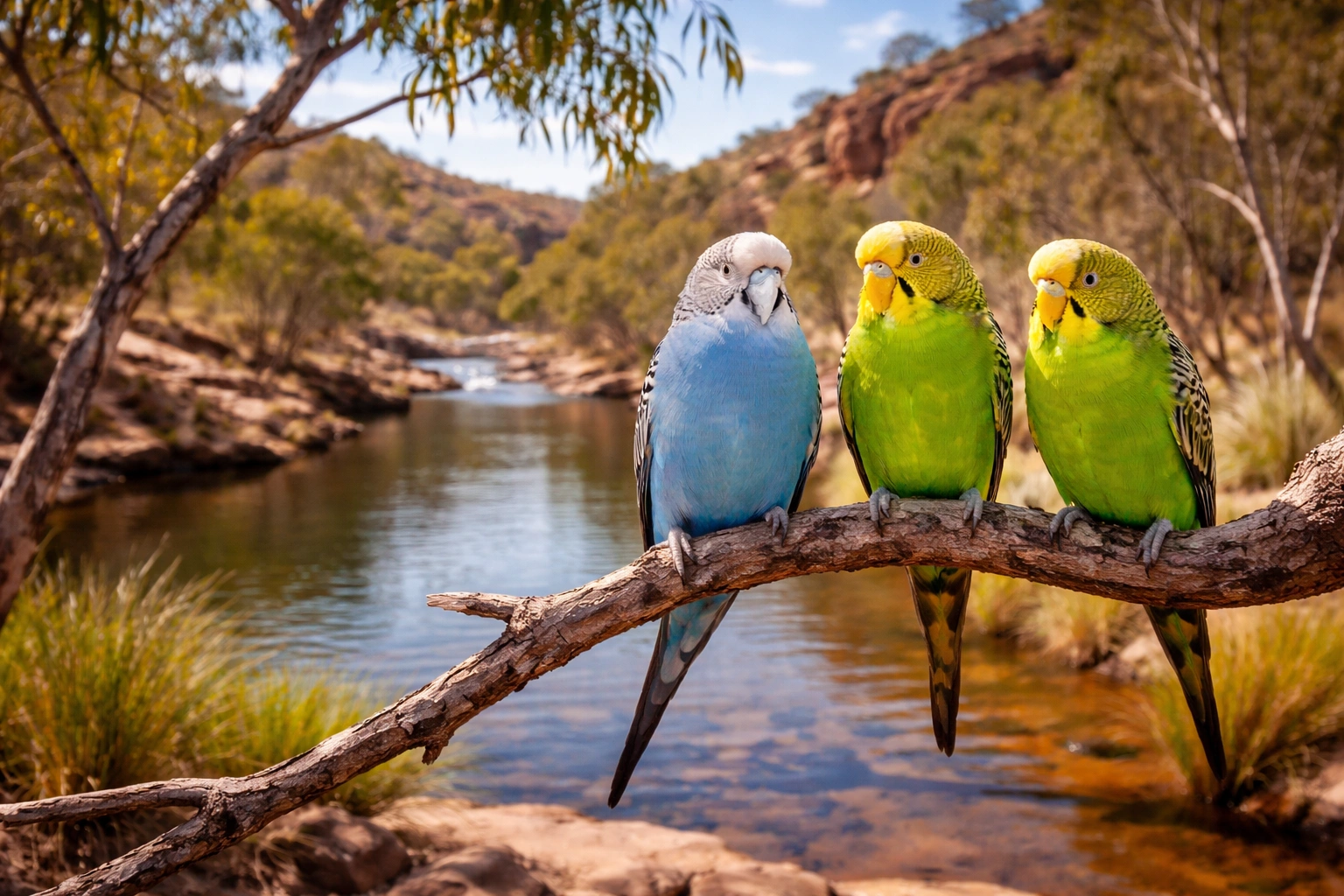
Budgerigar
Scientific name: Melopsittacus undulatus
The budgerigar — usually just called a “budgie” — is one of Australia’s smallest and most energetic native parrots. In the wild, they’re bright green and yellow with black scalloped markings across the back and wings. They’re found across the dry interior of Australia, especially in arid and semi-arid regions where they travel in huge flocks searching for water and fresh grass after rain.
Wild budgies are true outback survivors. They breed quickly when conditions are good and can travel long distances in fast, swirling flocks that almost look like green clouds moving across the sky. Although they’re one of the world’s most popular pet birds, their natural home is the Australian desert, where they thrive in tough conditions and bring flashes of colour to some of the harshest landscapes on Earth.
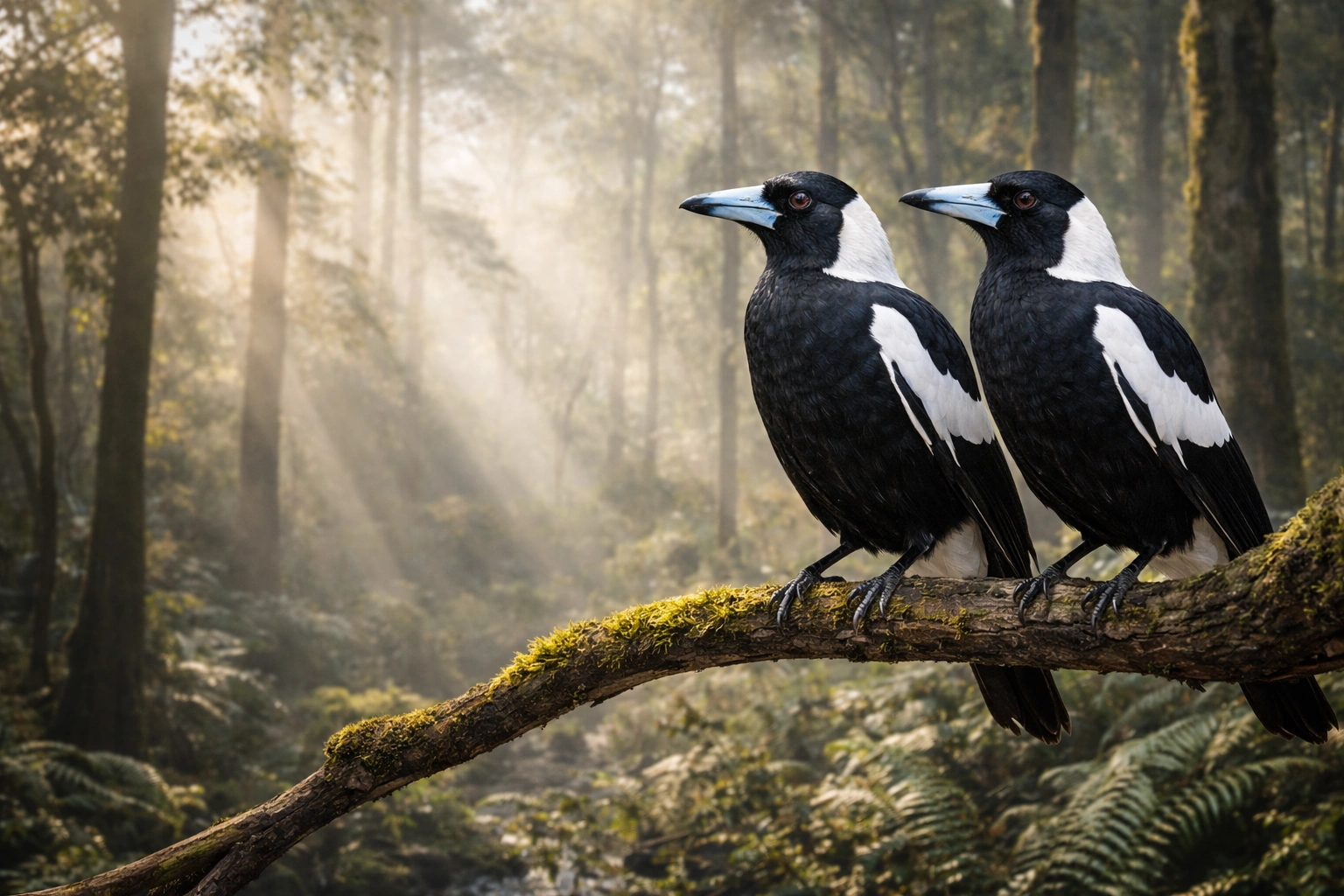
Australian Magpie
Scientific name: Gymnorhina tibicen
The Australian Magpie is one of the country’s most iconic and intelligent native birds, known for its striking black-and-white plumage and beautiful, flute-like song. Found across most of Australia in open woodlands, parks and suburban areas, magpies are highly adaptable and often live comfortably alongside people. Their warbling call at dawn is considered one of the most distinctive sounds of the Australian bush.
Magpies are also famously territorial during breeding season, when some males will swoop to protect their nests — a behaviour that’s earned them a bit of a reputation. Despite that, they’re highly social birds that live in family groups and are known for recognising human faces. Curious, clever and confident, the Australian magpie is both loved and cautiously respected across the country.
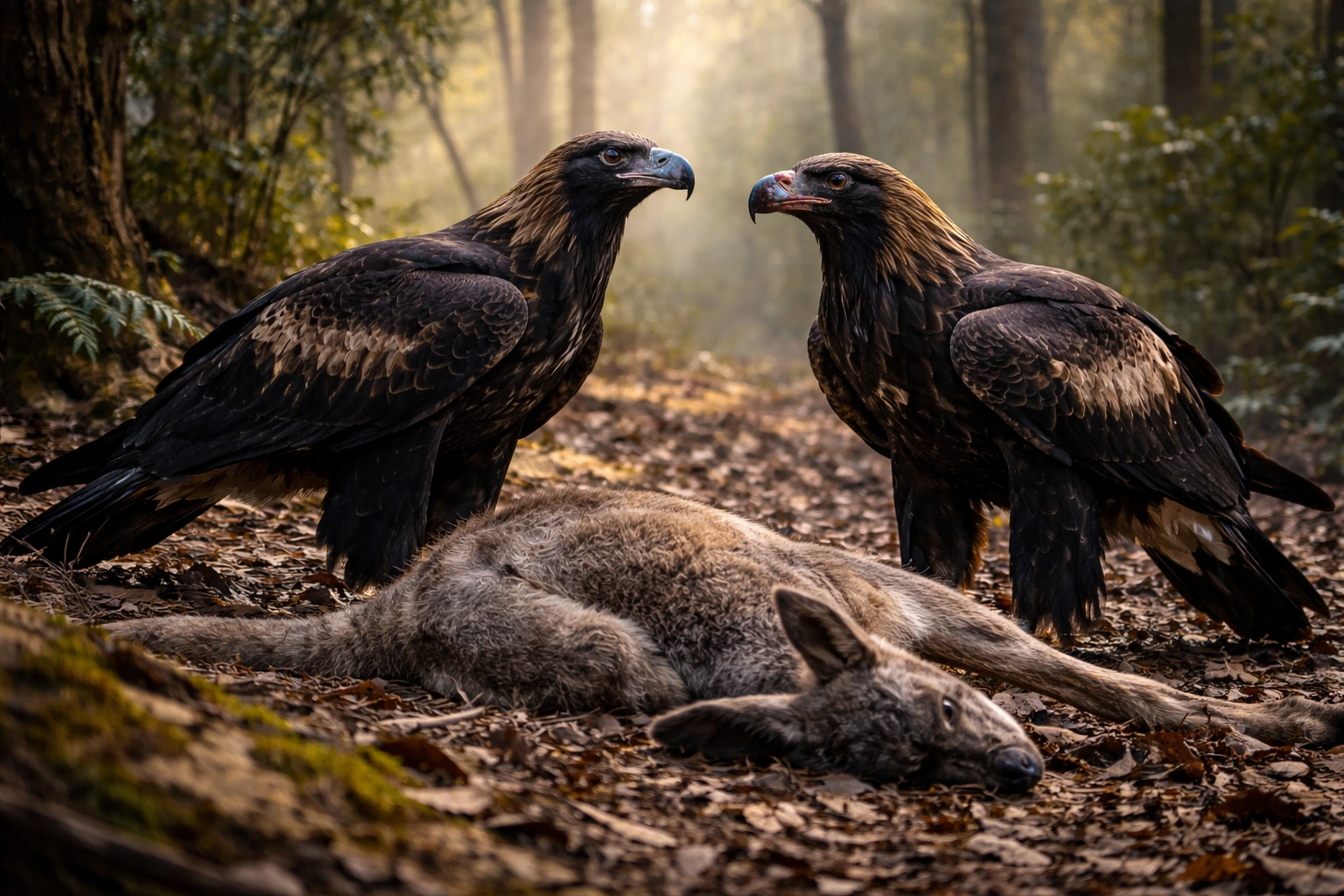
Wedge-tailed Eagle
Scientific name: Aquila audax
The wedge-tailed eagle is Australia’s largest bird of prey and an absolute powerhouse of the skies. With a wingspan that can stretch beyond two metres, it soars effortlessly over open plains, mountain ranges and deserts across most of the continent. Its long, diamond-shaped tail — which gives the species its name — is easy to spot when it’s gliding high on thermal currents.
These eagles are formidable hunters, feeding on rabbits, small mammals, reptiles and carrion. They build massive stick nests high in tall trees or on cliff faces, often reusing and adding to them year after year. Despite their size and strength, they’re surprisingly graceful in flight, barely moving their wings as they ride the air. The wedge-tailed eagle is a true symbol of Australia’s vast, wild landscapes — powerful, resilient and unmistakable against a big outback sky.
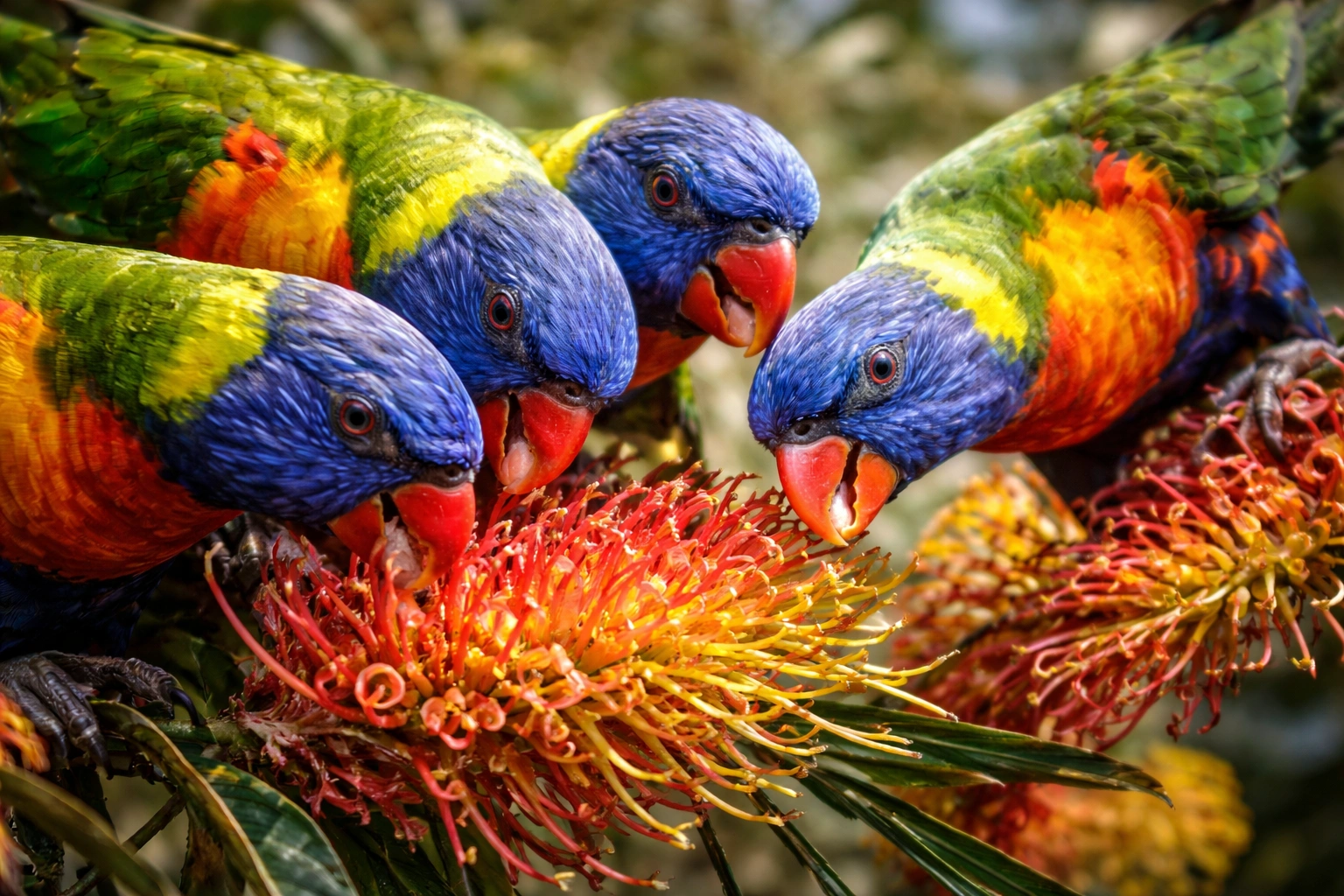
Rainbow Lorikeet
Scientific name: Trichoglossus moluccanus
The rainbow lorikeet is one of Australia’s most colourful and energetic native birds. With its bright blue head, fiery orange chest, green wings and flashes of yellow, it looks almost unreal against the green of the trees. Found along the east coast and in many cities and suburbs, these parrots are loud, fast and rarely sit still for long.
Unlike many other parrots, rainbow lorikeets mainly feed on nectar and pollen. They have a specialised brush-tipped tongue that helps them collect nectar from flowering trees, especially eucalyptus and bottlebrush. Highly social and often seen in noisy flocks, they’re bold around people and quick to dominate backyard feeders. Flashy, cheeky and full of personality, the rainbow lorikeet is pure colour and chaos in the Australian treetops.
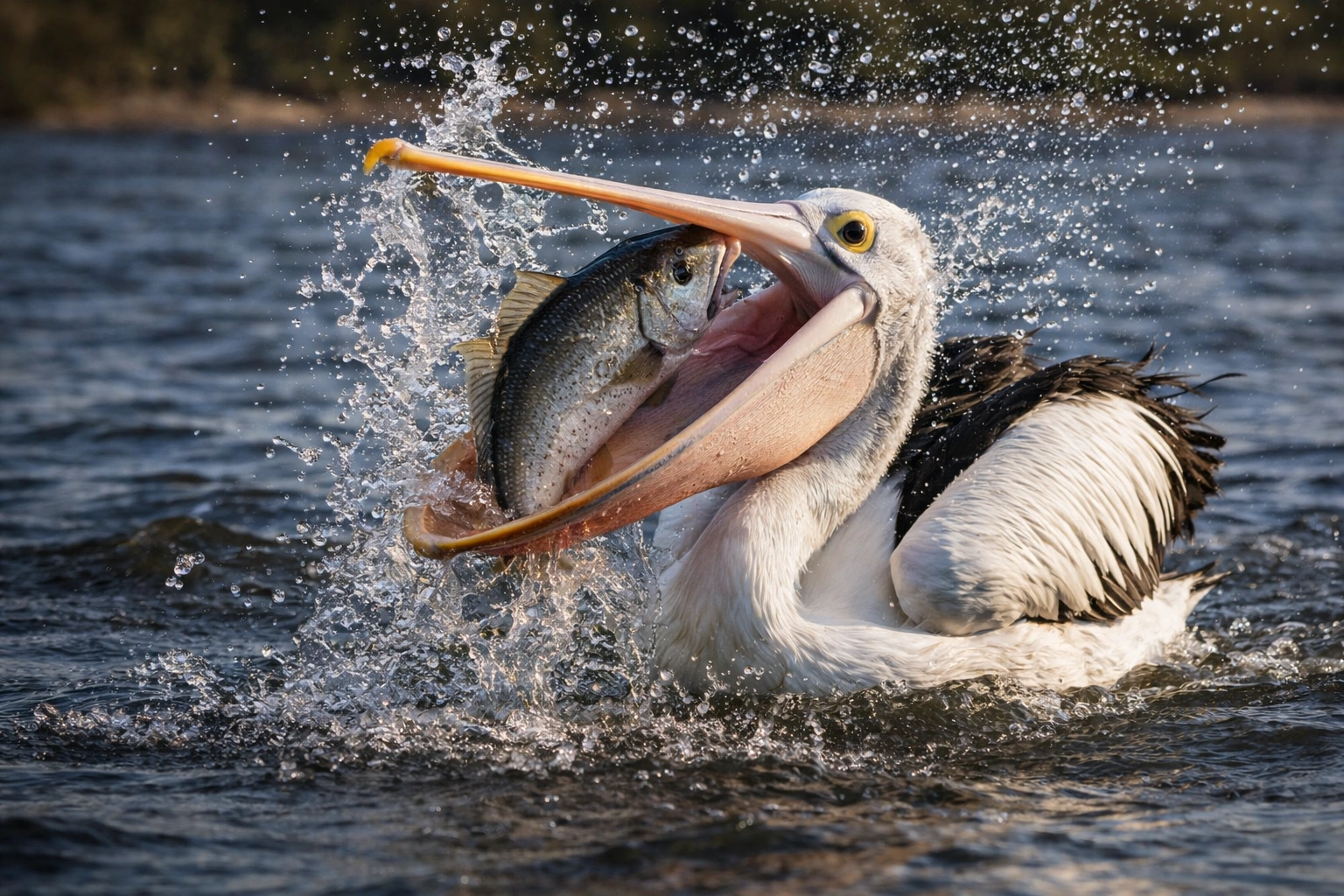
Australian Pelican
Scientific name: Pelecanus conspicillatus
The Australian pelican is one of the country’s most impressive waterbirds, instantly recognisable by its enormous bill and oversized throat pouch. With a wingspan reaching up to 2.5 metres, it’s surprisingly graceful in flight, often seen gliding low over lakes, rivers and coastal waters in smooth formation. Their black-and-white plumage contrasts sharply with their pale pink bill, making them stand out along shorelines.
Pelicans are expert fishers, using their huge pouch to scoop up fish before draining the water and swallowing their catch. They often work together in groups, herding fish into shallow water to make feeding easier. Found right across Australia wherever there’s water, they’re adaptable and resilient birds that can travel long distances to find food. Big, calm and slightly prehistoric-looking, the pelican is a striking presence on any Australian waterway.
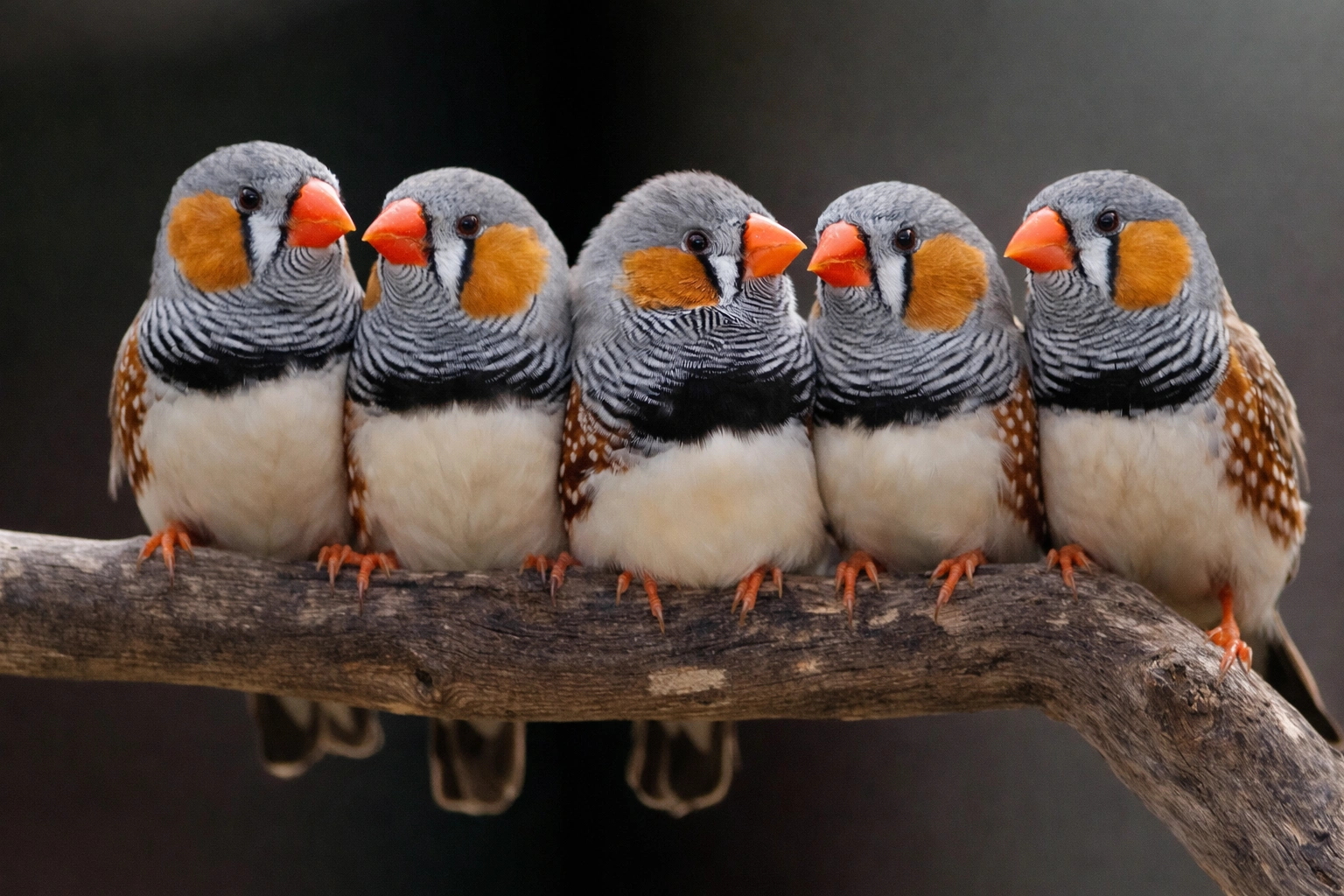
Zebra Finch
Scientific name: Taeniopygia guttata
The zebra finch is a small, lively native bird found across much of Australia’s dry interior. About the size of a sparrow, it has a soft grey body, white belly and distinctive black-and-white “zebra” striping on its throat and chest. Males are especially eye-catching, with bright orange cheek patches and a red beak, while females are more subtly coloured.
Zebra finches are true outback survivors, thriving in hot, arid environments where water can be scarce. They travel in tight flocks, constantly chattering to one another, and stay close to reliable water sources when they can. Quick breeders after rain, they take advantage of good conditions to raise young before the landscape dries out again. Small but tough, the zebra finch is a perfect example of how Australian wildlife adapts to extreme environments.
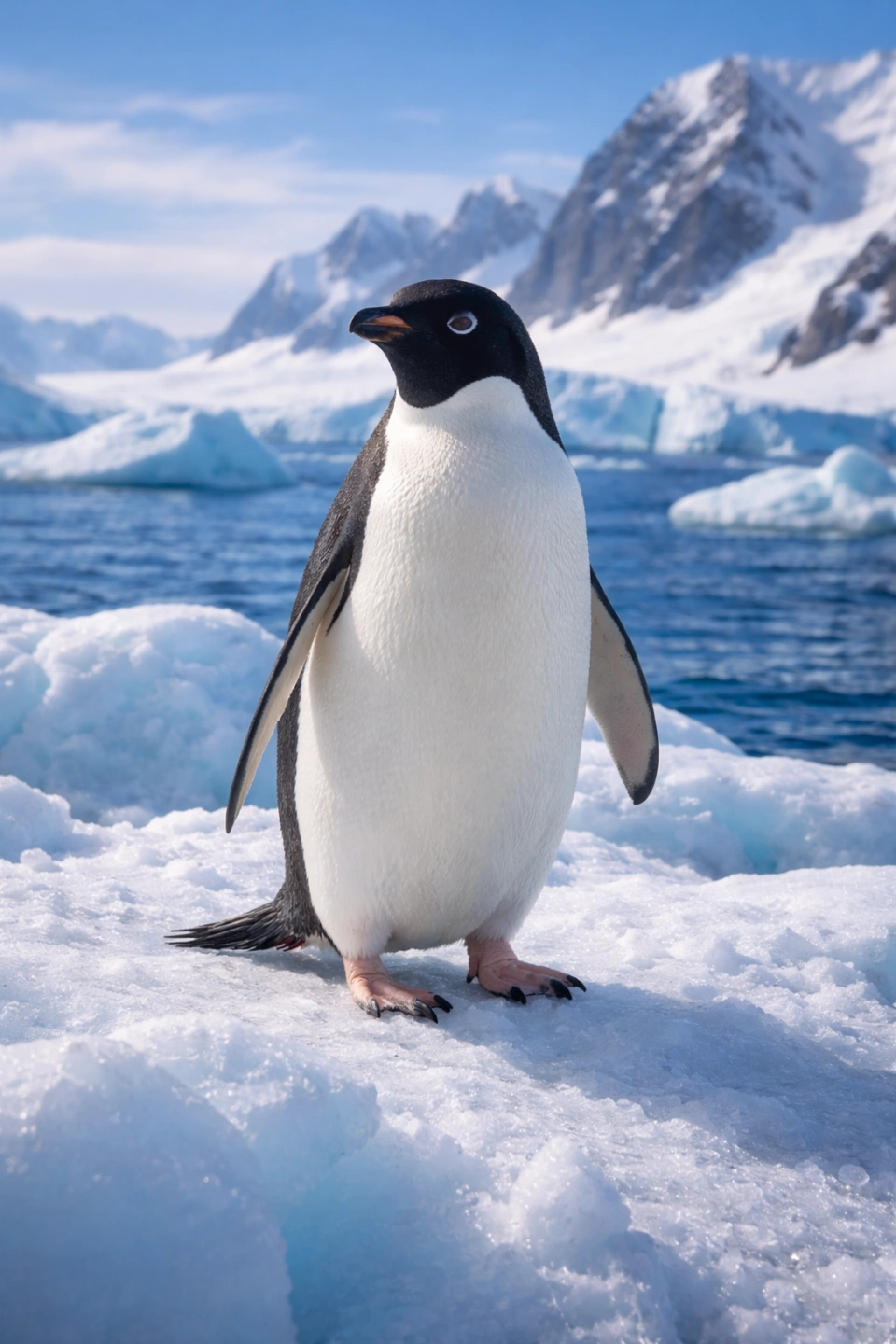
Adélie Penguin
Scientific name: Pygoscelis adeliae
The Adélie Penguin is one of the most widespread and well-known penguin species in Antarctica. Instantly recognisable by its classic black-and-white “tuxedo” look and distinctive white eye ring, it’s a compact, energetic penguin built for icy extremes.
They breed along the entire Antarctic coastline, forming massive colonies on rocky, ice-free ground during summer. Instead of nesting in snow, they carefully collect small stones to build pebble nests — and yes, pebble theft between neighbours is very much a thing.
Adélies feed mainly on krill, fish and squid, diving up to around 170 metres in search of food. In the water they’re fast and agile, porpoising through the waves to conserve energy and avoid predators like leopard seals.
During the brutal Antarctic winter, many migrate northward with the expanding sea ice. Despite their cute appearance, they’re tough, noisy and fiercely determined — perfectly adapted to one of the harshest environments on Earth.
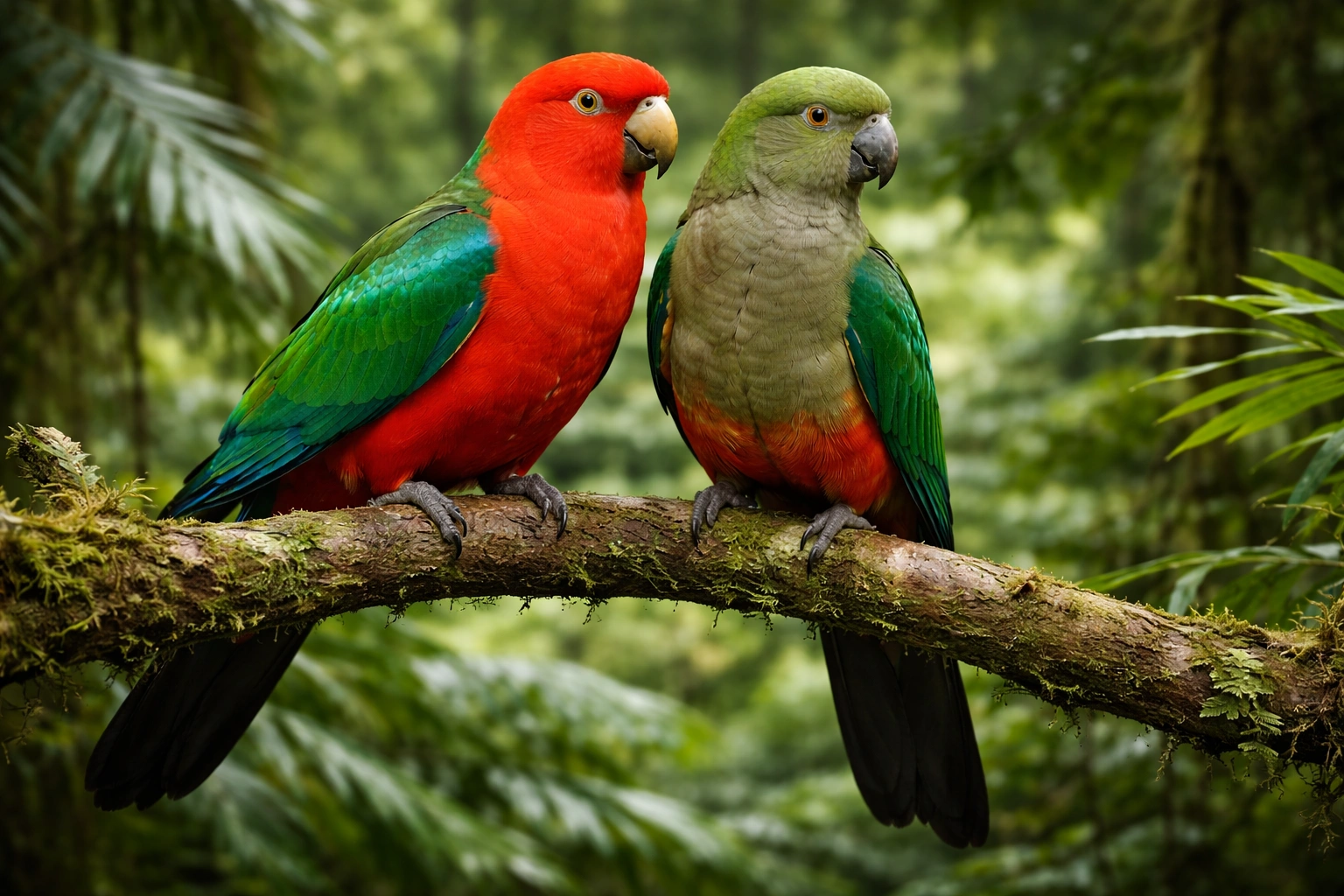
Australian King-Parrot
Scientific name: Alisterus scapularis
The Australian King-Parrot is one of the most striking parrots in eastern Australia. Males are instantly recognisable with their vivid red head and chest contrasted against bright emerald-green wings and back. Females look completely different — mostly green with a grey-green chest and a touch of red on the belly — a great example of sexual dimorphism in birds.
They’re found along the east coast of Australia, from Queensland through New South Wales to Victoria, usually in rainforests, wet sclerophyll forests and well-treed suburban areas. Unlike many noisy parrots, King-Parrots are relatively calm and often feed quietly in trees or even on the ground.
Their diet includes seeds, fruits, berries and blossoms. They’re strong fliers but tend to move gracefully between trees rather than in large, screeching flocks like cockatoos or lorikeets.
Breeding pairs nest in deep tree hollows, where the female incubates the eggs while the male brings food. Seeing a flash of red and green glide through the forest canopy is pure eastern-Australia magic.
Australia’s native birds are some of the most distinctive and colourful in the world, thanks to millions of years of isolation. From bright parrots like sulphur-crested cockatoos, galahs and rainbow lorikeets to massive outback flocks of budgerigars, parrots dominate much of the landscape. Iconic species like the laughing kookaburra — famous for its human-like call — and the wedge-tailed eagle, with a wingspan over two metres, add to Australia’s bold birdlife personality.
Beyond the forests and suburbs, Australia is home to impressive waterbirds like black swans and pelicans, as well as prehistoric-looking emus and cassowaries. Many native species are perfectly adapted to harsh desert conditions, surviving intense heat and limited water. What truly sets Australian birds apart, though, is the soundscape — from dawn magpie warbles to screeching cockatoos and kookaburra laughter echoing through the bush.
This stylistic image blends elements from multiple themes into one cohesive visual scene.
Emu
Scientific name: Dromaius novaehollandiae
The Emu is Australia’s largest native bird and the second-largest bird in the world after the ostrich. Standing up to about 1.9 metres tall, it has long powerful legs built for speed and can sprint at around 50 km/h across open country. Despite being flightless, emus are incredibly mobile and roam vast distances through the Australian outback, woodlands and grasslands in search of food and water. Their shaggy brown feathers help regulate body temperature in Australia’s harsh climate.
Emus are opportunistic feeders, eating seeds, native plants, fruits, insects and even small reptiles when available. They swallow small stones to help grind food in their gizzard, which is a pretty efficient survival trick in dry environments. Unlike many birds, emus don’t form permanent pairs. After the female lays large dark green eggs, the male takes over — and this is where it gets impressive.
The male emu incubates the eggs for about eight weeks without eating, drinking or leaving the nest for long periods, losing a significant amount of body weight in the process. Once the striped chicks hatch, he continues to protect and raise them for several months. The emu is such an iconic symbol of Australia that it appears on the national coat of arms alongside the kangaroo — fitting for a bird that can’t easily walk backwards, symbolising forward progress.
Kookaburra
Scientific name: Dacelo novaeguineae
The kookaburra is one of Australia’s most recognisable birds — famous for its loud, laughing call that echoes through the bush at dawn and dusk. The most common species is the Laughing Kookaburra, found along the east coast and in many suburban areas. With its large head, sturdy body and powerful beak, it looks almost oversized for a kingfisher — which is exactly what it is. Unlike other kingfishers that dive for fish, kookaburras are land hunters.
They feed on insects, small reptiles, frogs and even snakes, often swooping down from a perch to grab prey before returning to a branch to bash it against the wood. They’re territorial and live in family groups, with older offspring sometimes helping raise new chicks. Calm and confident around people, kookaburras have become a true symbol of the Australian bush — equal parts charming and slightly intimidating when that laugh kicks off nearby.
Sulphur-crested Cockatoo
Scientific name: Cacatua galerita
The sulphur-crested cockatoo is one of Australia’s most recognisable and loudest native birds. Brilliant white with a striking yellow crest that fans up when excited or alarmed, they’re hard to miss — and even harder to ignore. Found across eastern and northern Australia, they thrive in bushland, farmland and suburbs, often gathering in noisy flocks that can number in the dozens.
Highly intelligent and incredibly curious, these cockatoos are known for their problem-solving skills (and their talent for getting into mischief). They feed on seeds, nuts, roots and insects, and in urban areas they’ve mastered the art of opening rubbish bins. They form strong social bonds and can live for decades, which helps explain their complex behaviour and bold personalities. Love them or find them a bit chaotic, sulphur-crested cockatoos are pure Australian character with wings.
Galah
Scientific name: Eolophus roseicapilla
The galah is one of Australia’s most recognisable parrots, famous for its soft pink chest and face paired with grey wings and back. Also known as the pink and grey cockatoo, it’s found across most of mainland Australia, from inland deserts to farmland and even suburban parks. Galahs are highly social birds, often seen in large, noisy flocks that wheel through the sky together or gather on the ground to feed.
They mainly eat seeds, grasses and grains, which is why they’re commonly spotted in open country. Despite their pretty appearance, galahs are tough and adaptable, thriving in harsh, dry conditions. They form strong pair bonds and are often seen sitting closely together on branches, gently preening each other. Playful and full of personality, the galah has become a true symbol of the Australian landscape.
Budgerigar
Scientific name: Melopsittacus undulatus
The budgerigar — usually just called a “budgie” — is one of Australia’s smallest and most energetic native parrots. In the wild, they’re bright green and yellow with black scalloped markings across the back and wings. They’re found across the dry interior of Australia, especially in arid and semi-arid regions where they travel in huge flocks searching for water and fresh grass after rain.
Wild budgies are true outback survivors. They breed quickly when conditions are good and can travel long distances in fast, swirling flocks that almost look like green clouds moving across the sky. Although they’re one of the world’s most popular pet birds, their natural home is the Australian desert, where they thrive in tough conditions and bring flashes of colour to some of the harshest landscapes on Earth.
Australian Magpie
Scientific name: Gymnorhina tibicen
The Australian Magpie is one of the country’s most iconic and intelligent native birds, known for its striking black-and-white plumage and beautiful, flute-like song. Found across most of Australia in open woodlands, parks and suburban areas, magpies are highly adaptable and often live comfortably alongside people. Their warbling call at dawn is considered one of the most distinctive sounds of the Australian bush.
Magpies are also famously territorial during breeding season, when some males will swoop to protect their nests — a behaviour that’s earned them a bit of a reputation. Despite that, they’re highly social birds that live in family groups and are known for recognising human faces. Curious, clever and confident, the Australian magpie is both loved and cautiously respected across the country.
Wedge-tailed Eagle
Scientific name: Aquila audax
The wedge-tailed eagle is Australia’s largest bird of prey and an absolute powerhouse of the skies. With a wingspan that can stretch beyond two metres, it soars effortlessly over open plains, mountain ranges and deserts across most of the continent. Its long, diamond-shaped tail — which gives the species its name — is easy to spot when it’s gliding high on thermal currents.
These eagles are formidable hunters, feeding on rabbits, small mammals, reptiles and carrion. They build massive stick nests high in tall trees or on cliff faces, often reusing and adding to them year after year. Despite their size and strength, they’re surprisingly graceful in flight, barely moving their wings as they ride the air. The wedge-tailed eagle is a true symbol of Australia’s vast, wild landscapes — powerful, resilient and unmistakable against a big outback sky.
Rainbow Lorikeet
Scientific name: Trichoglossus moluccanus
The rainbow lorikeet is one of Australia’s most colourful and energetic native birds. With its bright blue head, fiery orange chest, green wings and flashes of yellow, it looks almost unreal against the green of the trees. Found along the east coast and in many cities and suburbs, these parrots are loud, fast and rarely sit still for long.
Unlike many other parrots, rainbow lorikeets mainly feed on nectar and pollen. They have a specialised brush-tipped tongue that helps them collect nectar from flowering trees, especially eucalyptus and bottlebrush. Highly social and often seen in noisy flocks, they’re bold around people and quick to dominate backyard feeders. Flashy, cheeky and full of personality, the rainbow lorikeet is pure colour and chaos in the Australian treetops.
Australian Pelican
Scientific name: Pelecanus conspicillatus
The Australian pelican is one of the country’s most impressive waterbirds, instantly recognisable by its enormous bill and oversized throat pouch. With a wingspan reaching up to 2.5 metres, it’s surprisingly graceful in flight, often seen gliding low over lakes, rivers and coastal waters in smooth formation. Their black-and-white plumage contrasts sharply with their pale pink bill, making them stand out along shorelines.
Pelicans are expert fishers, using their huge pouch to scoop up fish before draining the water and swallowing their catch. They often work together in groups, herding fish into shallow water to make feeding easier. Found right across Australia wherever there’s water, they’re adaptable and resilient birds that can travel long distances to find food. Big, calm and slightly prehistoric-looking, the pelican is a striking presence on any Australian waterway.
Zebra Finch
Scientific name: Taeniopygia guttata
The zebra finch is a small, lively native bird found across much of Australia’s dry interior. About the size of a sparrow, it has a soft grey body, white belly and distinctive black-and-white “zebra” striping on its throat and chest. Males are especially eye-catching, with bright orange cheek patches and a red beak, while females are more subtly coloured.
Zebra finches are true outback survivors, thriving in hot, arid environments where water can be scarce. They travel in tight flocks, constantly chattering to one another, and stay close to reliable water sources when they can. Quick breeders after rain, they take advantage of good conditions to raise young before the landscape dries out again. Small but tough, the zebra finch is a perfect example of how Australian wildlife adapts to extreme environments.
Adélie Penguin
Scientific name: Pygoscelis adeliae
The Adélie Penguin is one of the most widespread and well-known penguin species in Antarctica. Instantly recognisable by its classic black-and-white “tuxedo” look and distinctive white eye ring, it’s a compact, energetic penguin built for icy extremes.
They breed along the entire Antarctic coastline, forming massive colonies on rocky, ice-free ground during summer. Instead of nesting in snow, they carefully collect small stones to build pebble nests — and yes, pebble theft between neighbours is very much a thing.
Adélies feed mainly on krill, fish and squid, diving up to around 170 metres in search of food. In the water they’re fast and agile, porpoising through the waves to conserve energy and avoid predators like leopard seals.
During the brutal Antarctic winter, many migrate northward with the expanding sea ice. Despite their cute appearance, they’re tough, noisy and fiercely determined — perfectly adapted to one of the harshest environments on Earth.
Australian King-Parrot
Scientific name: Alisterus scapularis
The Australian King-Parrot is one of the most striking parrots in eastern Australia. Males are instantly recognisable with their vivid red head and chest contrasted against bright emerald-green wings and back. Females look completely different — mostly green with a grey-green chest and a touch of red on the belly — a great example of sexual dimorphism in birds.
They’re found along the east coast of Australia, from Queensland through New South Wales to Victoria, usually in rainforests, wet sclerophyll forests and well-treed suburban areas. Unlike many noisy parrots, King-Parrots are relatively calm and often feed quietly in trees or even on the ground.
Their diet includes seeds, fruits, berries and blossoms. They’re strong fliers but tend to move gracefully between trees rather than in large, screeching flocks like cockatoos or lorikeets.
Breeding pairs nest in deep tree hollows, where the female incubates the eggs while the male brings food. Seeing a flash of red and green glide through the forest canopy is pure eastern-Australia magic.
Our Amphibians
Australia’s native amphibians are a seriously fascinating bunch all of them are frogs. Around 240+ species call Australia home, with 93% found nowhere else on Earth, and they’ve adapted to everything from alpine snowfields to red desert sand.
Australia’s native amphibians are a seriously fascinating bunch — and almost all of them are frogs, as we don’t have native salamanders or newts on the continent. With more than 240 species recorded, Australian frogs have evolved in isolation for millions of years, resulting in an incredible variety of colours, sizes and behaviours. From tiny species no bigger than a fingernail to large, robust tree frogs, they occupy an astonishing range of habitats across the country.
What makes them truly remarkable is their ability to survive in some of the harshest and most diverse environments on Earth. You’ll find frogs living in alpine snowfields, tropical rainforests, coastal wetlands and even the arid red deserts of the interior. Some burrow underground for months waiting for rain, while others cling to rainforest leaves or suburban water tanks. Their adaptability and unique life cycles make them one of Australia’s most extraordinary — and often overlooked — groups of native wildlife.
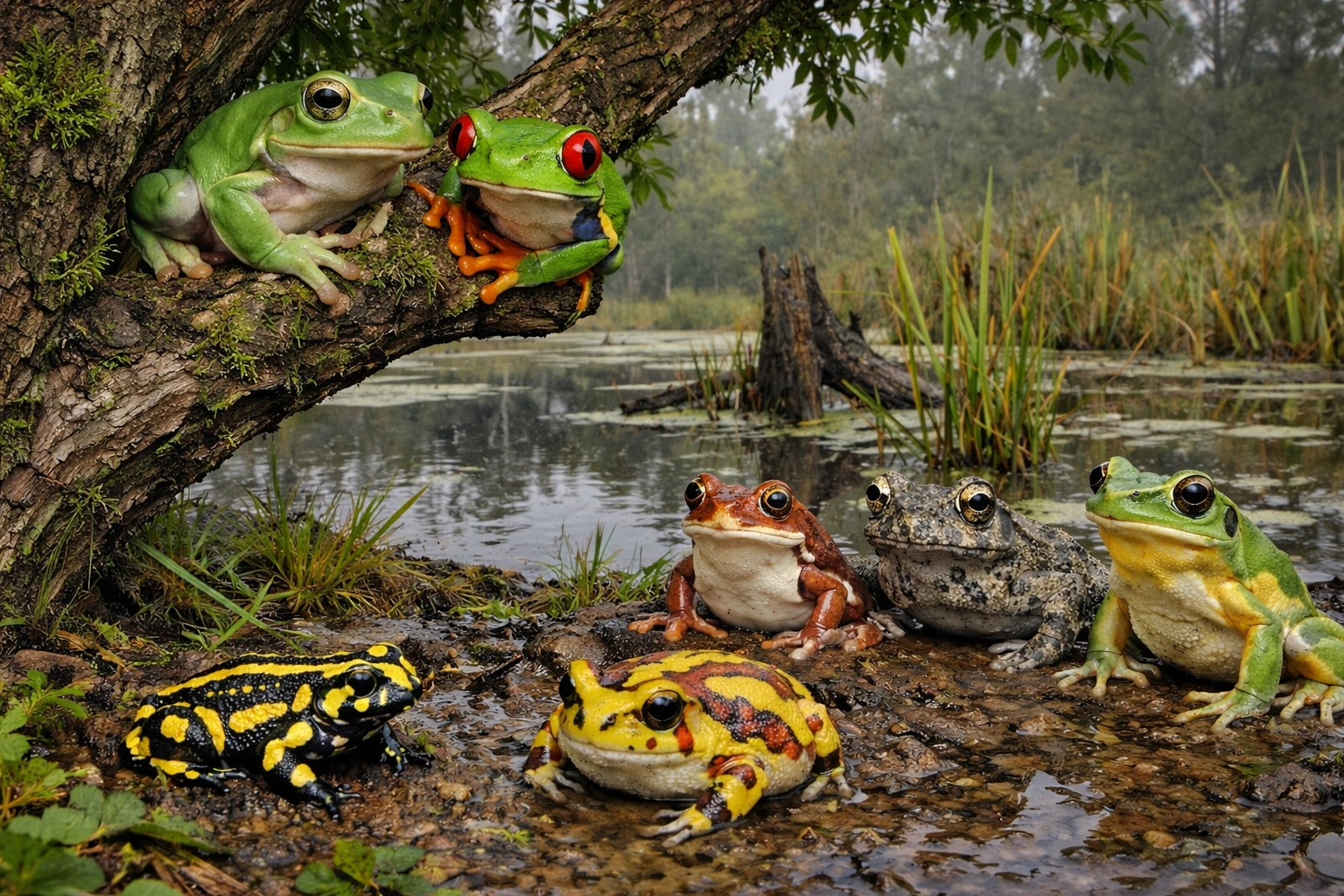
This stylistic image blends elements from multiple themes into one cohesive visual scene.
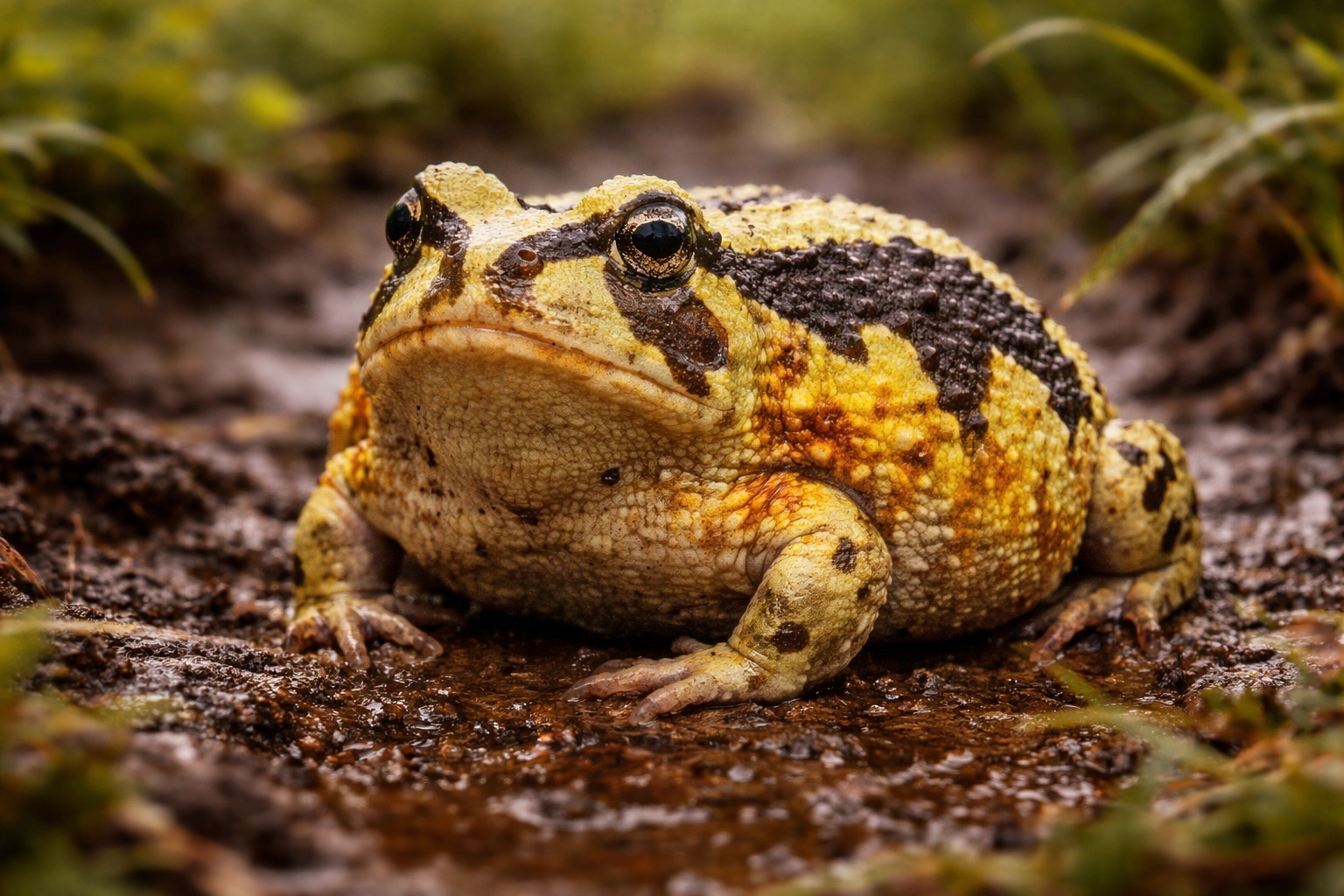
Crucifix Frog
Scientific name: Notaden bennettii
The Crucifix Frog is a small, round-bodied burrowing frog found across inland eastern Australia. It gets its name from the distinctive dark, cross-shaped marking on its back — a pattern that makes it instantly recognisable.
Stocky and almost ball-shaped, this frog has smooth skin, short limbs and a pale yellow to olive body colour with that bold dark “crucifix” marking. Unlike tree frogs or stream frogs, it lives in dry, arid and semi-arid environments. Most of the time, it stays underground, buried in soil to avoid heat and drought.
When heavy rains arrive, the Crucifix Frog emerges to breed in temporary pools. These explosive breeding events can happen rapidly after storms, with males calling from shallow water. The tadpoles develop quickly before the pools dry out again.
One of its more fascinating traits? When threatened, it secretes a sticky substance from its skin that can gum up the mouthparts of predators — a pretty effective defence for such a small amphibian.
Quiet, underground most of the year, then suddenly everywhere after rain — the Crucifix Frog is perfectly adapted to Australia’s boom-and-bust climate.
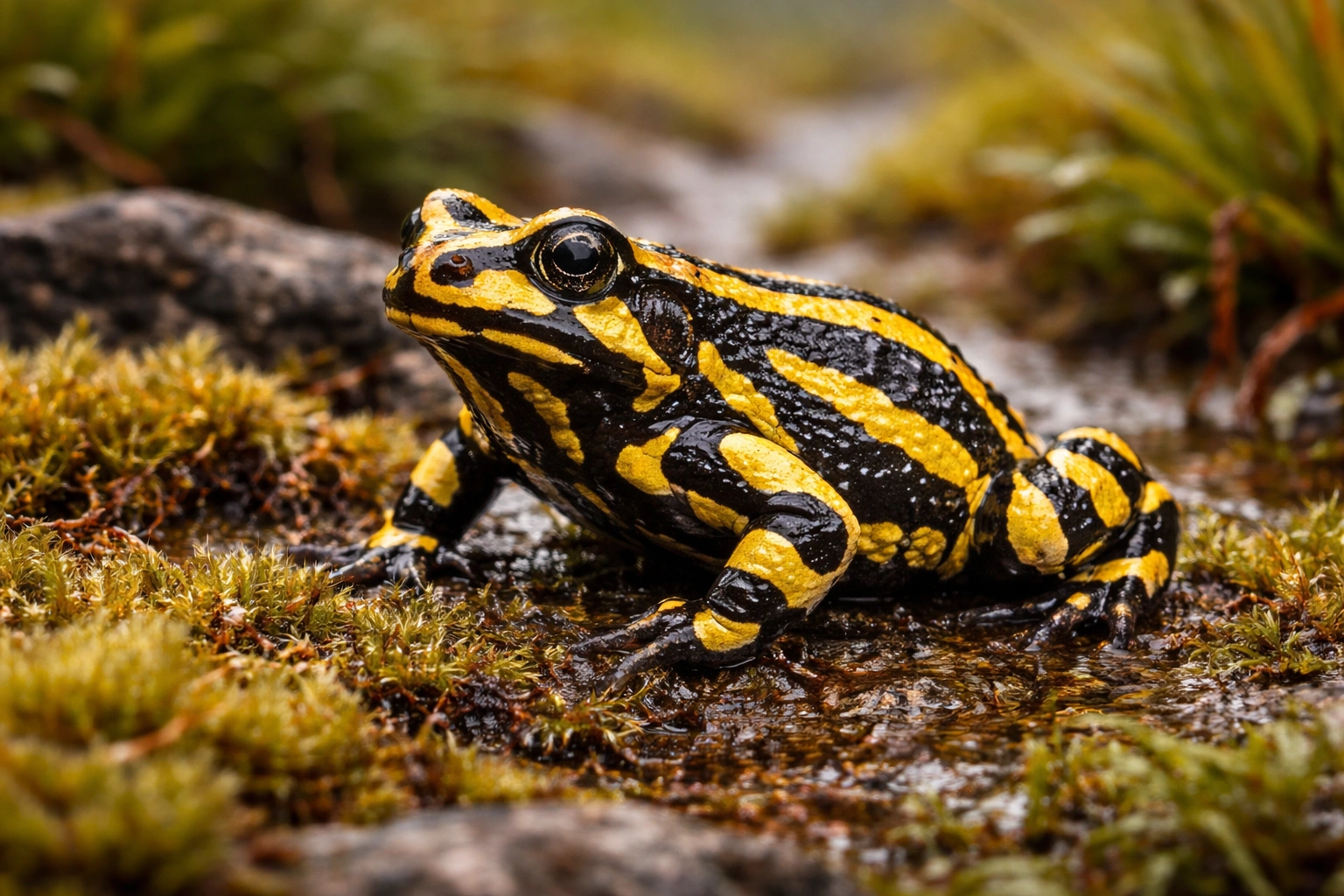
Corroboree Frog
Scientific name: Pseudophryne corroboree (Southern Corroboree Frog)
Related species: Pseudophryne pengilleyi (Northern Corroboree Frog)
The Corroboree Frog is one of Australia’s most striking and endangered amphibians. Instantly recognisable by its bold black-and-bright-yellow stripes, this tiny frog grows to only about 2.5–3 cm long — but visually, it makes a huge impression.
It lives in alpine and subalpine regions of the Snowy Mountains in New South Wales and the Australian Capital Territory. Unlike many frogs, Corroboree Frogs don’t lay their eggs directly in water. Instead, females lay eggs in moist moss or leaf litter near temporary pools. When seasonal rains arrive, the tadpoles are washed into the pools to continue developing.
Here’s something unusual: the Corroboree Frog is one of the few vertebrates that can produce its own toxic alkaloid compounds (rather than obtaining toxins from its diet). Those bright stripes act as a warning to predators — basically nature’s “do not eat” sign.
Sadly, the species has suffered massive declines due to habitat loss, climate change and the chytrid fungus disease, which has devastated frog populations worldwide. Intensive conservation programs, captive breeding and reintroduction efforts are ongoing to prevent extinction.
Small, bold and critically endangered — the Corroboree Frog has become a symbol of amphibian conservation in Australia.
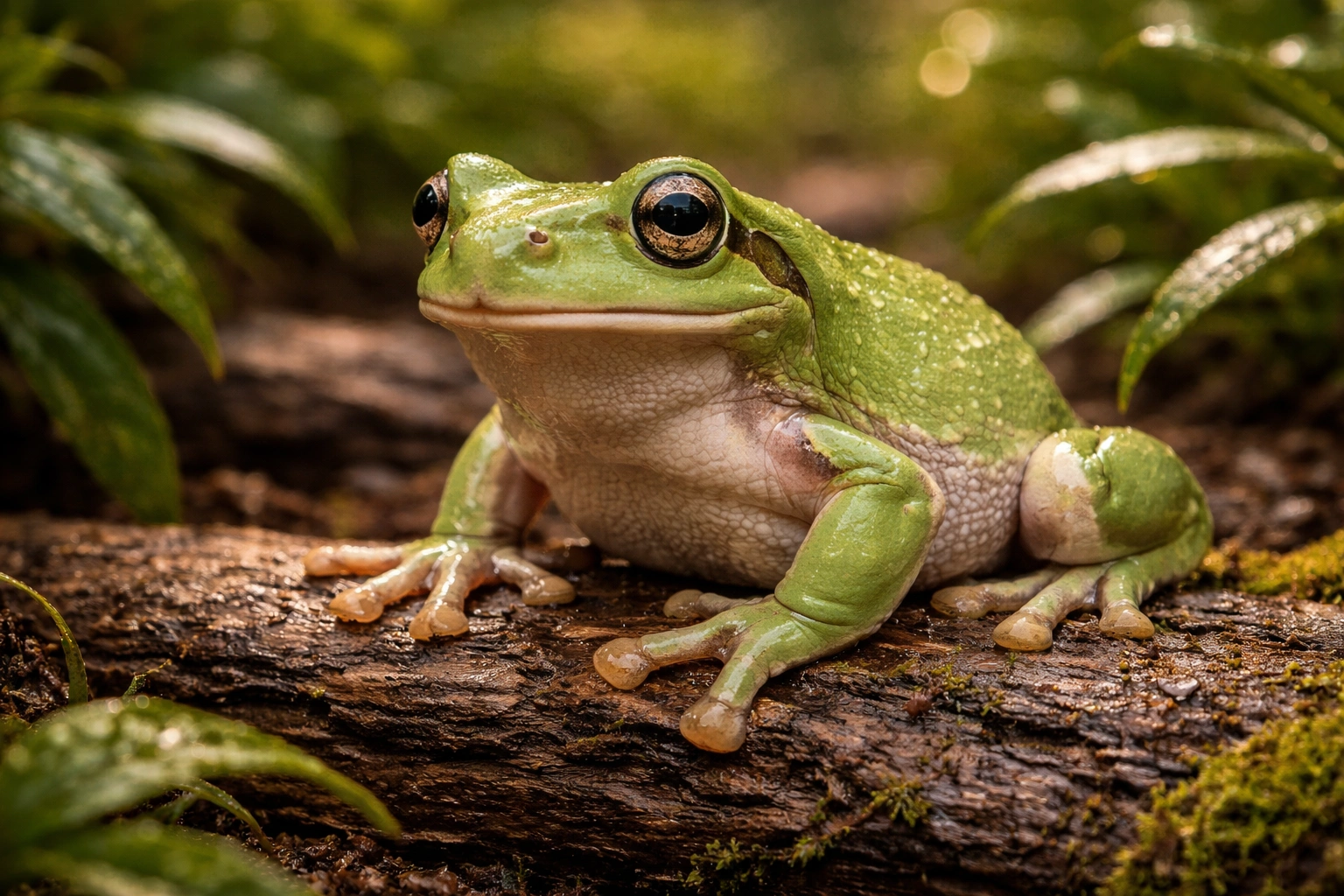
Australian Green Tree Frog
Scientific name: Litoria caerulea
The Australian Green Tree Frog — often called the White’s Tree Frog — is one of Australia’s most recognisable and much-loved amphibians 🐸. With its smooth, bright green skin, soft pale belly and big golden eyes, it has that permanently relaxed, slightly smiling look that makes it famous.
It’s found across northern and eastern Australia, especially in tropical and subtropical regions. True to its name, it lives in trees near water — but it’s also incredibly adaptable and often turns up around houses, bathrooms, rainwater tanks and garden lights where insects gather.
Green Tree Frogs are nocturnal hunters, feeding on insects, spiders and sometimes even smaller frogs. They have sticky toe pads for climbing and can grow quite large for a tree frog — up to 10 cm long.
One of their clever survival tricks is producing a waxy coating on their skin. They actually spread this secretion over their body with their legs to reduce water loss in hot conditions. Smart little survivalists.
They’re generally calm and tolerant compared to many frog species, which is why they’ve become popular in captivity (though wild frogs should always be left alone).
Big, bright and full of personality — the Australian Green Tree Frog is basically the laid-back ambassador of Aussie frogs.
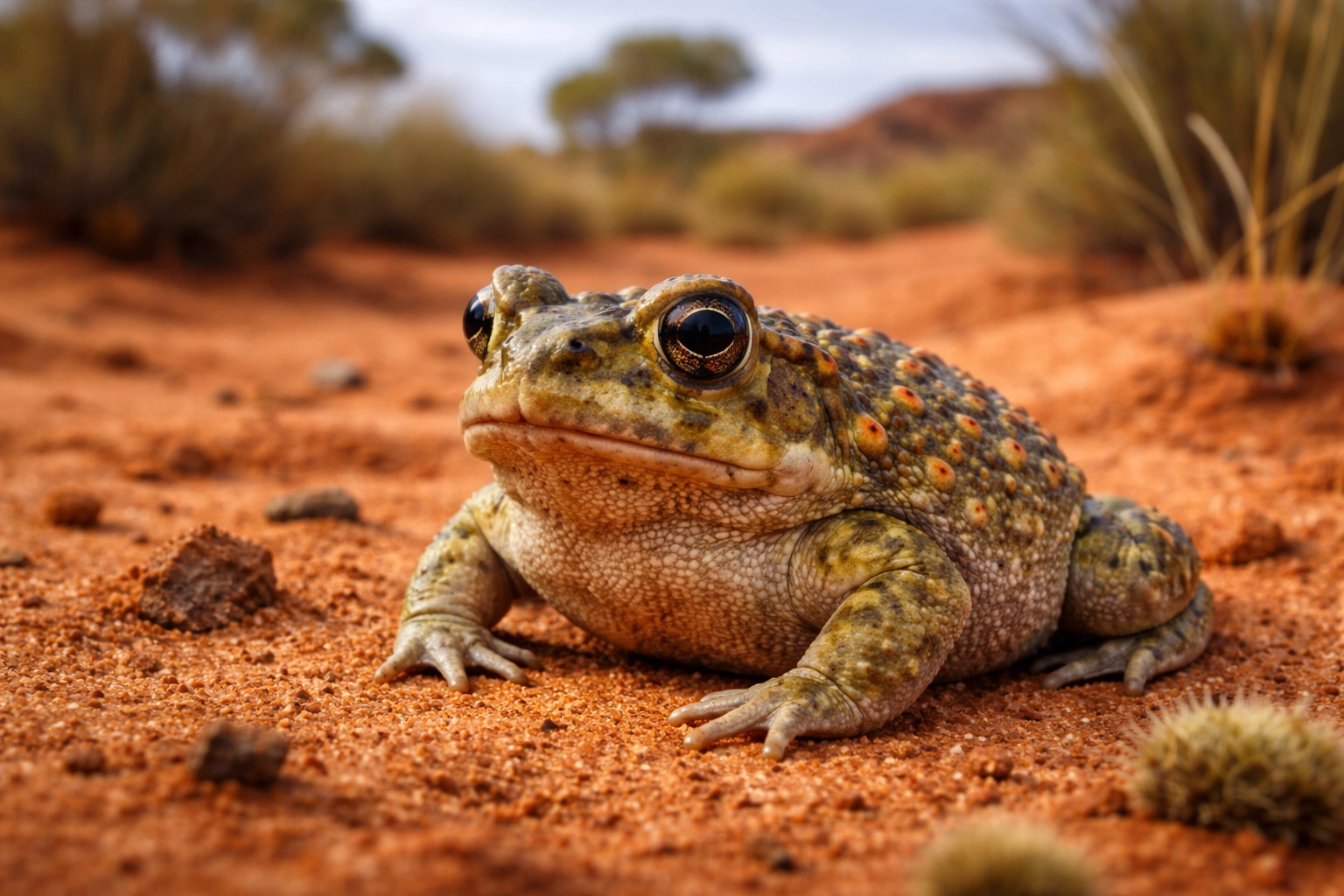
Desert Spadefoot Toad
Scientific name: Notaden nichollsi
The Desert Spadefoot Toad is one of Australia’s most fascinating survival specialists 🐸🌵. Found in arid and semi-arid regions of central and western Australia, this chunky little amphibian spends most of its life underground, hidden from the harsh desert sun.
It gets its name from the hard, spade-like structure on its hind feet, which it uses to dig backwards into sandy soil. When conditions are dry — which is most of the time — it can remain buried for months or even years in a state called aestivation, slowing its metabolism to conserve energy and moisture.
After heavy rain, it suddenly emerges in large numbers to breed in temporary pools. Like many desert frogs, it breeds quickly, and its tadpoles develop fast before the water evaporates.
The Desert Spadefoot Toad has a rounded body, smooth skin and earthy colouring — usually browns and olive tones that help it blend into sandy landscapes. When threatened, it can inflate its body to appear larger and may secrete a sticky defensive substance to deter predators.
It’s a perfect example of boom-and-bust adaptation — invisible most of the year, then suddenly active and vocal after rain.
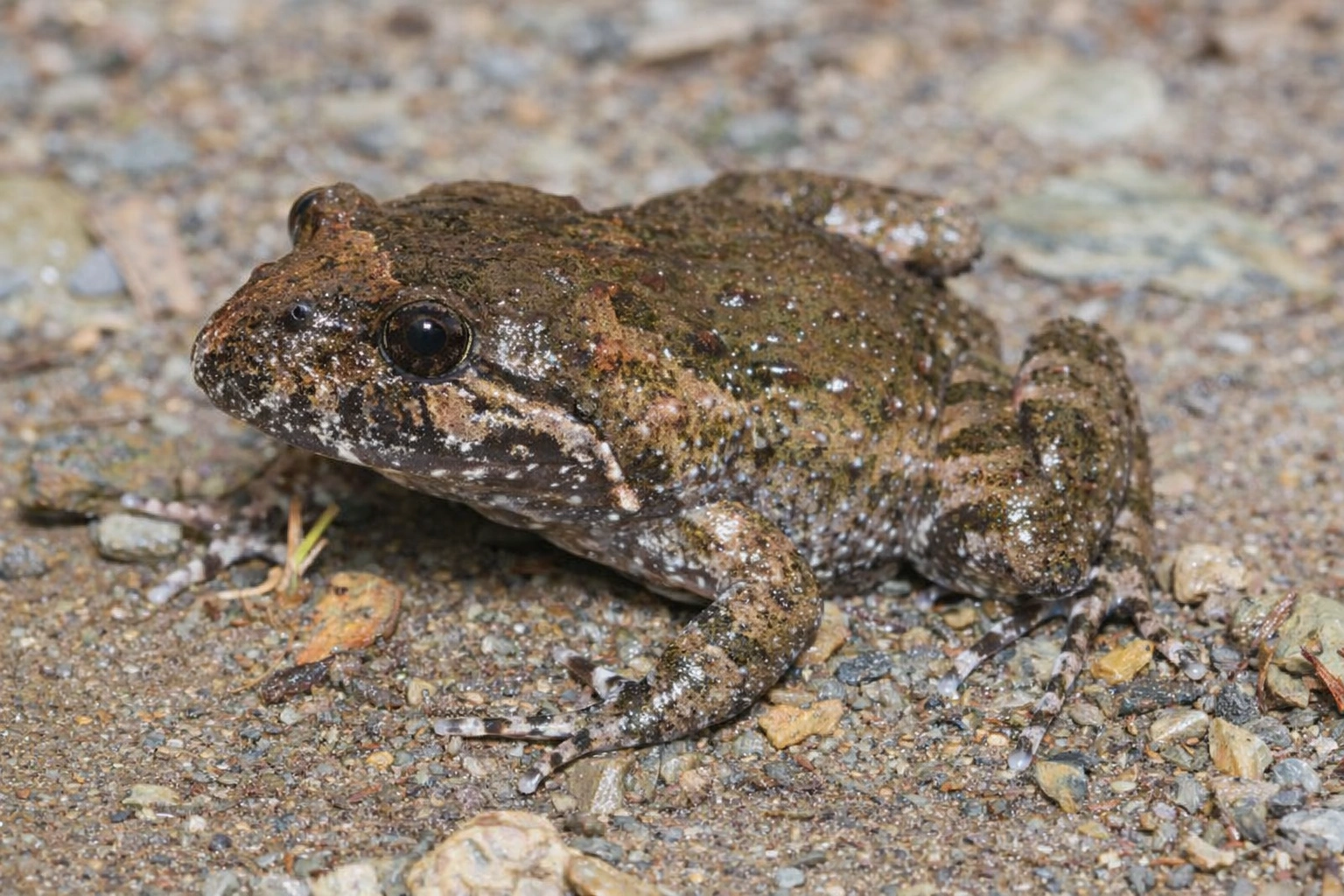
Australian Tusked Frog
Scientific name: Adelotus brevis
The Australian Tusked Frog is one of those “you wouldn’t expect that” species 🐸 — because yes, it actually has tusks.
Found along the east coast of Australia, from northern New South Wales into Queensland, this medium-sized frog lives around dams, swamps, slow-moving creeks and forested wetlands. It’s usually brown, olive or grey with a pale underside — nothing flashy at first glance.
But here’s the twist: males develop two sharp, fang-like projections (odontodes) on their lower jaw during breeding season. These “tusks” aren’t for eating — they’re for fighting. Males use them to wrestle rival males for territory and access to females.
Unlike many frogs that lay eggs in open water, Tusked Frogs build foam nests in burrows or concealed spots near water. When rain or rising water floods the nest site, the tadpoles are washed into the pond to continue developing.
They’re mostly nocturnal and not often seen, but you might hear their distinctive call — a soft “tok” or “unk” sound from vegetation near water.
Plain looking… until you realise it’s one of the only frogs in the world that brings tusks to a breeding fight.
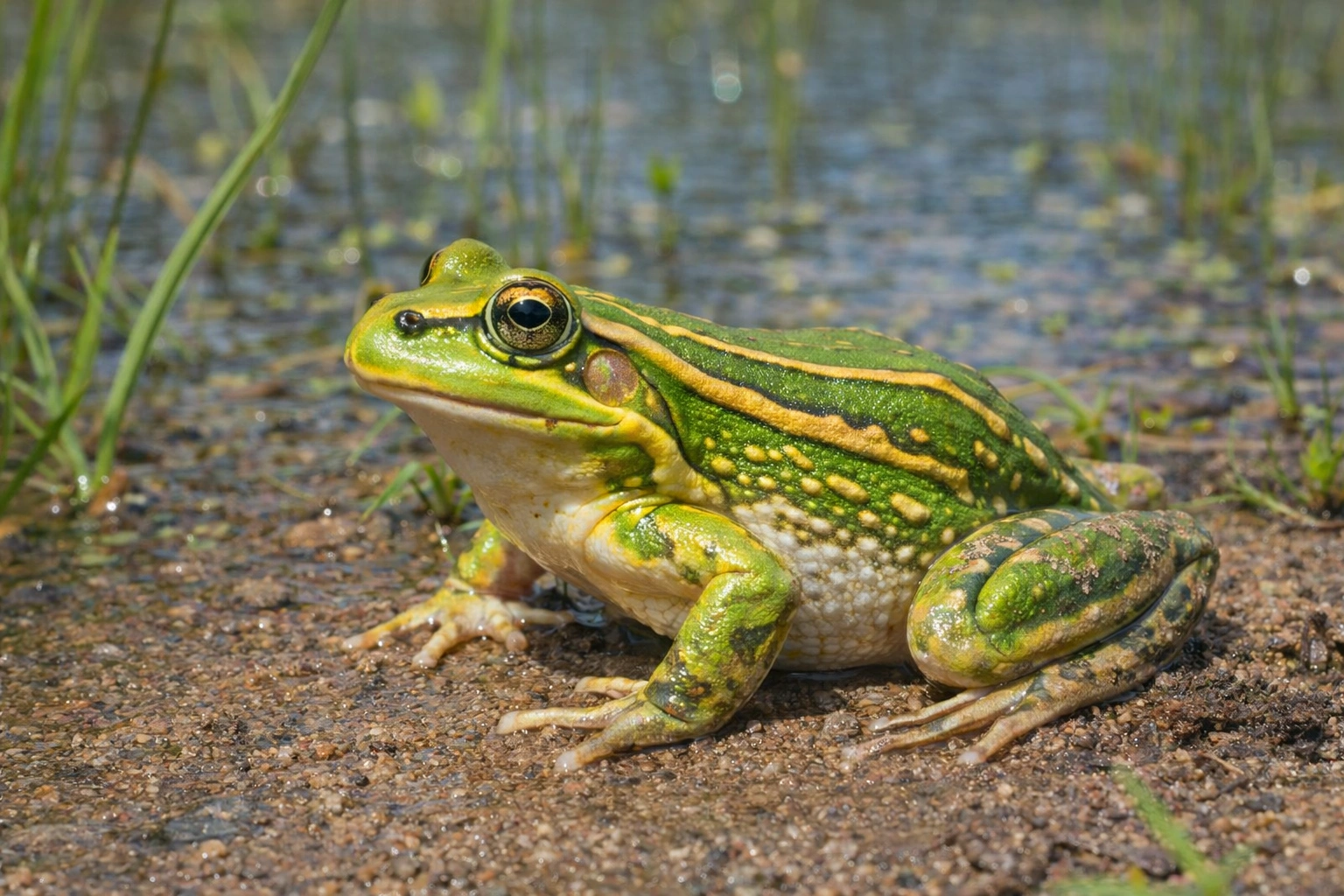
Green and Golden Bell Frog
Scientific name: Litoria aurea
The Green and Golden Bell Frog is one of Australia’s most striking frogs — bright lime green with shimmering gold or bronze markings along its back and legs 🐸✨. Some individuals have bold green patches edged in metallic gold, while others show more olive or bronze tones.
It grows relatively large for a tree frog (up to about 10 cm long) and has long legs built for powerful jumps. Despite being called a tree frog, it actually spends a lot of time on the ground near wetlands, ponds, lagoons and even old quarry sites or urban water bodies.
Found mainly in coastal New South Wales and parts of Victoria, the species has declined significantly due to habitat loss, pollution and the chytrid fungus. It’s now listed as endangered in many areas, and conservation programs are actively working to protect remaining populations.
The “bell” in its name comes from its call — a distinctive, resonant “crawk-crawk-crawk” that can carry across wetlands at night.
Beautiful, bold and unfortunately vulnerable — the Green and Golden Bell Frog has become an important symbol of wetland conservation in Australia.
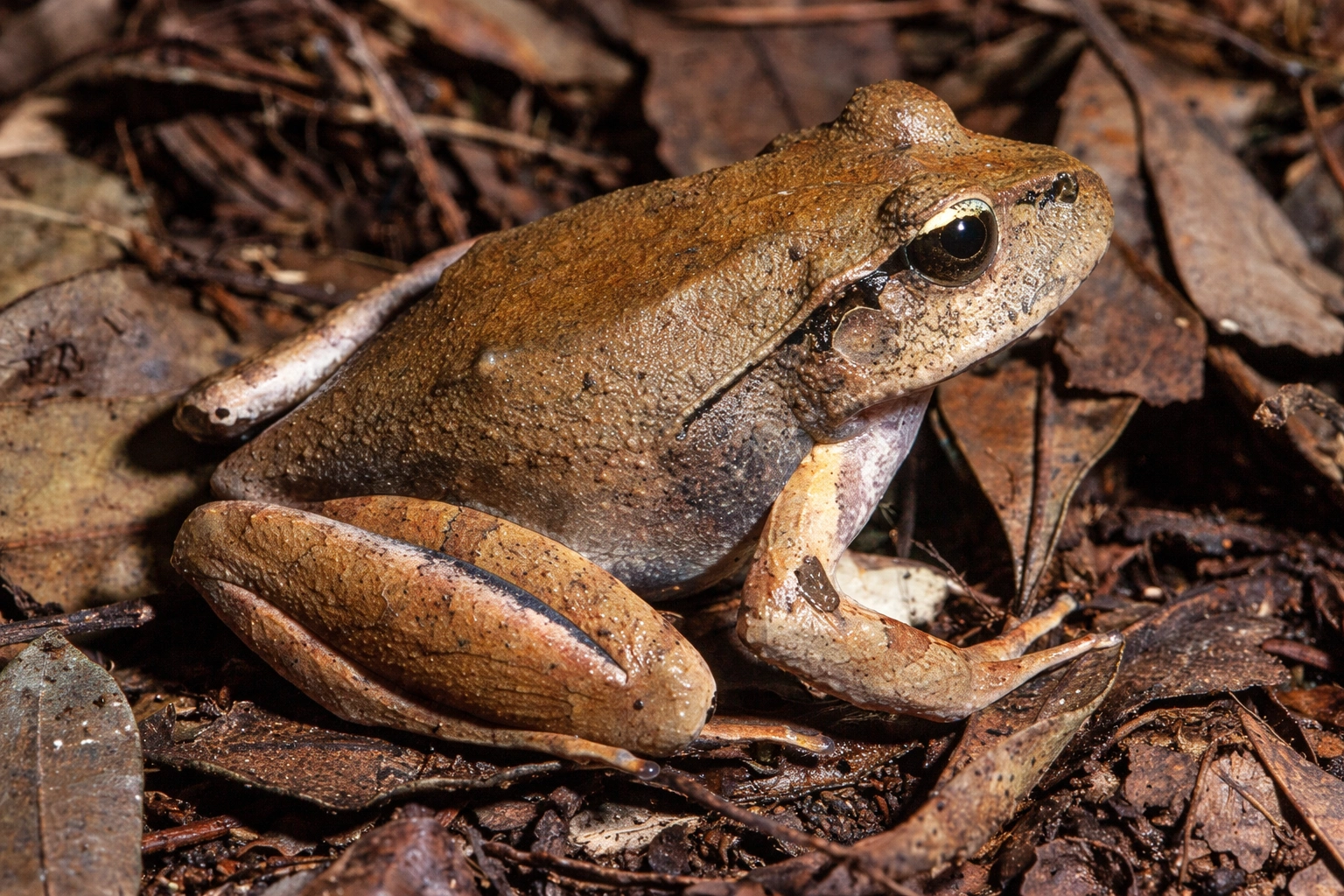
Fletcher’s Frog
Scientific name: Lechriodus fletcheri
Also known as: Sandpaper Frog
Fletcher’s Frog — better known as the Sandpaper Frog — is a small, stocky frog found along the east coast of Australia, particularly in New South Wales and southern Queensland. Its nickname comes from its rough, slightly abrasive skin texture, which really does feel like fine sandpaper.
Usually brown, grey or olive with darker mottling, it blends beautifully into leaf litter and muddy ground. It’s not flashy — it’s built for camouflage. These frogs favour forested areas, farmland and suburban bushland, especially around temporary ponds and flooded grasslands.
They’re explosive breeders after heavy rain. Males call from shallow water with a short, repetitive “cluck” or “tok” sound. Unlike many frogs, they lay eggs in a floating frothy mass that looks a bit like whipped foam on the water’s surface. As the eggs develop, the foam breaks down and releases the tadpoles into the pond.
Mostly nocturnal and rarely noticed unless you’re listening carefully after rain, the Sandpaper Frog is one of those quiet contributors to Australia’s wetland ecosystems.
Small, rough-skinned and perfectly adapted to muddy puddles after a storm — it’s classic east coast bush frog energy.
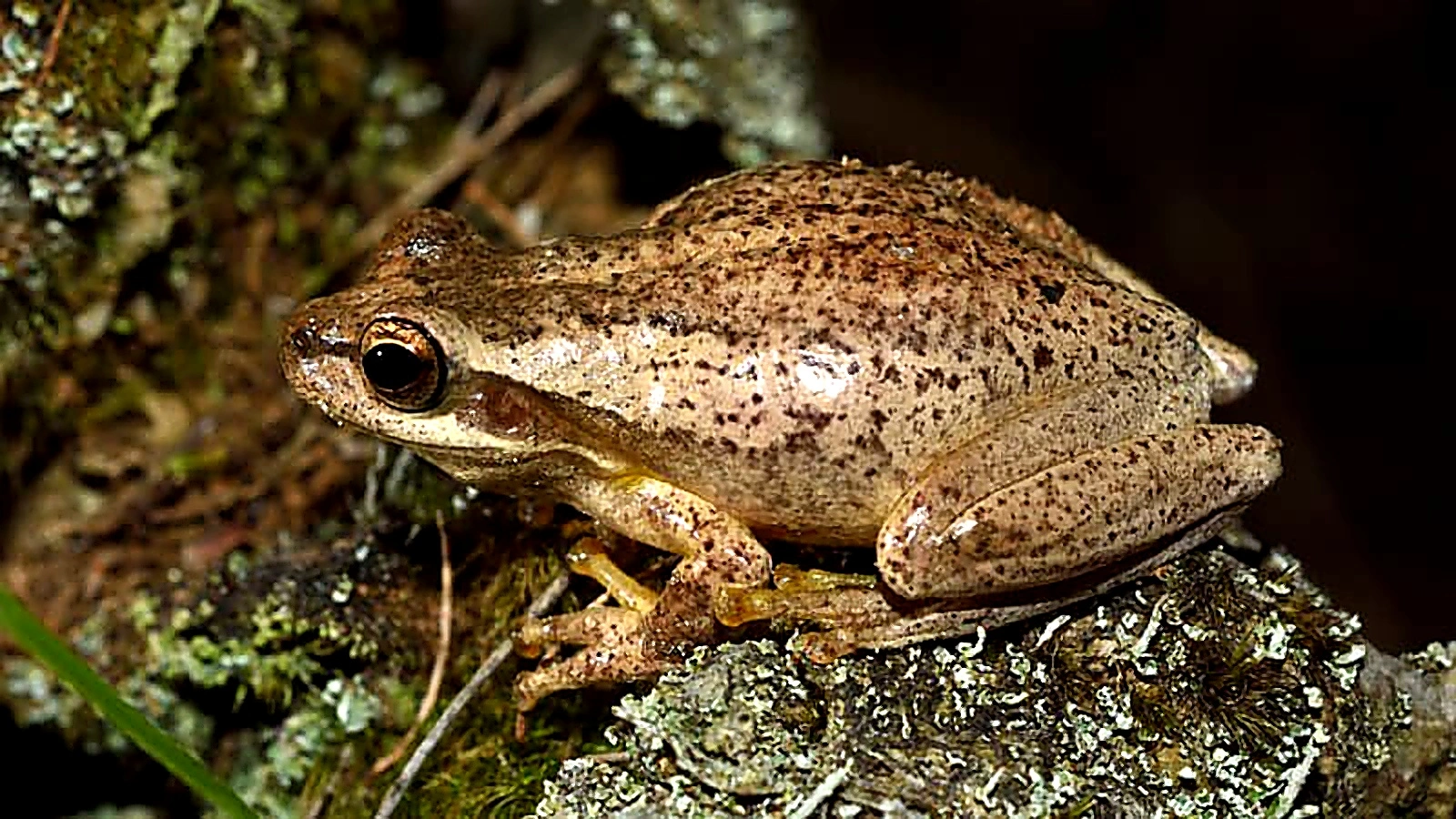
The Jervis Bay Tree Frog
Scientific Name: Litoria jervisiensis
is a medium-sized Australian tree frog found along the east coast of Australia, particularly in coastal areas of New South Wales, though its range extends from southern Queensland to eastern Victoria. Despite its name, the species is not limited to Jervis Bay; it was simply first identified there. It is commonly found in coastal wetlands, wallum swamps, lagoons, and sandy dune systems, usually near still or slow-moving water surrounded by vegetation. Adults typically grow to about 5 cm in length and have a brown or grey back with a distinctive dark stripe or pair of bands running along the body, along with a dark line from the snout to the shoulder.
This frog is mostly nocturnal and becomes active around water during cooler, wetter periods when breeding occurs. Males call from reeds or low vegetation with a distinctive three-note “weep-weep-weep” call to attract females. The species has large toe pads for climbing and partially webbed feet for swimming, allowing it to move easily between vegetation and water. Like many Australian frogs it feeds on small insects and other invertebrates, and interestingly individuals can sometimes give off a faint curry-like smell when handled, earning it the nickname “curry frog.”
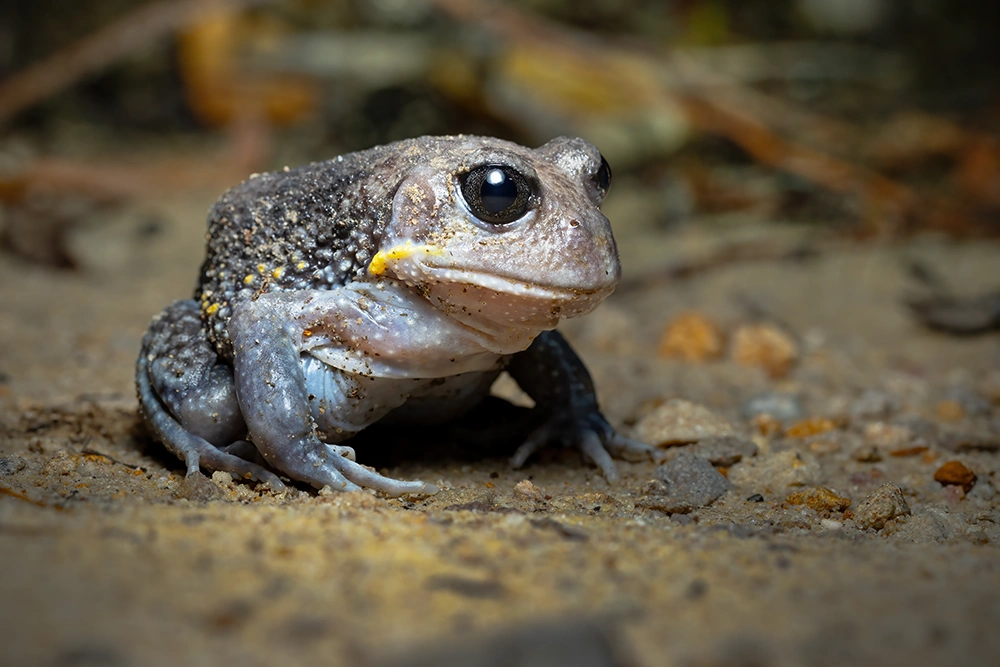
The Giant Burrowing Frog
Scientific Name: Heleioporus australiacus
is a large, robust frog native to eastern Australia, particularly in coastal and tableland areas of New South Wales and southeastern Queensland. As its name suggests, it spends much of its life underground, living in burrows in sandy or loose soils near forests, heathland, and creek systems. Adults can reach 7–9 cm in length, making them one of the larger burrowing frogs in the region. They typically have a dark brown to grey body with scattered lighter spots, a broad head, and powerful front limbs used for digging.
This species is mainly nocturnal and rarely seen, emerging from its burrow mostly after heavy rain to feed on insects and other small invertebrates. During the breeding season, males call from hidden chambers or burrows near temporary pools and streams, producing a deep, resonant “whoop” or “bonk” call. Eggs are laid in underground nests where the tadpoles develop until heavy rain floods the chamber, washing them into nearby pools where they continue their growth. The Giant Burrowing Frog is considered vulnerable in parts of its range, mainly due to habitat loss, changes to water flow, and disturbance of its specialised breeding sites.
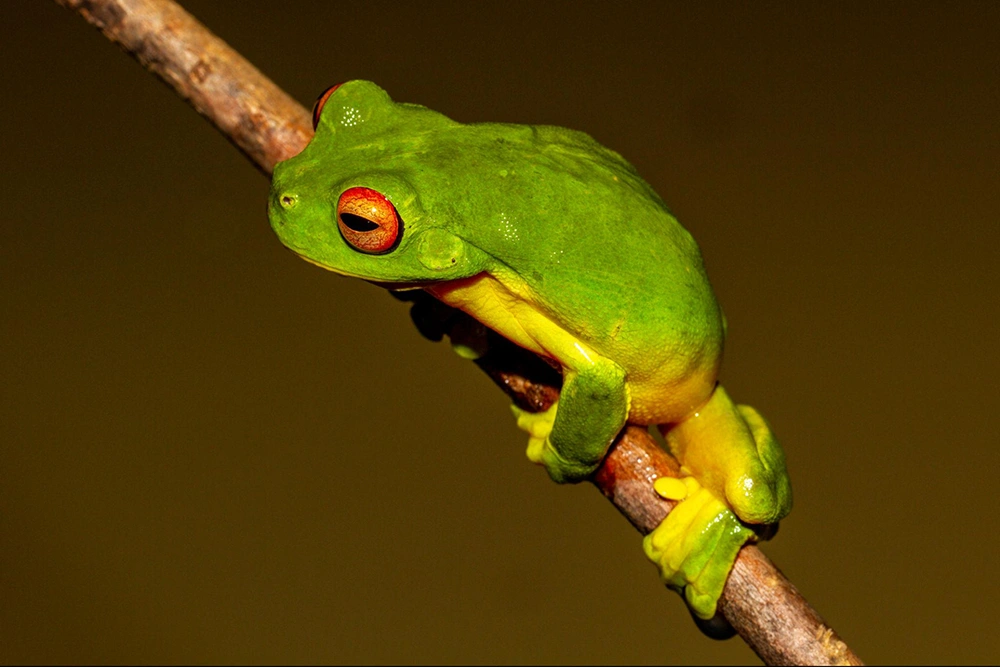
The Red-eyed Tree Frog
Scientific Name: Litoria chloris
is a striking Australian tree frog found along the eastern coast of Australia, from northern New South Wales through Queensland and into tropical regions. It is most commonly found in rainforests, wet forests, and forested creeks, where there is plenty of moisture and vegetation. This species usually grows to about 6–7 cm in length and is easily recognised by its bright green body, vivid red eyes, and yellow or bluish colouring on the sides and thighs. The frog also has large toe pads that allow it to climb and cling to leaves and branches in its forest habitat.
The Red-eyed Tree Frog is nocturnal, spending the day resting on leaves and becoming active at night to hunt insects and other small invertebrates. During the breeding season, which usually occurs after warm rains, males call from vegetation near streams, ponds, and rainforest pools with a repeated “crawk-crawk” call to attract females. Eggs are laid in water or on vegetation near water, where the tadpoles develop before transforming into frogs. The species is generally common within suitable habitat, although it relies on healthy forest and wetland environments to thrive.
Australia’s native amphibians are a seriously fascinating bunch — and almost all of them are frogs, as we don’t have native salamanders or newts on the continent. With more than 240 species recorded, Australian frogs have evolved in isolation for millions of years, resulting in an incredible variety of colours, sizes and behaviours. From tiny species no bigger than a fingernail to large, robust tree frogs, they occupy an astonishing range of habitats across the country.
What makes them truly remarkable is their ability to survive in some of the harshest and most diverse environments on Earth. You’ll find frogs living in alpine snowfields, tropical rainforests, coastal wetlands and even the arid red deserts of the interior. Some burrow underground for months waiting for rain, while others cling to rainforest leaves or suburban water tanks. Their adaptability and unique life cycles make them one of Australia’s most extraordinary — and often overlooked — groups of native wildlife.
This stylistic image blends elements from multiple themes into one cohesive visual scene.
Crucifix Frog
Scientific name: Notaden bennettii
The Crucifix Frog is a small, round-bodied burrowing frog found across inland eastern Australia. It gets its name from the distinctive dark, cross-shaped marking on its back — a pattern that makes it instantly recognisable.
Stocky and almost ball-shaped, this frog has smooth skin, short limbs and a pale yellow to olive body colour with that bold dark “crucifix” marking. Unlike tree frogs or stream frogs, it lives in dry, arid and semi-arid environments. Most of the time, it stays underground, buried in soil to avoid heat and drought.
When heavy rains arrive, the Crucifix Frog emerges to breed in temporary pools. These explosive breeding events can happen rapidly after storms, with males calling from shallow water. The tadpoles develop quickly before the pools dry out again.
One of its more fascinating traits? When threatened, it secretes a sticky substance from its skin that can gum up the mouthparts of predators — a pretty effective defence for such a small amphibian.
Quiet, underground most of the year, then suddenly everywhere after rain — the Crucifix Frog is perfectly adapted to Australia’s boom-and-bust climate.
Corroboree Frog
Scientific name: Pseudophryne corroboree (Southern Corroboree Frog)
Related species: Pseudophryne pengilleyi (Northern Corroboree Frog)
The Corroboree Frog is one of Australia’s most striking and endangered amphibians. Instantly recognisable by its bold black-and-bright-yellow stripes, this tiny frog grows to only about 2.5–3 cm long — but visually, it makes a huge impression.
It lives in alpine and subalpine regions of the Snowy Mountains in New South Wales and the Australian Capital Territory. Unlike many frogs, Corroboree Frogs don’t lay their eggs directly in water. Instead, females lay eggs in moist moss or leaf litter near temporary pools. When seasonal rains arrive, the tadpoles are washed into the pools to continue developing.
Here’s something unusual: the Corroboree Frog is one of the few vertebrates that can produce its own toxic alkaloid compounds (rather than obtaining toxins from its diet). Those bright stripes act as a warning to predators — basically nature’s “do not eat” sign.
Sadly, the species has suffered massive declines due to habitat loss, climate change and the chytrid fungus disease, which has devastated frog populations worldwide. Intensive conservation programs, captive breeding and reintroduction efforts are ongoing to prevent extinction.
Small, bold and critically endangered — the Corroboree Frog has become a symbol of amphibian conservation in Australia.
Australian Green Tree Frog
Scientific name: Litoria caerulea
The Australian Green Tree Frog — often called the White’s Tree Frog — is one of Australia’s most recognisable and much-loved amphibians 🐸. With its smooth, bright green skin, soft pale belly and big golden eyes, it has that permanently relaxed, slightly smiling look that makes it famous.
It’s found across northern and eastern Australia, especially in tropical and subtropical regions. True to its name, it lives in trees near water — but it’s also incredibly adaptable and often turns up around houses, bathrooms, rainwater tanks and garden lights where insects gather.
Green Tree Frogs are nocturnal hunters, feeding on insects, spiders and sometimes even smaller frogs. They have sticky toe pads for climbing and can grow quite large for a tree frog — up to 10 cm long.
One of their clever survival tricks is producing a waxy coating on their skin. They actually spread this secretion over their body with their legs to reduce water loss in hot conditions. Smart little survivalists.
They’re generally calm and tolerant compared to many frog species, which is why they’ve become popular in captivity (though wild frogs should always be left alone).
Big, bright and full of personality — the Australian Green Tree Frog is basically the laid-back ambassador of Aussie frogs.
Desert Spadefoot Toad
Scientific name: Notaden nichollsi
The Desert Spadefoot Toad is one of Australia’s most fascinating survival specialists 🐸🌵. Found in arid and semi-arid regions of central and western Australia, this chunky little amphibian spends most of its life underground, hidden from the harsh desert sun.
It gets its name from the hard, spade-like structure on its hind feet, which it uses to dig backwards into sandy soil. When conditions are dry — which is most of the time — it can remain buried for months or even years in a state called aestivation, slowing its metabolism to conserve energy and moisture.
After heavy rain, it suddenly emerges in large numbers to breed in temporary pools. Like many desert frogs, it breeds quickly, and its tadpoles develop fast before the water evaporates.
The Desert Spadefoot Toad has a rounded body, smooth skin and earthy colouring — usually browns and olive tones that help it blend into sandy landscapes. When threatened, it can inflate its body to appear larger and may secrete a sticky defensive substance to deter predators.
It’s a perfect example of boom-and-bust adaptation — invisible most of the year, then suddenly active and vocal after rain.
Australian Tusked Frog
Scientific name: Adelotus brevis
The Australian Tusked Frog is one of those “you wouldn’t expect that” species 🐸 — because yes, it actually has tusks.
Found along the east coast of Australia, from northern New South Wales into Queensland, this medium-sized frog lives around dams, swamps, slow-moving creeks and forested wetlands. It’s usually brown, olive or grey with a pale underside — nothing flashy at first glance.
But here’s the twist: males develop two sharp, fang-like projections (odontodes) on their lower jaw during breeding season. These “tusks” aren’t for eating — they’re for fighting. Males use them to wrestle rival males for territory and access to females.
Unlike many frogs that lay eggs in open water, Tusked Frogs build foam nests in burrows or concealed spots near water. When rain or rising water floods the nest site, the tadpoles are washed into the pond to continue developing.
They’re mostly nocturnal and not often seen, but you might hear their distinctive call — a soft “tok” or “unk” sound from vegetation near water.
Plain looking… until you realise it’s one of the only frogs in the world that brings tusks to a breeding fight.
Green and Golden Bell Frog
Scientific name: Litoria aurea
The Green and Golden Bell Frog is one of Australia’s most striking frogs — bright lime green with shimmering gold or bronze markings along its back and legs 🐸✨. Some individuals have bold green patches edged in metallic gold, while others show more olive or bronze tones.
It grows relatively large for a tree frog (up to about 10 cm long) and has long legs built for powerful jumps. Despite being called a tree frog, it actually spends a lot of time on the ground near wetlands, ponds, lagoons and even old quarry sites or urban water bodies.
Found mainly in coastal New South Wales and parts of Victoria, the species has declined significantly due to habitat loss, pollution and the chytrid fungus. It’s now listed as endangered in many areas, and conservation programs are actively working to protect remaining populations.
The “bell” in its name comes from its call — a distinctive, resonant “crawk-crawk-crawk” that can carry across wetlands at night.
Beautiful, bold and unfortunately vulnerable — the Green and Golden Bell Frog has become an important symbol of wetland conservation in Australia.
Fletcher’s Frog
Scientific name: Lechriodus fletcheri
Also known as: Sandpaper Frog
Fletcher’s Frog — better known as the Sandpaper Frog — is a small, stocky frog found along the east coast of Australia, particularly in New South Wales and southern Queensland. Its nickname comes from its rough, slightly abrasive skin texture, which really does feel like fine sandpaper.
Usually brown, grey or olive with darker mottling, it blends beautifully into leaf litter and muddy ground. It’s not flashy — it’s built for camouflage. These frogs favour forested areas, farmland and suburban bushland, especially around temporary ponds and flooded grasslands.
They’re explosive breeders after heavy rain. Males call from shallow water with a short, repetitive “cluck” or “tok” sound. Unlike many frogs, they lay eggs in a floating frothy mass that looks a bit like whipped foam on the water’s surface. As the eggs develop, the foam breaks down and releases the tadpoles into the pond.
Mostly nocturnal and rarely noticed unless you’re listening carefully after rain, the Sandpaper Frog is one of those quiet contributors to Australia’s wetland ecosystems.
Small, rough-skinned and perfectly adapted to muddy puddles after a storm — it’s classic east coast bush frog energy.
The Jervis Bay Tree Frog
Scientific Name: Litoria jervisiensis
is a medium-sized Australian tree frog found along the east coast of Australia, particularly in coastal areas of New South Wales, though its range extends from southern Queensland to eastern Victoria. Despite its name, the species is not limited to Jervis Bay; it was simply first identified there. It is commonly found in coastal wetlands, wallum swamps, lagoons, and sandy dune systems, usually near still or slow-moving water surrounded by vegetation. Adults typically grow to about 5 cm in length and have a brown or grey back with a distinctive dark stripe or pair of bands running along the body, along with a dark line from the snout to the shoulder.
This frog is mostly nocturnal and becomes active around water during cooler, wetter periods when breeding occurs. Males call from reeds or low vegetation with a distinctive three-note “weep-weep-weep” call to attract females. The species has large toe pads for climbing and partially webbed feet for swimming, allowing it to move easily between vegetation and water. Like many Australian frogs it feeds on small insects and other invertebrates, and interestingly individuals can sometimes give off a faint curry-like smell when handled, earning it the nickname “curry frog.”
The Giant Burrowing Frog
Scientific Name: Heleioporus australiacus
is a large, robust frog native to eastern Australia, particularly in coastal and tableland areas of New South Wales and southeastern Queensland. As its name suggests, it spends much of its life underground, living in burrows in sandy or loose soils near forests, heathland, and creek systems. Adults can reach 7–9 cm in length, making them one of the larger burrowing frogs in the region. They typically have a dark brown to grey body with scattered lighter spots, a broad head, and powerful front limbs used for digging.
This species is mainly nocturnal and rarely seen, emerging from its burrow mostly after heavy rain to feed on insects and other small invertebrates. During the breeding season, males call from hidden chambers or burrows near temporary pools and streams, producing a deep, resonant “whoop” or “bonk” call. Eggs are laid in underground nests where the tadpoles develop until heavy rain floods the chamber, washing them into nearby pools where they continue their growth. The Giant Burrowing Frog is considered vulnerable in parts of its range, mainly due to habitat loss, changes to water flow, and disturbance of its specialised breeding sites.
The Red-eyed Tree Frog
Scientific Name: Litoria chloris
is a striking Australian tree frog found along the eastern coast of Australia, from northern New South Wales through Queensland and into tropical regions. It is most commonly found in rainforests, wet forests, and forested creeks, where there is plenty of moisture and vegetation. This species usually grows to about 6–7 cm in length and is easily recognised by its bright green body, vivid red eyes, and yellow or bluish colouring on the sides and thighs. The frog also has large toe pads that allow it to climb and cling to leaves and branches in its forest habitat.
The Red-eyed Tree Frog is nocturnal, spending the day resting on leaves and becoming active at night to hunt insects and other small invertebrates. During the breeding season, which usually occurs after warm rains, males call from vegetation near streams, ponds, and rainforest pools with a repeated “crawk-crawk” call to attract females. Eggs are laid in water or on vegetation near water, where the tadpoles develop before transforming into frogs. The species is generally common within suitable habitat, although it relies on healthy forest and wetland environments to thrive.
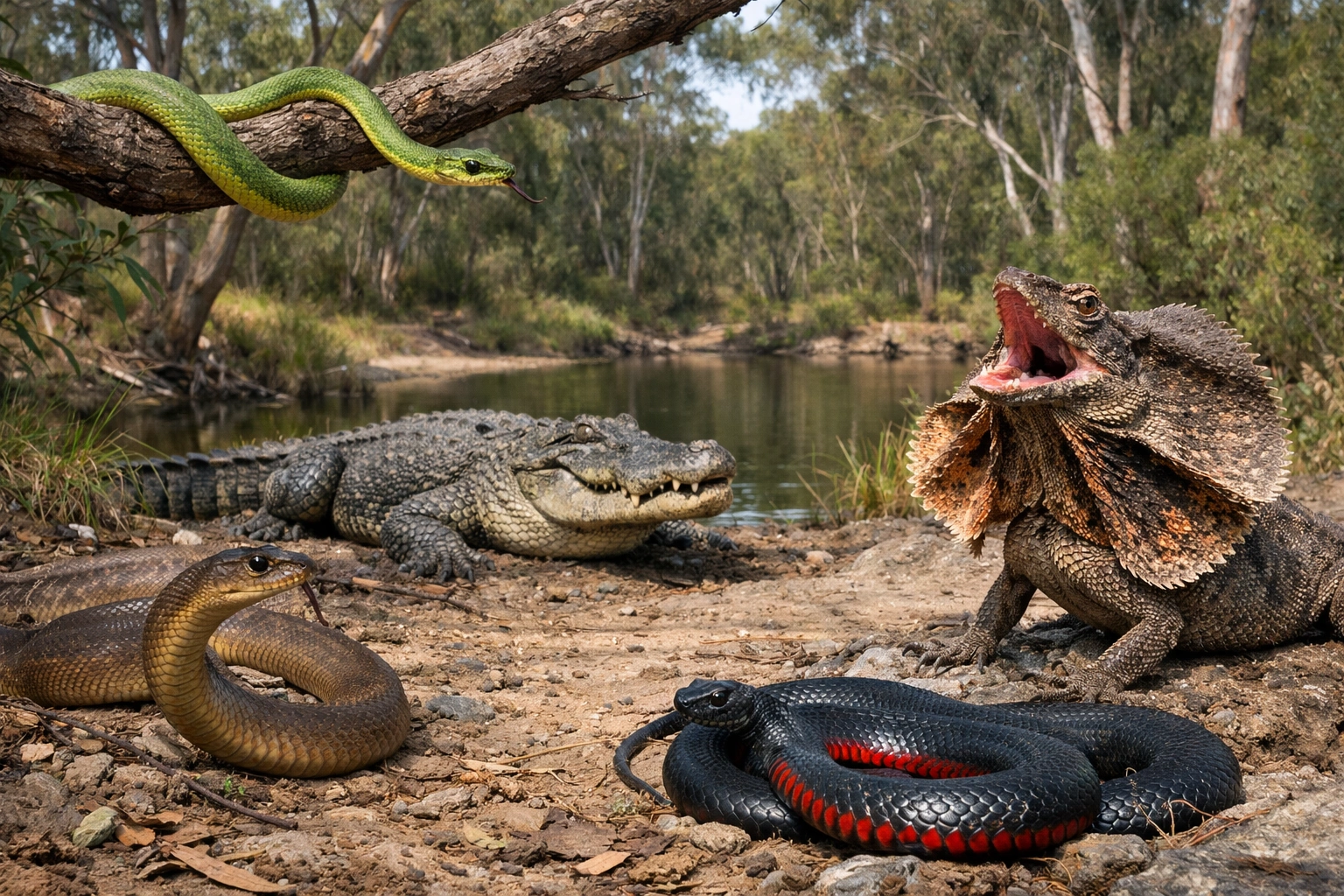
Our Reptiles
Australia is home to over 1,000 reptile species — from crocodiles and sea turtles to desert dragons and highly venomous snakes — found across nearly every environment and vital to maintaining balanced ecosystems.
Australian reptiles are some of the most diverse and fascinating in the world, thriving in everything from tropical rainforests to harsh desert landscapes. The country is especially famous for its snakes and lizards, including species like the eastern brown snake, inland taipan and red-bellied black snake. While several of Australia’s snakes are highly venomous, they are generally shy and avoid human contact. Lizards are just as impressive — from large goannas (monitor lizards) to the iconic blue-tongue skink and the frilled-neck lizard with its dramatic display.
Australia is also home to ancient reptile lineages, including saltwater crocodiles in the tropical north — the largest living reptiles on Earth — and freshwater crocodiles in inland river systems. Turtles inhabit both coastal waters and freshwater rivers, while small geckos and skinks are found across suburbs and bushland alike. Adapted to extreme heat and dry conditions, Australian reptiles are a major part of the country’s ecosystems and reflect its rugged, sun-baked environment.
This stylistic image blends elements from multiple themes into one cohesive visual scene.
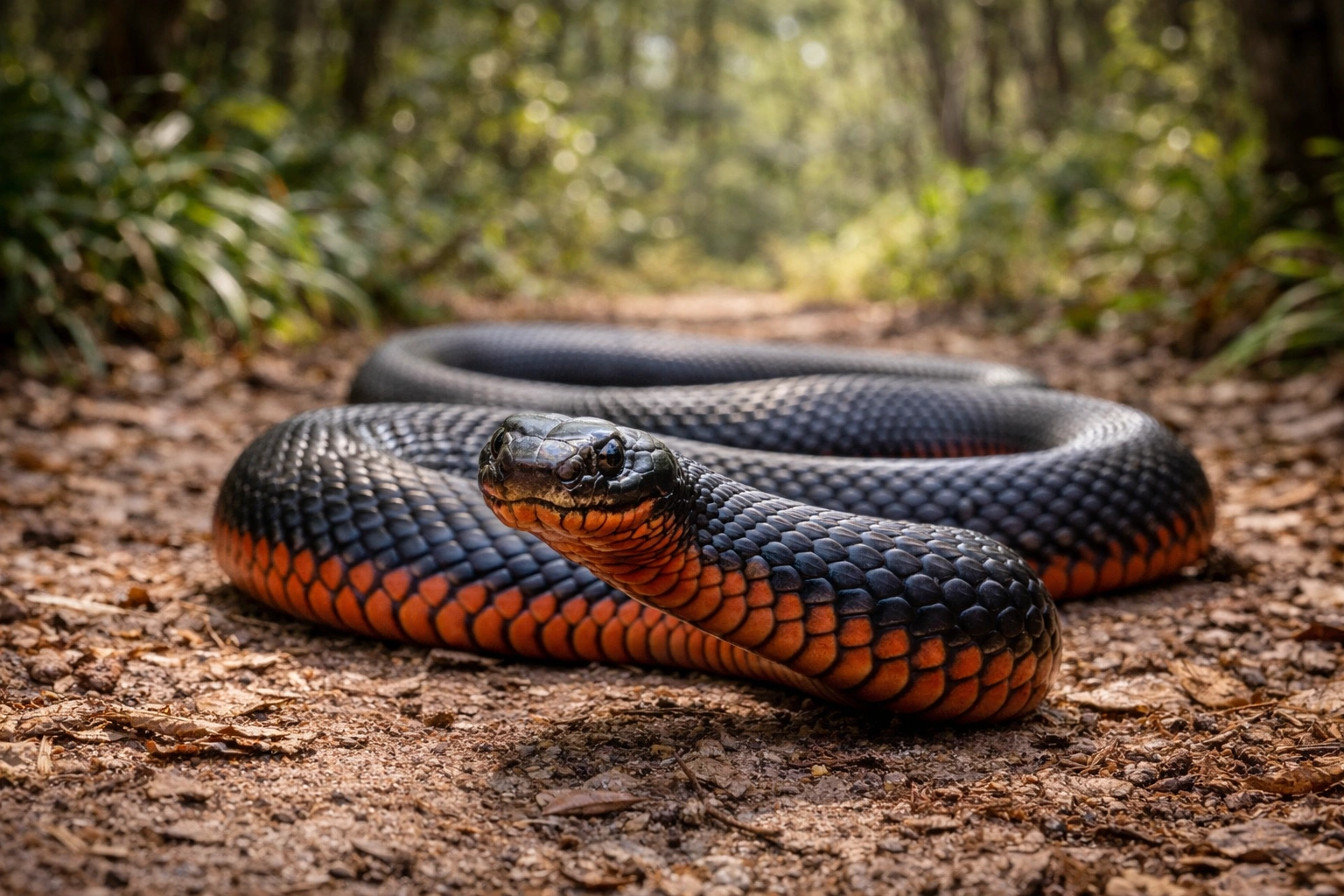
Red-Bellied Black Snake
Scientific name: Pseudechis porphyriacus
is one of Australia’s most recognisable snakes. It has a glossy black upper body contrasted with a vivid red or pink belly and flanks, giving it a striking and unmistakable appearance. This species is commonly found along Australia’s east coast, particularly near waterways in Queensland, New South Wales, and Victoria. Bushwalkers exploring creeks, wetlands, or damp bushland are quite likely to encounter one.
Although the Red-Bellied Black Snake is venomous, it is generally considered less dangerous than the Pseudonaja textilis (Eastern Brown Snake), which is responsible for more severe envenomations. Bites from a Red-Bellied Black Snake can cause pain and swelling at the site, along with symptoms such as nausea, headache, and muscle weakness. Serious cases can occur, but fatalities are extremely rare with modern medical treatment, and effective antivenom is available.
This species favours moist environments including swamps, creek banks, dams, and wet bushland. It is also a strong swimmer and will often retreat into water if disturbed. Unlike some more defensive snake species, the Red-Bellied Black Snake is generally shy and prefers to escape rather than confront a threat.
If a bite does occur, immediate first aid is essential. Call 000, apply a pressure immobilisation bandage, and keep the person as still as possible until medical assistance arrives.
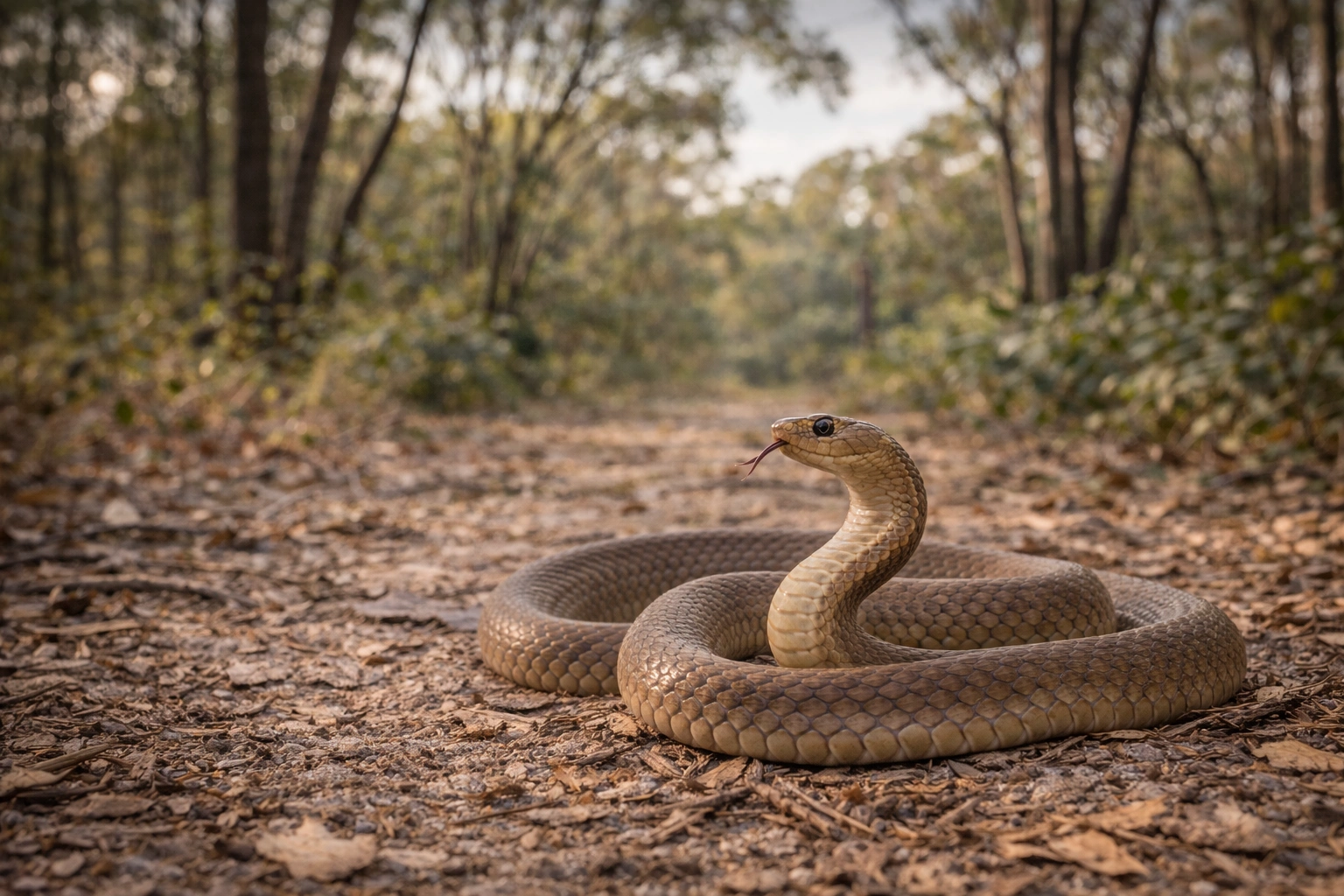
Eastern Brown Snake
Scientific Name: Pseudonaja textile
is one of Australia’s most well-known — and most feared — snakes. It’s considered the second most venomous land snake in the world and is responsible for more snakebite deaths in Australia than any other species. Despite that reputation, it’s not out hunting people; it’s simply highly venomous and widely distributed.
Eastern Browns are found along much of Australia’s east coast and inland regions, including Queensland, New South Wales, Victoria and into South Australia — so they cover a big stretch of the country. They prefer open grasslands, farmland, bushland and even suburban edges, especially where rodents are present, as mice are a favourite food source. They’re fast, alert snakes and may raise the front of their body into an S-shaped defensive posture if threatened.
Their venom contains powerful neurotoxins and blood-clotting agents that can cause paralysis, internal bleeding and even cardiac collapse. One of the dangers is that the bite may not be very painful at first, which can delay treatment. However, Australia has highly effective antivenom and strong emergency response systems, and survival rates are very high when medical care is received quickly.
If a bite occurs, call 000 immediately, apply a pressure immobilisation bandage, keep the person still and seek urgent medical attention. Do not wash, cut or attempt to suck the wound. Most bites happen when someone accidentally steps on a snake or tries to handle it — if left alone, an Eastern Brown will usually move away quickly.
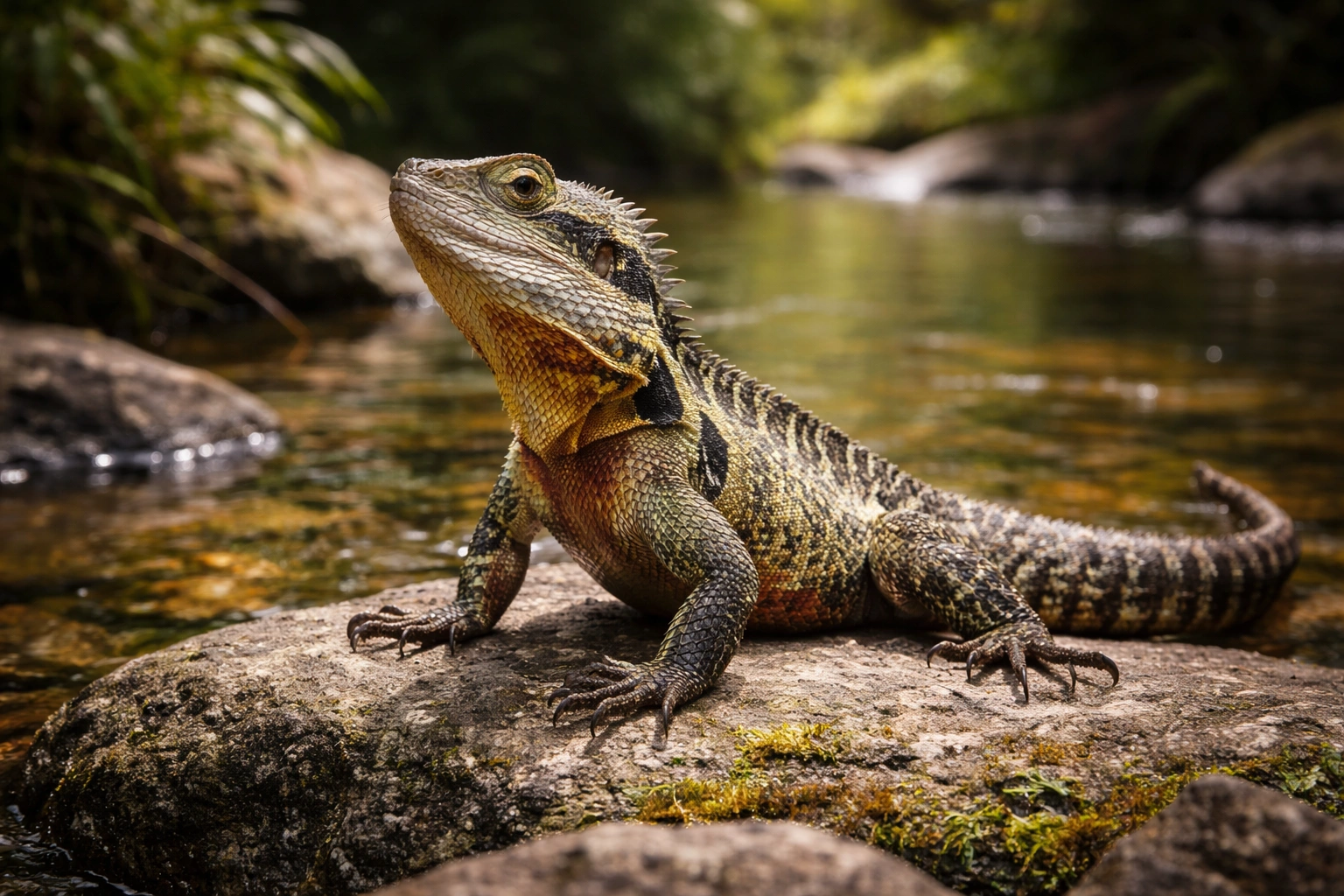
Australian Water Dragon
Scientific name: Intellagama lesueurii
The Australian Water Dragon is a large, semi-aquatic lizard commonly seen along eastern Australia, especially near rivers, creeks and suburban parklands. With its long muscular tail, powerful legs and sharp claws, it’s built for both climbing and swimming.
They have striking features — a row of spines running from the back of the head down the spine, strong limbs, and a long tail that can make up more than half their body length. Males are larger than females and often show bold markings with dark bands, yellowish underbellies and hints of red on the chest during breeding season.
As their name suggests, they’re excellent swimmers. When startled, they’ll bolt toward water and can stay submerged for up to 90 minutes to avoid predators. On land, you’ll often see them basking on rocks, logs or garden edges, soaking up the sun.
Their diet is varied — insects, small frogs, fish, flowers and fruit. In urban areas, they’ve adapted well to human presence, often becoming surprisingly tolerant of people in parks and backyards.
Big, prehistoric-looking and completely at home by the water — they’re one of Australia’s most impressive backyard reptiles.
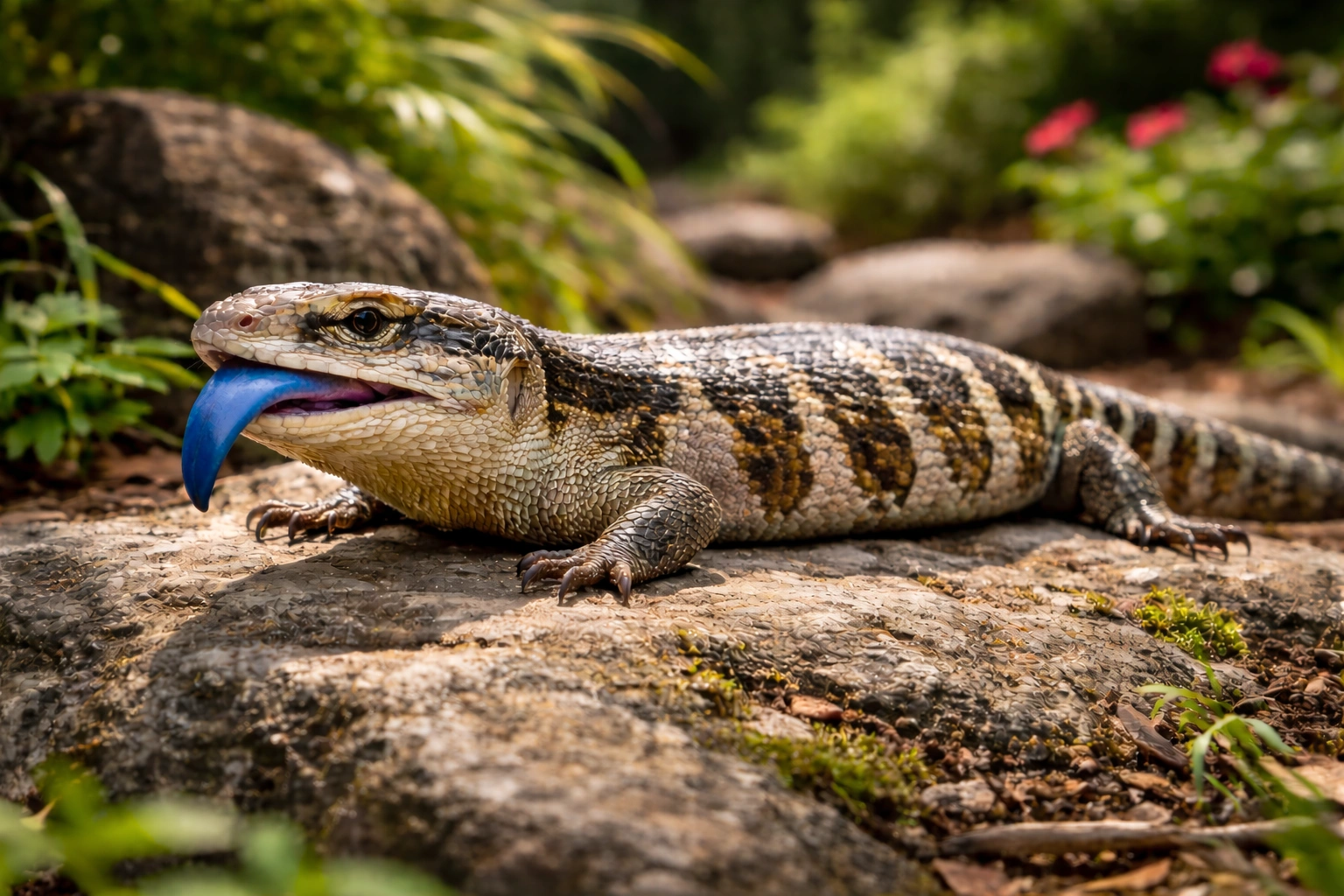
Australian Blue-tongue Lizard
Scientific name: Tiliqua scincoides
The Australian Blue-tongue Lizard (often called a blue-tongue skink) is a chunky, slow-moving reptile famous for its bright cobalt-blue tongue — which it flashes as a warning display when threatened. It has a broad triangular head, smooth overlapping scales and a thick, sausage-like body with dark bands across a pale grey, brown or sandy background.
Found across much of Australia, especially in eastern and southern regions, they thrive in woodlands, grasslands and suburban gardens. They’re surprisingly tolerant of people and are often welcomed by gardeners because they eat snails, slugs and insects. Their diet also includes flowers, berries and small invertebrates.
When startled, instead of sprinting away immediately, they’ll open their mouth wide, stick out that vivid blue tongue and hiss — a bluff that often convinces predators to back off. Despite their tough look, they’re generally calm and non-aggressive.
They give birth to live young rather than laying eggs, which is unusual among reptiles.
Solid, prehistoric-looking and surprisingly useful in the backyard — the blue-tongue is one of Australia’s most recognisable reptiles.
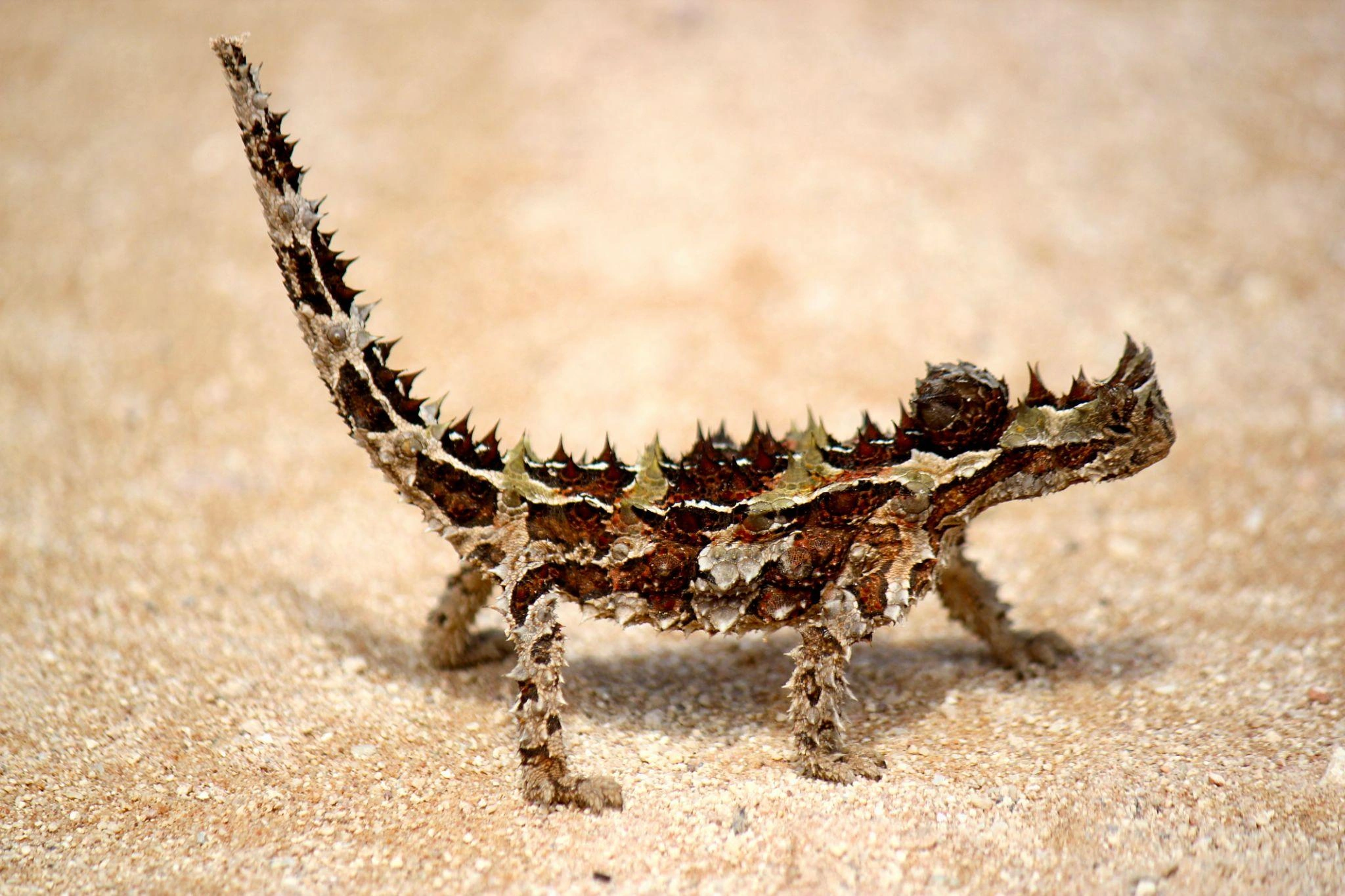
Thorny Devil
Scientific Name: Moloch horridus
is one of Australia’s most distinctive reptiles, found in the arid deserts and sandy regions of central and western Australia. This small lizard usually grows to about 20 centimetres in length and is covered in sharp spines that help protect it from predators. Its body colour ranges from brown to reddish or yellowish tones, allowing it to blend perfectly with desert sand and scrub. The thorny devil also has a unique false “head” on the back of its neck, which it can present to predators while protecting its real head.
One of the most remarkable features of the thorny devil is its ability to collect water through tiny channels between the scales on its skin. These channels draw moisture from rain, dew, or damp sand and transport it to the lizard’s mouth. Thorny devils feed almost exclusively on ants, sometimes eating thousands in a single day as they slowly move through the desert. Despite their fierce appearance, they are gentle, slow-moving reptiles that rely heavily on camouflage and their spiny armour to survive in Australia’s harsh desert environment.
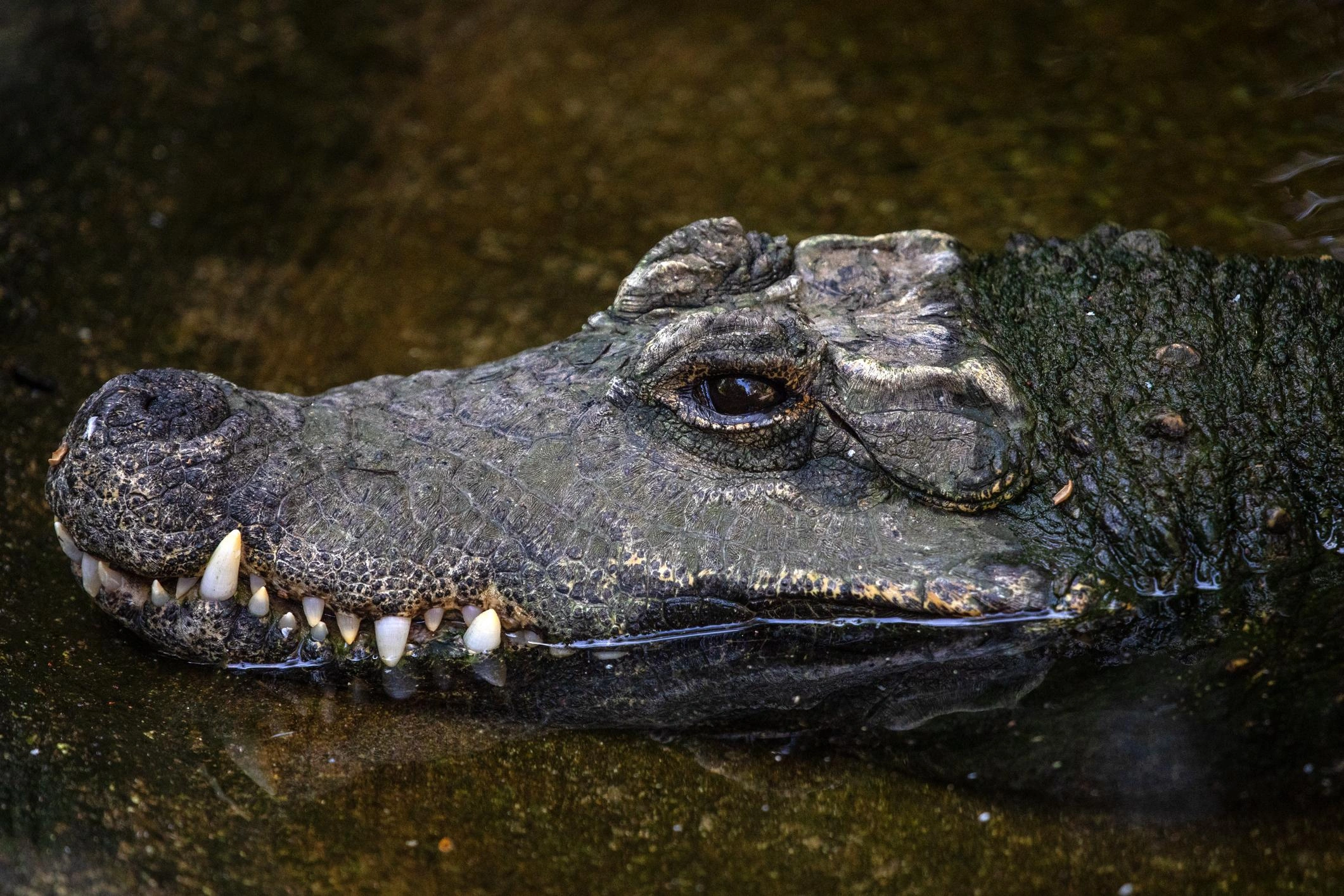
Saltwater Crocodile
Scientific Name: Crocodylus porosus
often called the “saltie,” is the largest living reptile in the world. It is found across northern Australia, as well as parts of Southeast Asia and the western Pacific. Adult males can grow over 6 metres long and weigh more than 1,000 kilograms, although most are smaller. These powerful predators inhabit rivers, estuaries, coastal wetlands, and mangrove swamps, and they are capable of travelling long distances through the ocean, which is why they are called saltwater crocodiles.
Saltwater crocodiles are ambush predators that feed on a wide variety of animals, including fish, birds, turtles, and mammals. They often lie almost completely submerged with only their eyes and nostrils visible before launching a sudden attack with incredible speed and strength. Despite their fearsome reputation, they are an important part of northern Australia’s ecosystems. Female crocodiles build large nests of vegetation and mud near waterways where they lay their eggs, and the mother guards the nest until the hatchlings emerge. Today the species is protected in Australia, and populations have recovered after heavy hunting in the early 20th century.
Australian reptiles are some of the most diverse and fascinating in the world, thriving in everything from tropical rainforests to harsh desert landscapes. The country is especially famous for its snakes and lizards, including species like the eastern brown snake, inland taipan and red-bellied black snake. While several of Australia’s snakes are highly venomous, they are generally shy and avoid human contact. Lizards are just as impressive — from large goannas (monitor lizards) to the iconic blue-tongue skink and the frilled-neck lizard with its dramatic display.
Australia is also home to ancient reptile lineages, including saltwater crocodiles in the tropical north — the largest living reptiles on Earth — and freshwater crocodiles in inland river systems. Turtles inhabit both coastal waters and freshwater rivers, while small geckos and skinks are found across suburbs and bushland alike. Adapted to extreme heat and dry conditions, Australian reptiles are a major part of the country’s ecosystems and reflect its rugged, sun-baked environment.
This stylistic image blends elements from multiple themes into one cohesive visual scene.
Red-Bellied Black Snake
Scientific name: Pseudechis porphyriacus
is one of Australia’s most recognisable snakes. It has a glossy black upper body contrasted with a vivid red or pink belly and flanks, giving it a striking and unmistakable appearance. This species is commonly found along Australia’s east coast, particularly near waterways in Queensland, New South Wales, and Victoria. Bushwalkers exploring creeks, wetlands, or damp bushland are quite likely to encounter one.
Although the Red-Bellied Black Snake is venomous, it is generally considered less dangerous than the Pseudonaja textilis (Eastern Brown Snake), which is responsible for more severe envenomations. Bites from a Red-Bellied Black Snake can cause pain and swelling at the site, along with symptoms such as nausea, headache, and muscle weakness. Serious cases can occur, but fatalities are extremely rare with modern medical treatment, and effective antivenom is available.
This species favours moist environments including swamps, creek banks, dams, and wet bushland. It is also a strong swimmer and will often retreat into water if disturbed. Unlike some more defensive snake species, the Red-Bellied Black Snake is generally shy and prefers to escape rather than confront a threat.
If a bite does occur, immediate first aid is essential. Call 000, apply a pressure immobilisation bandage, and keep the person as still as possible until medical assistance arrives.
Eastern Brown Snake
Scientific Name: Pseudonaja textile
is one of Australia’s most well-known — and most feared — snakes. It’s considered the second most venomous land snake in the world and is responsible for more snakebite deaths in Australia than any other species. Despite that reputation, it’s not out hunting people; it’s simply highly venomous and widely distributed.
Eastern Browns are found along much of Australia’s east coast and inland regions, including Queensland, New South Wales, Victoria and into South Australia — so they cover a big stretch of the country. They prefer open grasslands, farmland, bushland and even suburban edges, especially where rodents are present, as mice are a favourite food source. They’re fast, alert snakes and may raise the front of their body into an S-shaped defensive posture if threatened.
Their venom contains powerful neurotoxins and blood-clotting agents that can cause paralysis, internal bleeding and even cardiac collapse. One of the dangers is that the bite may not be very painful at first, which can delay treatment. However, Australia has highly effective antivenom and strong emergency response systems, and survival rates are very high when medical care is received quickly.
If a bite occurs, call 000 immediately, apply a pressure immobilisation bandage, keep the person still and seek urgent medical attention. Do not wash, cut or attempt to suck the wound. Most bites happen when someone accidentally steps on a snake or tries to handle it — if left alone, an Eastern Brown will usually move away quickly.
Australian Water Dragon
Scientific name: Intellagama lesueurii
The Australian Water Dragon is a large, semi-aquatic lizard commonly seen along eastern Australia, especially near rivers, creeks and suburban parklands. With its long muscular tail, powerful legs and sharp claws, it’s built for both climbing and swimming.
They have striking features — a row of spines running from the back of the head down the spine, strong limbs, and a long tail that can make up more than half their body length. Males are larger than females and often show bold markings with dark bands, yellowish underbellies and hints of red on the chest during breeding season.
As their name suggests, they’re excellent swimmers. When startled, they’ll bolt toward water and can stay submerged for up to 90 minutes to avoid predators. On land, you’ll often see them basking on rocks, logs or garden edges, soaking up the sun.
Their diet is varied — insects, small frogs, fish, flowers and fruit. In urban areas, they’ve adapted well to human presence, often becoming surprisingly tolerant of people in parks and backyards.
Big, prehistoric-looking and completely at home by the water — they’re one of Australia’s most impressive backyard reptiles.
Australian Blue-tongue Lizard
Scientific name: Tiliqua scincoides
The Australian Blue-tongue Lizard (often called a blue-tongue skink) is a chunky, slow-moving reptile famous for its bright cobalt-blue tongue — which it flashes as a warning display when threatened. It has a broad triangular head, smooth overlapping scales and a thick, sausage-like body with dark bands across a pale grey, brown or sandy background.
Found across much of Australia, especially in eastern and southern regions, they thrive in woodlands, grasslands and suburban gardens. They’re surprisingly tolerant of people and are often welcomed by gardeners because they eat snails, slugs and insects. Their diet also includes flowers, berries and small invertebrates.
When startled, instead of sprinting away immediately, they’ll open their mouth wide, stick out that vivid blue tongue and hiss — a bluff that often convinces predators to back off. Despite their tough look, they’re generally calm and non-aggressive.
They give birth to live young rather than laying eggs, which is unusual among reptiles.
Solid, prehistoric-looking and surprisingly useful in the backyard — the blue-tongue is one of Australia’s most recognisable reptiles.
Thorny Devil
Scientific Name: Moloch horridus
is one of Australia’s most distinctive reptiles, found in the arid deserts and sandy regions of central and western Australia. This small lizard usually grows to about 20 centimetres in length and is covered in sharp spines that help protect it from predators. Its body colour ranges from brown to reddish or yellowish tones, allowing it to blend perfectly with desert sand and scrub. The thorny devil also has a unique false “head” on the back of its neck, which it can present to predators while protecting its real head.
One of the most remarkable features of the thorny devil is its ability to collect water through tiny channels between the scales on its skin. These channels draw moisture from rain, dew, or damp sand and transport it to the lizard’s mouth. Thorny devils feed almost exclusively on ants, sometimes eating thousands in a single day as they slowly move through the desert. Despite their fierce appearance, they are gentle, slow-moving reptiles that rely heavily on camouflage and their spiny armour to survive in Australia’s harsh desert environment.
Saltwater Crocodile
Scientific Name: Crocodylus porosus
often called the “saltie,” is the largest living reptile in the world. It is found across northern Australia, as well as parts of Southeast Asia and the western Pacific. Adult males can grow over 6 metres long and weigh more than 1,000 kilograms, although most are smaller. These powerful predators inhabit rivers, estuaries, coastal wetlands, and mangrove swamps, and they are capable of travelling long distances through the ocean, which is why they are called saltwater crocodiles.
Saltwater crocodiles are ambush predators that feed on a wide variety of animals, including fish, birds, turtles, and mammals. They often lie almost completely submerged with only their eyes and nostrils visible before launching a sudden attack with incredible speed and strength. Despite their fearsome reputation, they are an important part of northern Australia’s ecosystems. Female crocodiles build large nests of vegetation and mud near waterways where they lay their eggs, and the mother guards the nest until the hatchlings emerge. Today the species is protected in Australia, and populations have recovered after heavy hunting in the early 20th century.
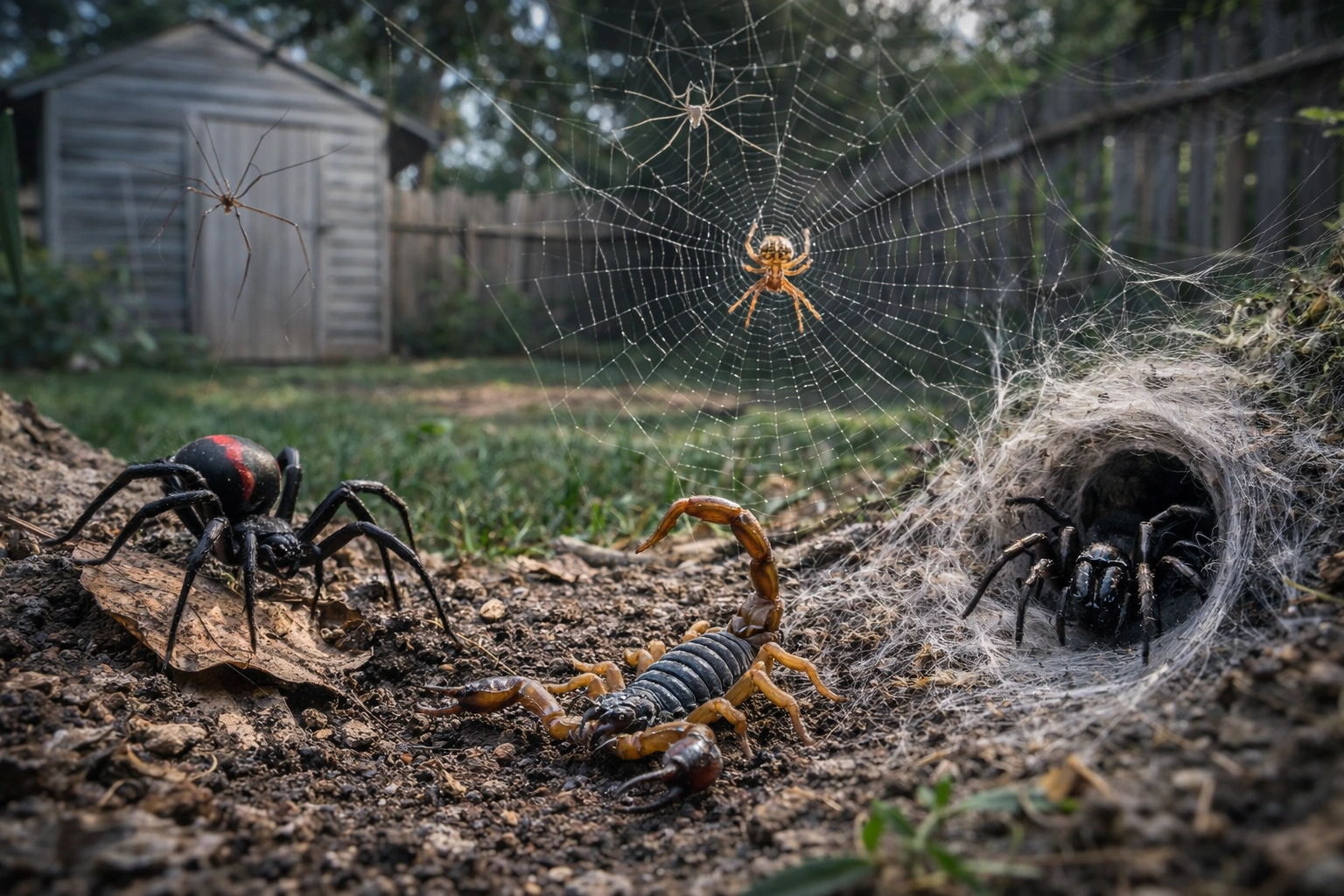
Our Arachnids
Australia’s arachnids — including spiders, scorpions, ticks and mites — number in the hundreds of species, and while some like the Sydney funnel-web and redback spider are highly venomous, most are harmless and play an important role in controlling insect populations.
Australian arachnids have a bit of a reputation — and yes, some of them deserve it. From spiders to scorpions, Australia is home to a wide variety of species adapted to deserts, forests and coastal regions. The most famous (or infamous) include the Sydney funnel-web spider, redback spider and mouse spider, all of which are venomous. Despite their fearsome image, serious incidents are rare thanks to modern antivenom and medical care.
Beyond the headline species, Australia also has many harmless and fascinating arachnids. Huntsman spiders, for example, are large but generally non-aggressive and help control insect populations. In the outback, you’ll find trapdoor spiders that build camouflaged burrows, and small desert scorpions that glow under ultraviolet light. Like much of Australia’s wildlife, its arachnids are diverse, resilient and perfectly adapted to some of the toughest environments on Earth.
This stylistic image blends elements from multiple themes into one cohesive visual scene.
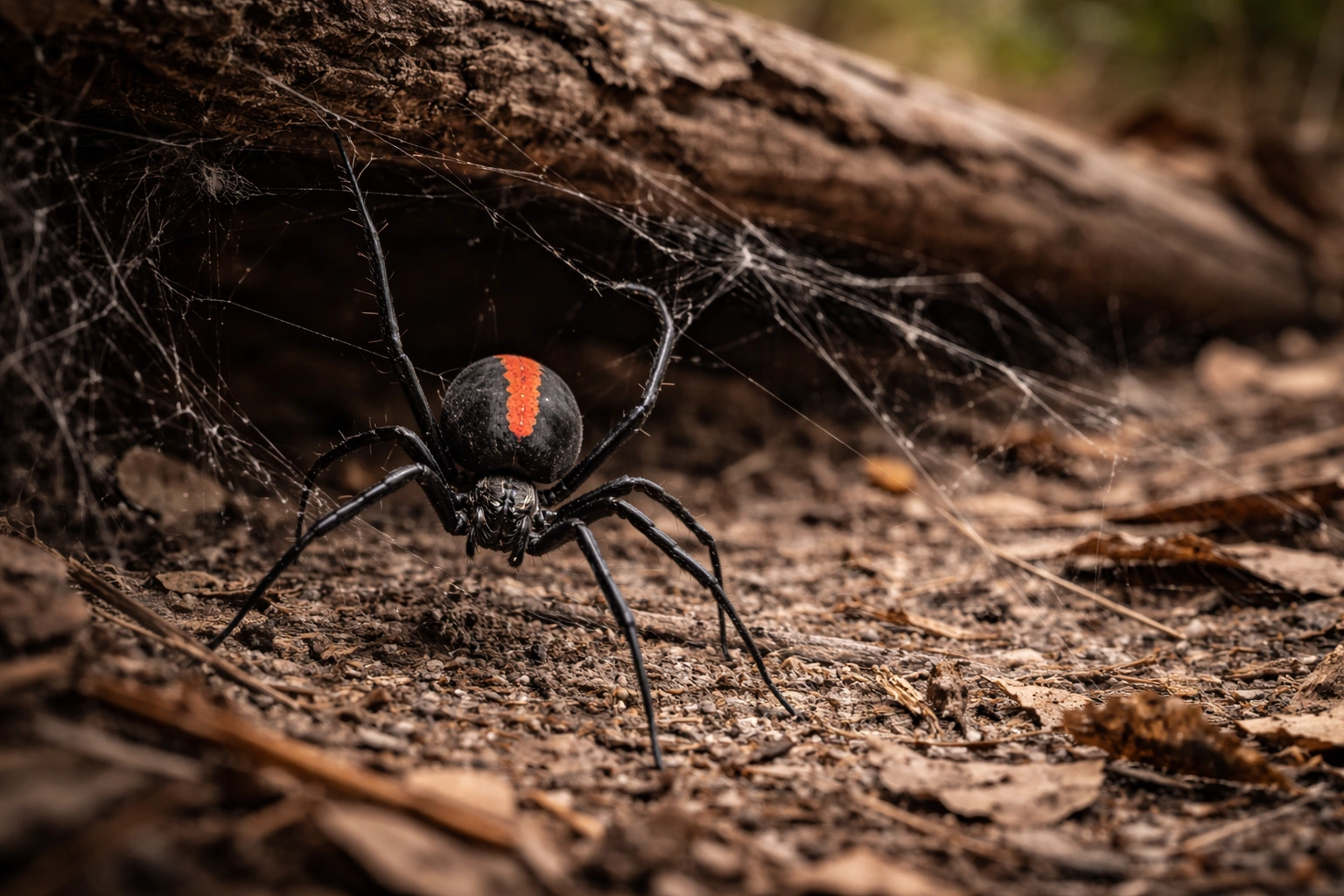
The Redback Spider
Scientific Name: Latrodectus hasselti
is one of Australia’s most familiar spiders and is easily recognised by the female’s glossy black body and distinctive red or orange stripe along her back. Males are much smaller and far less dangerous. As with many spider species, the female is the more prominent and medically significant of the two.
Redbacks are venomous, and their bites can cause intense local pain along with symptoms such as sweating, nausea, muscle weakness, and pain that may spread from the bite site. Before antivenom became available in 1956, there were recorded fatalities, but there have been no confirmed deaths in decades due to effective medical treatment. Unlike funnel-web spider bites, redback bites do not require a pressure immobilisation bandage. Recommended first aid includes washing the area, applying ice for pain relief, and seeking medical advice, particularly for children or elderly individuals.
Redbacks commonly inhabit sheltered, dry locations around homes and gardens, including sheds, under outdoor furniture, inside letterboxes, around playground equipment, and occasionally in outdoor toilets. Their webs are irregular, messy tangles rather than the neat, circular designs produced by orb-weaver spiders.
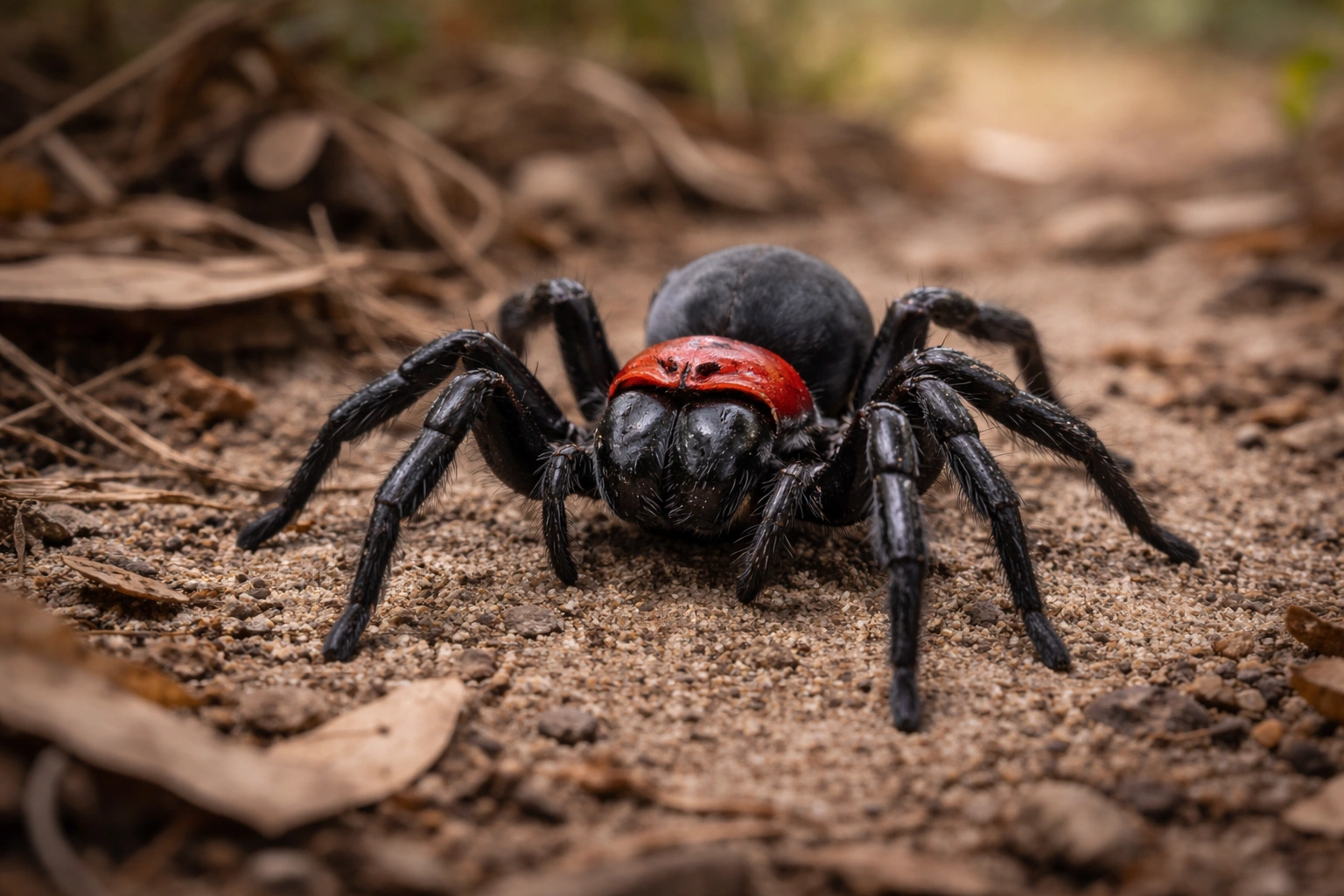
Red-headed Mouse Spider
Scientific name: Missulena occatoria
The mouse spider, belonging to the genus Missulena, is found across much of Australia. Despite its name, it does not resemble a mouse — early European settlers simply thought its burrows looked like mouse holes. These spiders are solid, glossy, and powerfully built, with strong downward-pointing fangs similar to those of funnel-web spiders. Some males are particularly striking in appearance, especially the red-headed mouse spider (Missulena occatoria), which features bright red jaws and a dark blue or black body.
Mouse spiders are venomous and closely related to funnel-web spiders, and while their venom is considered potentially serious, confirmed severe bites are rare. Funnel-web antivenom has been successfully used to treat mouse spider bites due to similarities in their toxins. They typically inhabit dry open forests, shrubland, and suburban gardens, living in silk-lined burrows often fitted with a small trapdoor-like entrance. Males tend to wander during the day, particularly after rain, which is when they are most commonly seen. If a bite is suspected, a pressure immobilisation bandage should be applied and urgent medical assistance sought.
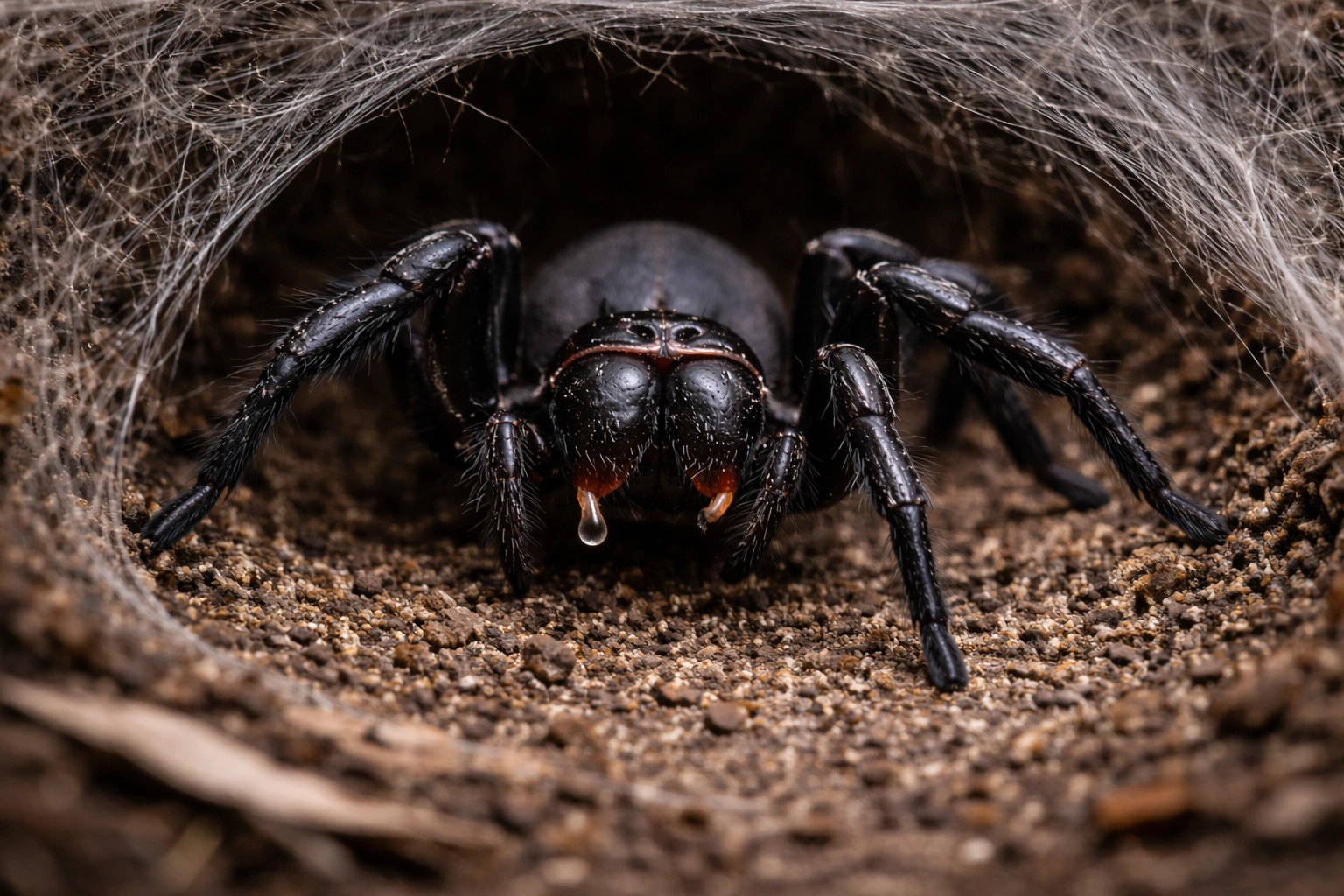
Sydney Funnel-Web Spider
Scientific name: Atrax robustus
is one of Australia’s most well-known and feared spiders. It is found primarily in and around Sydney and the surrounding parts of NSW. These spiders are glossy black to dark brown, solidly built, and can reach around five centimetres in body length. They possess large, powerful fangs that point straight downward, allowing them to deliver deep bites. Their venom is highly toxic to humans, which is why they have earned such a formidable reputation.
Before the development of antivenom in 1981, funnel-web bites could be fatal. Today, however, effective treatment has meant there have been no recorded deaths since its introduction. The antivenom was developed at the Australian Reptile Park, which continues to operate a venom-milking program. Male funnel-web spiders are considered more dangerous than females and are more likely to wander during warm, humid weather, particularly after rain — increasing the chance of human encounters.
Sydney funnel-web spiders favour cool, moist environments such as under rocks and logs, in garden beds, and sometimes even in suburban backyards. They construct silk-lined burrows with distinctive funnel-shaped entrances. While they are capable of delivering a serious bite, they are not aggressive toward people, and most incidents occur when the spider is accidentally disturbed. If a bite is suspected, the correct response is to remain calm, apply a pressure immobilisation bandage, and call emergency services immediately (000 in Australia).
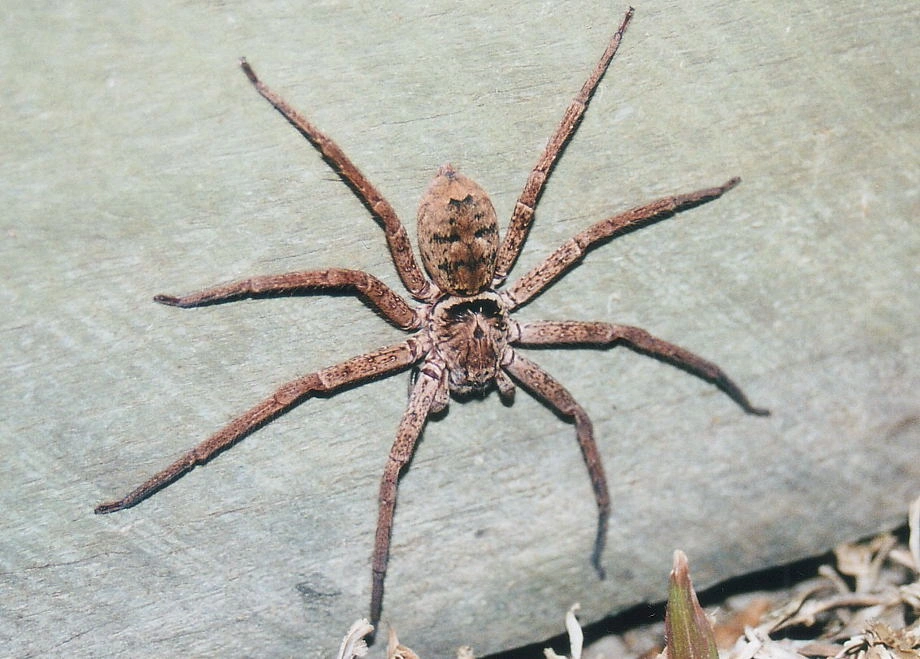
Huntsman Spider
Scientific Name: Heteropoda venatoria
is a large, fast-moving spider commonly found throughout Australia and many other warm regions of the world. Belonging to the family Sparassidae, these spiders are easily recognised by their long legs that extend sideways, giving them a crab-like appearance. Some species can have a leg span of up to 15 centimetres or more, making them one of the largest spiders many Australians encounter. Their bodies are usually brown or grey, helping them blend into tree bark, rocks, and walls where they like to rest.
Despite their intimidating size, huntsman spiders are generally harmless to humans and are actually beneficial because they hunt and eat insects such as cockroaches, moths, and other pests. Unlike many spiders, they do not rely on webs to catch prey. Instead, they actively chase and capture insects, which is how they get their name. Huntsman spiders are often found inside houses, garages, and sheds, especially in warmer weather, but they are typically shy and will quickly run away rather than bite.
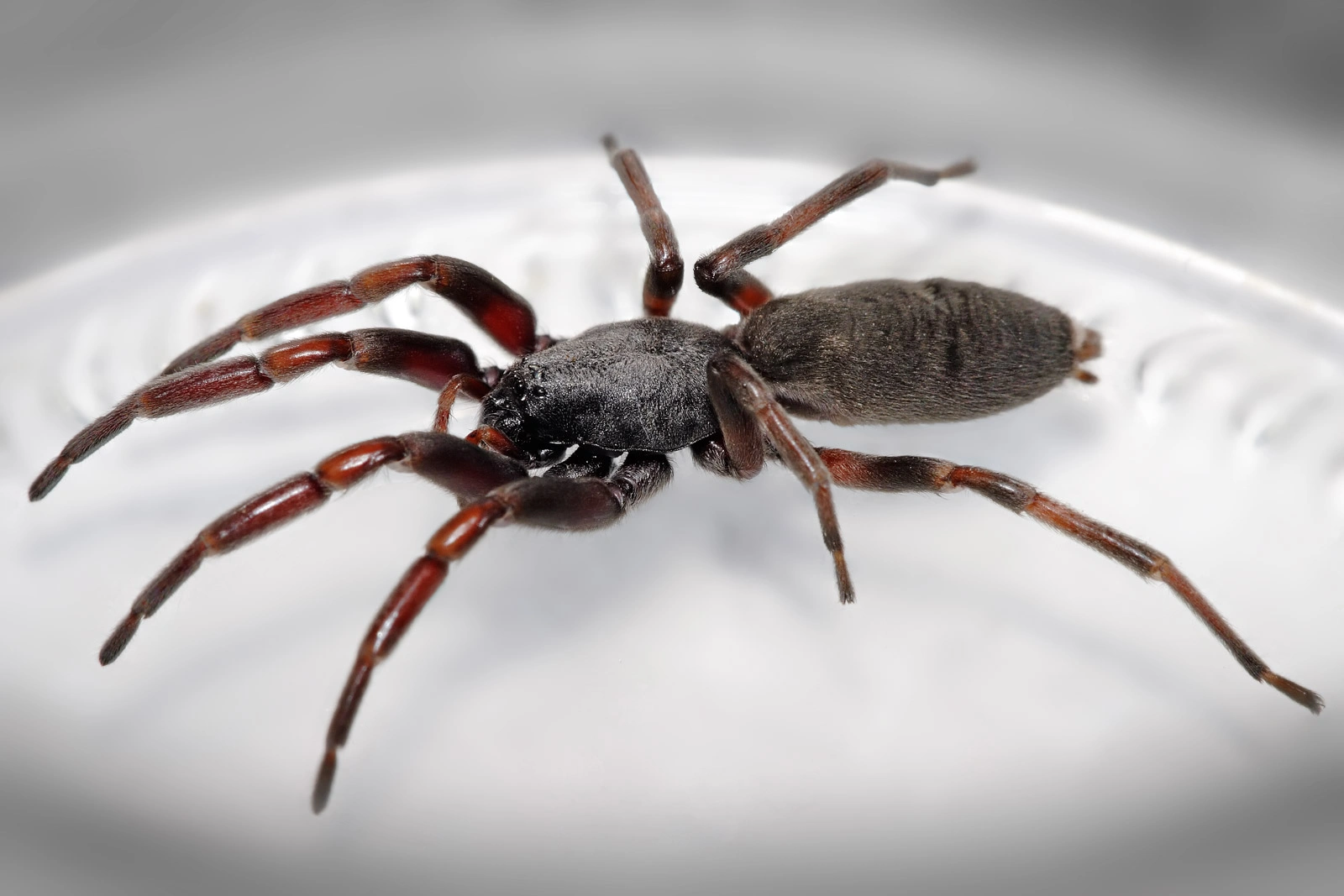
White-tailed Spider refers to two closely related Australian species: (Lampona cylindrata) and (Lampona murina).
These medium-sized hunting spiders are easily recognised by their dark grey or brown cylindrical body and the distinctive white spot on the tip of the abdomen, which gives them their common name. They are commonly found across Australia, including urban areas, and may wander into houses, particularly at night.
White-tailed spiders are active hunters rather than web builders. They roam walls, ceilings, and floors searching for prey, and their favourite food is other spiders, especially black house spiders. Although their bite can be painful and may cause redness or irritation, research has shown that they do not cause severe skin ulceration, a myth that circulated for many years. Like most spiders, they prefer to avoid people and will usually run away rather than bite unless handled or trapped against the skin
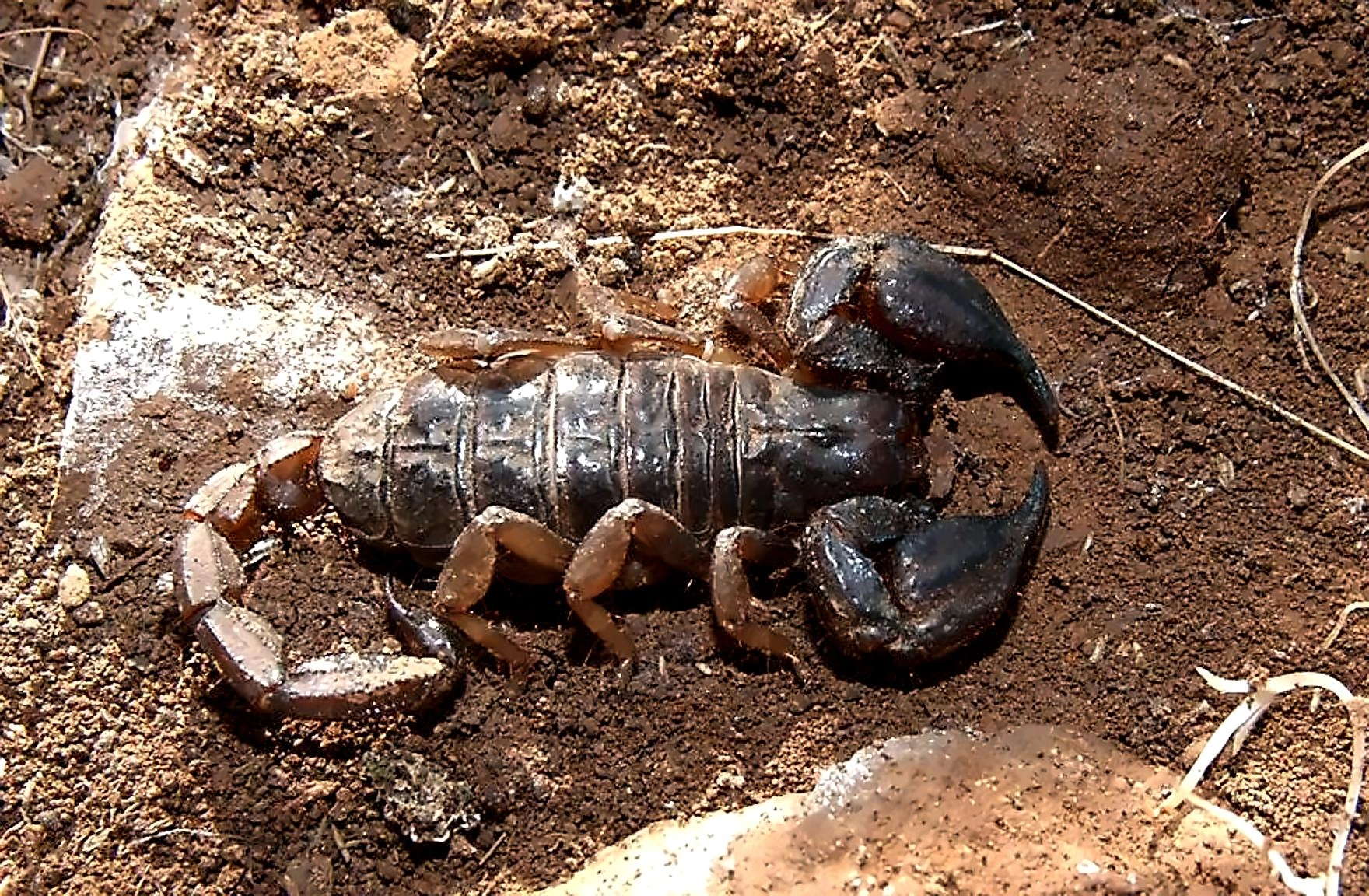
Brown Scorpion
Scientific Name: Urodacus manicatus
is one of the most common scorpion species found across eastern and southern Australia. It typically lives in dry habitats such as forests, grasslands, and scrubland, often sheltering under rocks, logs, or in shallow burrows in the soil. This species is usually light brown to reddish-brown in colour and grows to about 4–6 centimetres in length. Like other scorpions, it has large pincers for grabbing prey and a curved tail tipped with a stinger used for defence and subduing food.
The Brown Scorpion is nocturnal, emerging at night to hunt small insects, spiders, and other invertebrates. During the day it hides in protected places to avoid heat and predators. While it can sting if threatened, the venom is generally mild and comparable to a bee sting for most people, causing pain and swelling but rarely serious reactions. Despite their intimidating appearance, these scorpions play an important role in controlling insect populations and are a normal part of Australia’s natural ecosystems.
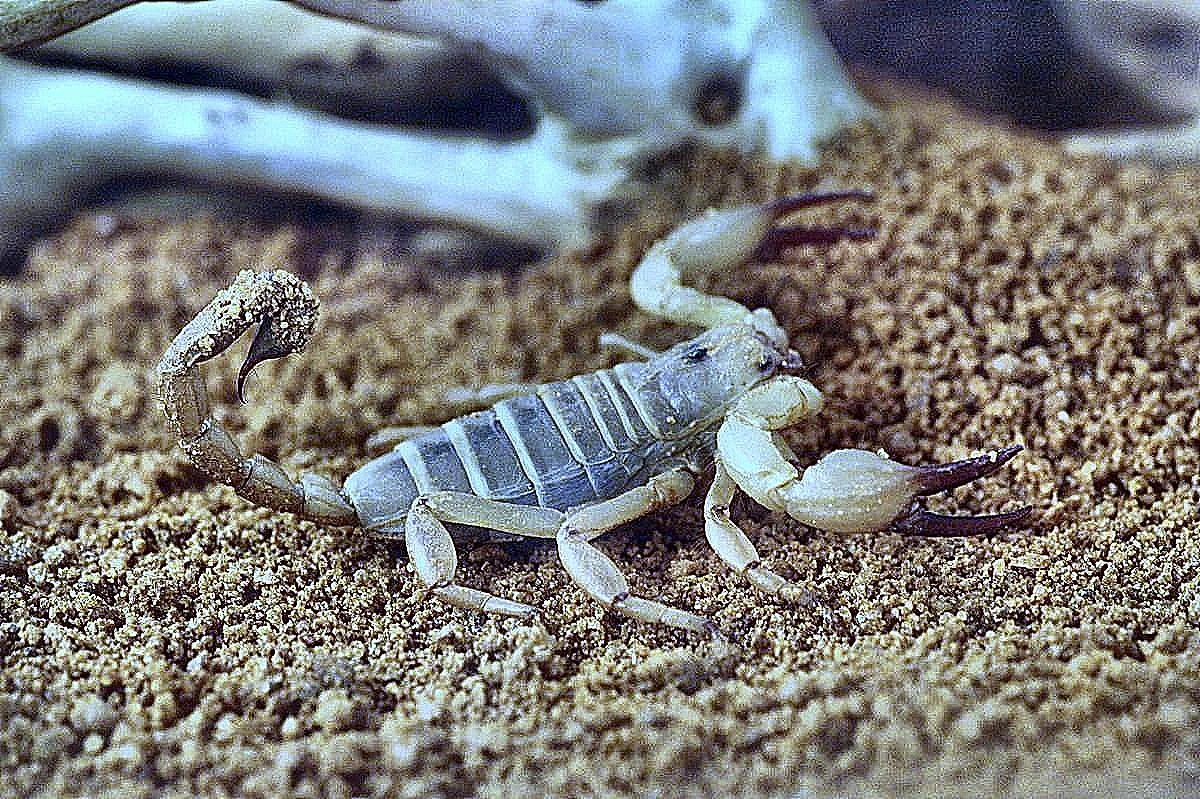
Desert Scorpion
Scientific Name: Urodacus yaschenkoi
is one of the largest and most well-known scorpions found in Australia’s arid interior. It occurs across the central deserts of Western Australia, South Australia, the Northern Territory, and parts of inland Queensland and New South Wales. This species usually grows to about 7–10 centimetres in length and is typically yellowish-brown to reddish-brown, helping it blend into desert sand and soil. It has large, powerful pincers and a curved tail with a stinger, which it uses to capture prey and defend itself.
Desert scorpions are burrowing animals, often digging deep vertical burrows in sandy or loose soils where they shelter during the hot daytime temperatures. At night they emerge to hunt insects, spiders, and other small invertebrates, using their pincers to grab prey before delivering a sting if needed. Their sting can be painful but is usually not dangerous to humans, producing symptoms similar to a bee or wasp sting. Like many desert animals, Urodacus yaschenkoi is well adapted to harsh environments and plays an important role in controlling insect populations in Australia’s arid ecosystems.
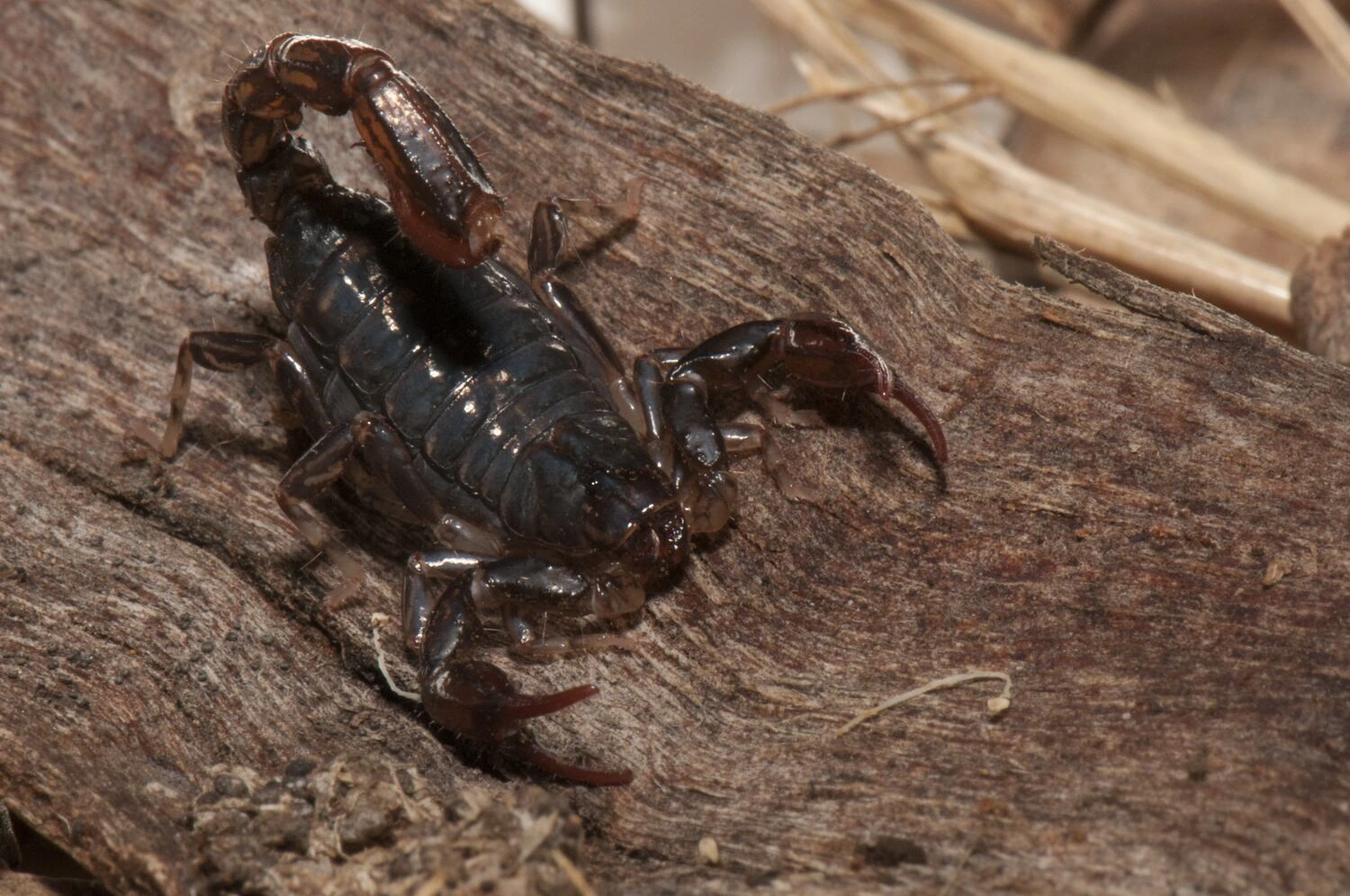
Wood or Forest Scorpion
Scientific Name: Cercophonius squama
is a small scorpion species found in the cooler forested regions of southeastern Australia, particularly in Victoria and Tasmania. It usually grows to about 2–4 centimetres in length and is typically dark brown to reddish-brown, helping it blend into leaf litter and forest soil. Unlike many desert-dwelling scorpions, this species prefers moist environments, often sheltering under logs, rocks, bark, and within damp leaf litter on the forest floor.
The Wood Scorpion is nocturnal, emerging at night to hunt small insects and other tiny invertebrates. During the day it hides in sheltered places to avoid predators and maintain moisture. Its sting can be painful but is generally mild and similar to a bee sting, causing local pain and swelling but rarely serious reactions. Despite their intimidating appearance, these scorpions are an important part of forest ecosystems, helping to control insect populations and contributing to the biodiversity of Australia’s woodland habitats.
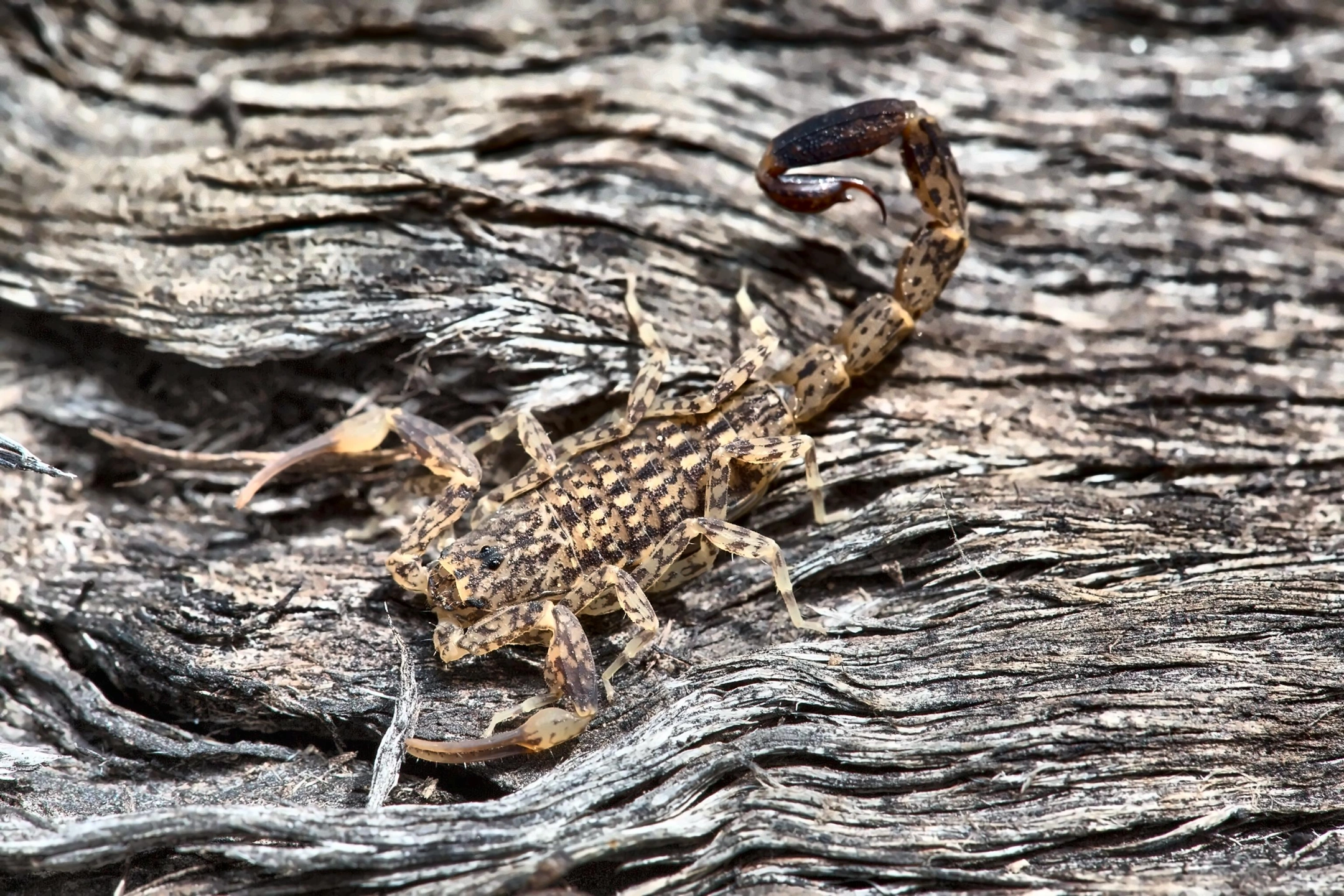
Marbled Scorpion
Scientific Name:Lychas marmoreus
is a small but widespread scorpion species found across eastern and northern Australia, as well as parts of Southeast Asia. It usually grows to around 3–5 centimetres long and gets its common name from the distinctive marbled or mottled pattern across its body, which is typically yellow-brown to reddish with darker markings. This species often shelters under bark, stones, logs, and leaf litter, and is sometimes found in houses, sheds, or gardens where suitable hiding places exist.
The Marbled Scorpion is nocturnal, emerging at night to hunt small insects, spiders, and other invertebrates. It uses its pincers to seize prey and its curved tail to deliver a sting when necessary. Although it can sting if threatened, the venom is generally mild, producing symptoms similar to a bee sting such as pain, redness, or swelling. Like other scorpions, Lychas marmoreus plays an important role in the ecosystem by helping control insect populations.
Australian arachnids have a bit of a reputation — and yes, some of them deserve it. From spiders to scorpions, Australia is home to a wide variety of species adapted to deserts, forests and coastal regions. The most famous (or infamous) include the Sydney funnel-web spider, redback spider and mouse spider, all of which are venomous. Despite their fearsome image, serious incidents are rare thanks to modern antivenom and medical care.
Beyond the headline species, Australia also has many harmless and fascinating arachnids. Huntsman spiders, for example, are large but generally non-aggressive and help control insect populations. In the outback, you’ll find trapdoor spiders that build camouflaged burrows, and small desert scorpions that glow under ultraviolet light. Like much of Australia’s wildlife, its arachnids are diverse, resilient and perfectly adapted to some of the toughest environments on Earth.
This stylistic image blends elements from multiple themes into one cohesive visual scene.
The Redback Spider
Scientific Name: Latrodectus hasselti
is one of Australia’s most familiar spiders and is easily recognised by the female’s glossy black body and distinctive red or orange stripe along her back. Males are much smaller and far less dangerous. As with many spider species, the female is the more prominent and medically significant of the two.
Redbacks are venomous, and their bites can cause intense local pain along with symptoms such as sweating, nausea, muscle weakness, and pain that may spread from the bite site. Before antivenom became available in 1956, there were recorded fatalities, but there have been no confirmed deaths in decades due to effective medical treatment. Unlike funnel-web spider bites, redback bites do not require a pressure immobilisation bandage. Recommended first aid includes washing the area, applying ice for pain relief, and seeking medical advice, particularly for children or elderly individuals.
Redbacks commonly inhabit sheltered, dry locations around homes and gardens, including sheds, under outdoor furniture, inside letterboxes, around playground equipment, and occasionally in outdoor toilets. Their webs are irregular, messy tangles rather than the neat, circular designs produced by orb-weaver spiders.
Red-headed Mouse Spider
Scientific name: Missulena occatoria
The mouse spider, belonging to the genus Missulena, is found across much of Australia. Despite its name, it does not resemble a mouse — early European settlers simply thought its burrows looked like mouse holes. These spiders are solid, glossy, and powerfully built, with strong downward-pointing fangs similar to those of funnel-web spiders. Some males are particularly striking in appearance, especially the red-headed mouse spider (Missulena occatoria), which features bright red jaws and a dark blue or black body.
Mouse spiders are venomous and closely related to funnel-web spiders, and while their venom is considered potentially serious, confirmed severe bites are rare. Funnel-web antivenom has been successfully used to treat mouse spider bites due to similarities in their toxins. They typically inhabit dry open forests, shrubland, and suburban gardens, living in silk-lined burrows often fitted with a small trapdoor-like entrance. Males tend to wander during the day, particularly after rain, which is when they are most commonly seen. If a bite is suspected, a pressure immobilisation bandage should be applied and urgent medical assistance sought.
Sydney Funnel-Web Spider
Scientific name: Atrax robustus
is one of Australia’s most well-known and feared spiders. It is found primarily in and around Sydney and the surrounding parts of NSW. These spiders are glossy black to dark brown, solidly built, and can reach around five centimetres in body length. They possess large, powerful fangs that point straight downward, allowing them to deliver deep bites. Their venom is highly toxic to humans, which is why they have earned such a formidable reputation.
Before the development of antivenom in 1981, funnel-web bites could be fatal. Today, however, effective treatment has meant there have been no recorded deaths since its introduction. The antivenom was developed at the Australian Reptile Park, which continues to operate a venom-milking program. Male funnel-web spiders are considered more dangerous than females and are more likely to wander during warm, humid weather, particularly after rain — increasing the chance of human encounters.
Sydney funnel-web spiders favour cool, moist environments such as under rocks and logs, in garden beds, and sometimes even in suburban backyards. They construct silk-lined burrows with distinctive funnel-shaped entrances. While they are capable of delivering a serious bite, they are not aggressive toward people, and most incidents occur when the spider is accidentally disturbed. If a bite is suspected, the correct response is to remain calm, apply a pressure immobilisation bandage, and call emergency services immediately (000 in Australia).
Huntsman Spider
Scientific Name: Heteropoda venatoria
is a large, fast-moving spider commonly found throughout Australia and many other warm regions of the world. Belonging to the family Sparassidae, these spiders are easily recognised by their long legs that extend sideways, giving them a crab-like appearance. Some species can have a leg span of up to 15 centimetres or more, making them one of the largest spiders many Australians encounter. Their bodies are usually brown or grey, helping them blend into tree bark, rocks, and walls where they like to rest.
Despite their intimidating size, huntsman spiders are generally harmless to humans and are actually beneficial because they hunt and eat insects such as cockroaches, moths, and other pests. Unlike many spiders, they do not rely on webs to catch prey. Instead, they actively chase and capture insects, which is how they get their name. Huntsman spiders are often found inside houses, garages, and sheds, especially in warmer weather, but they are typically shy and will quickly run away rather than bite.
White-tailed Spider refers to two closely related Australian species: (Lampona cylindrata) and (Lampona murina).
These medium-sized hunting spiders are easily recognised by their dark grey or brown cylindrical body and the distinctive white spot on the tip of the abdomen, which gives them their common name. They are commonly found across Australia, including urban areas, and may wander into houses, particularly at night.
White-tailed spiders are active hunters rather than web builders. They roam walls, ceilings, and floors searching for prey, and their favourite food is other spiders, especially black house spiders. Although their bite can be painful and may cause redness or irritation, research has shown that they do not cause severe skin ulceration, a myth that circulated for many years. Like most spiders, they prefer to avoid people and will usually run away rather than bite unless handled or trapped against the skin
Brown Scorpion
Scientific Name: Urodacus manicatus
is one of the most common scorpion species found across eastern and southern Australia. It typically lives in dry habitats such as forests, grasslands, and scrubland, often sheltering under rocks, logs, or in shallow burrows in the soil. This species is usually light brown to reddish-brown in colour and grows to about 4–6 centimetres in length. Like other scorpions, it has large pincers for grabbing prey and a curved tail tipped with a stinger used for defence and subduing food.
The Brown Scorpion is nocturnal, emerging at night to hunt small insects, spiders, and other invertebrates. During the day it hides in protected places to avoid heat and predators. While it can sting if threatened, the venom is generally mild and comparable to a bee sting for most people, causing pain and swelling but rarely serious reactions. Despite their intimidating appearance, these scorpions play an important role in controlling insect populations and are a normal part of Australia’s natural ecosystems.
Desert Scorpion
Scientific Name: Urodacus yaschenkoi
is one of the largest and most well-known scorpions found in Australia’s arid interior. It occurs across the central deserts of Western Australia, South Australia, the Northern Territory, and parts of inland Queensland and New South Wales. This species usually grows to about 7–10 centimetres in length and is typically yellowish-brown to reddish-brown, helping it blend into desert sand and soil. It has large, powerful pincers and a curved tail with a stinger, which it uses to capture prey and defend itself.
Desert scorpions are burrowing animals, often digging deep vertical burrows in sandy or loose soils where they shelter during the hot daytime temperatures. At night they emerge to hunt insects, spiders, and other small invertebrates, using their pincers to grab prey before delivering a sting if needed. Their sting can be painful but is usually not dangerous to humans, producing symptoms similar to a bee or wasp sting. Like many desert animals, Urodacus yaschenkoi is well adapted to harsh environments and plays an important role in controlling insect populations in Australia’s arid ecosystems.
Wood or Forest Scorpion
Scientific Name: Cercophonius squama
is a small scorpion species found in the cooler forested regions of southeastern Australia, particularly in Victoria and Tasmania. It usually grows to about 2–4 centimetres in length and is typically dark brown to reddish-brown, helping it blend into leaf litter and forest soil. Unlike many desert-dwelling scorpions, this species prefers moist environments, often sheltering under logs, rocks, bark, and within damp leaf litter on the forest floor.
The Wood Scorpion is nocturnal, emerging at night to hunt small insects and other tiny invertebrates. During the day it hides in sheltered places to avoid predators and maintain moisture. Its sting can be painful but is generally mild and similar to a bee sting, causing local pain and swelling but rarely serious reactions. Despite their intimidating appearance, these scorpions are an important part of forest ecosystems, helping to control insect populations and contributing to the biodiversity of Australia’s woodland habitats.
Marbled Scorpion
Scientific Name:Lychas marmoreus
is a small but widespread scorpion species found across eastern and northern Australia, as well as parts of Southeast Asia. It usually grows to around 3–5 centimetres long and gets its common name from the distinctive marbled or mottled pattern across its body, which is typically yellow-brown to reddish with darker markings. This species often shelters under bark, stones, logs, and leaf litter, and is sometimes found in houses, sheds, or gardens where suitable hiding places exist.
The Marbled Scorpion is nocturnal, emerging at night to hunt small insects, spiders, and other invertebrates. It uses its pincers to seize prey and its curved tail to deliver a sting when necessary. Although it can sting if threatened, the venom is generally mild, producing symptoms similar to a bee sting such as pain, redness, or swelling. Like other scorpions, Lychas marmoreus plays an important role in the ecosystem by helping control insect populations.
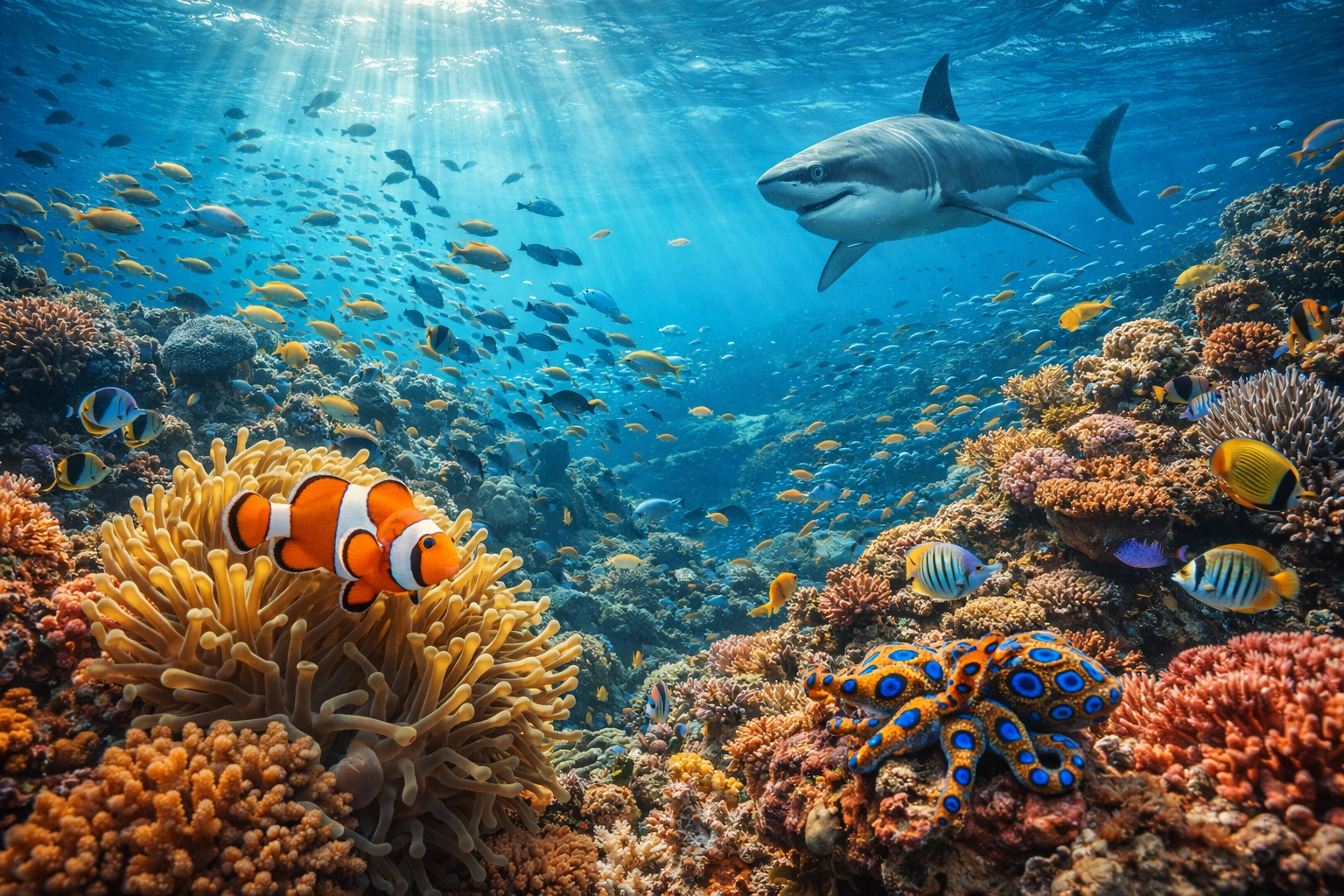
Under the Sea
Australia’s oceans are rich with marine life — from colourful reef fish and coral to whales, sharks and sea turtles — with ecosystems like the Great Barrier Reef supporting thousands of species.
Australian sea life is some of the most diverse and spectacular in the world, thanks to the country’s enormous coastline and mix of tropical, temperate and southern oceans. The Great Barrier Reef alone is home to thousands of species — colourful coral, reef fish, sea turtles, reef sharks and giant clams. In tropical northern waters you’ll find vibrant clownfish, manta rays and even dugongs grazing on seagrass beds.
Further south, the marine life changes dramatically. Great white sharks patrol cooler waters, leafy seadragons drift through southern reefs, and playful Australian sea lions rest along rocky shores. Humpback whales migrate along the east and west coasts each year, putting on incredible breaching displays. From coral reefs to deep ocean trenches, Australia’s sea life reflects the country’s huge range of habitats — colourful, powerful and often surprisingly unique.
This stylistic image blends elements from multiple themes into one cohesive visual scene.
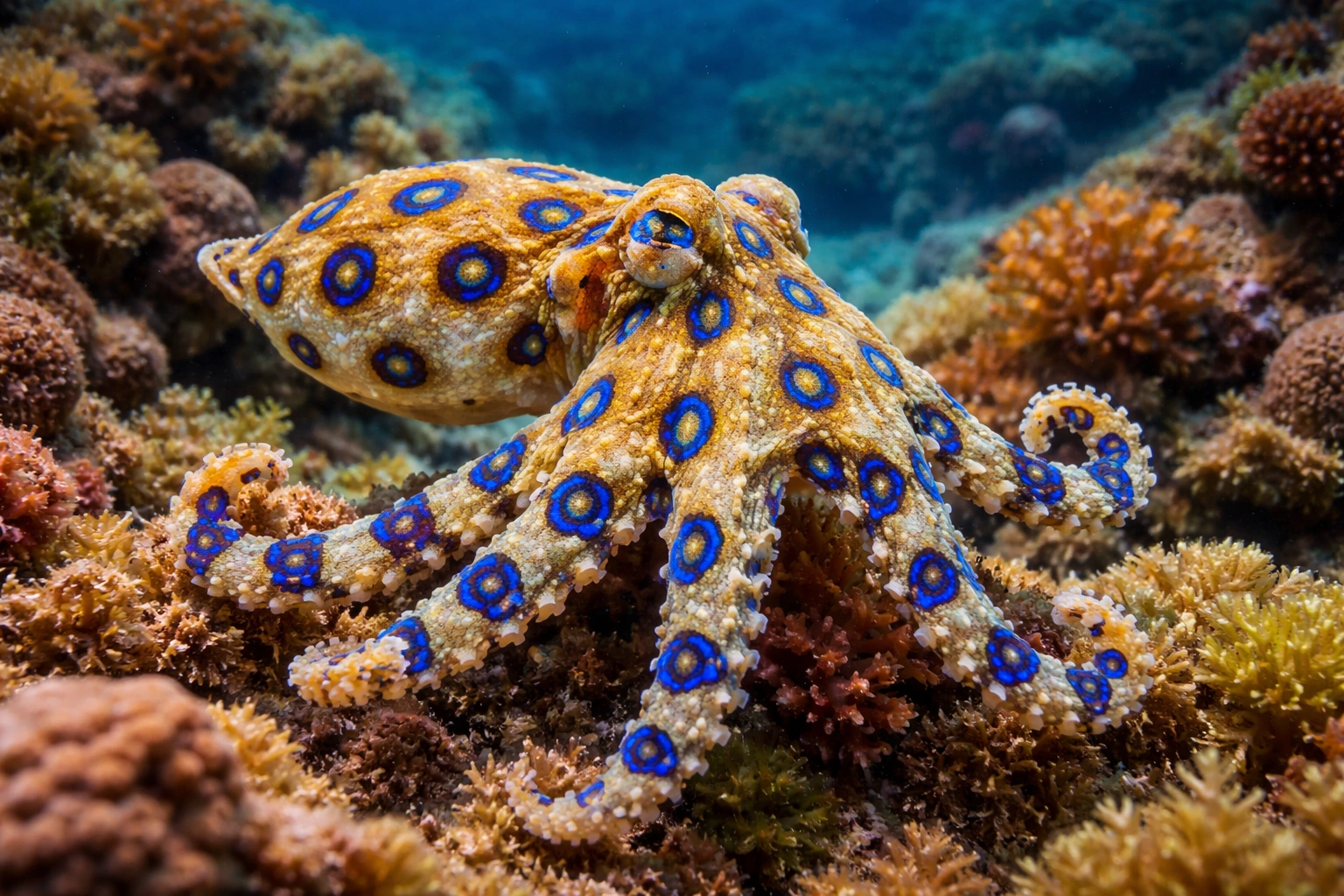
Blue-Ringed Octopus
Scientific name: Hapalochlaena fasciata
is small, beautiful, and extremely dangerous. Roughly the size of a golf ball, it inhabits rock pools and shallow coastal waters around Australia, particularly along the east and south coasts. When undisturbed, it appears beige or yellowish with subtle markings. However, when threatened, its bright electric blue rings flash vividly across its body — a clear warning signal to stay away.
Despite its tiny size, the Blue-Ringed Octopus carries tetrodotoxin, a powerful neurotoxin also found in pufferfish. The venom can cause rapid paralysis, respiratory failure, and leave a person conscious but unable to move. There is no antivenom available. Fortunately, bites are rare and fatalities are extremely uncommon, as prompt CPR can keep a person alive until the toxin naturally wears off. The bite itself is often painless, so some victims may not immediately realise they have been envenomated.
Blue-Ringed Octopuses are commonly found in rock pools, coral reefs, beneath shells and rocks, and in shallow coastal waters — environments frequently explored by swimmers and snorkellers. If a bite is suspected, emergency services should be contacted immediately, a pressure immobilisation bandage applied, and CPR started if breathing stops, continuing until medical assistance arrives. With rapid response and supportive care, recovery is possible once the effects of the toxin subside.
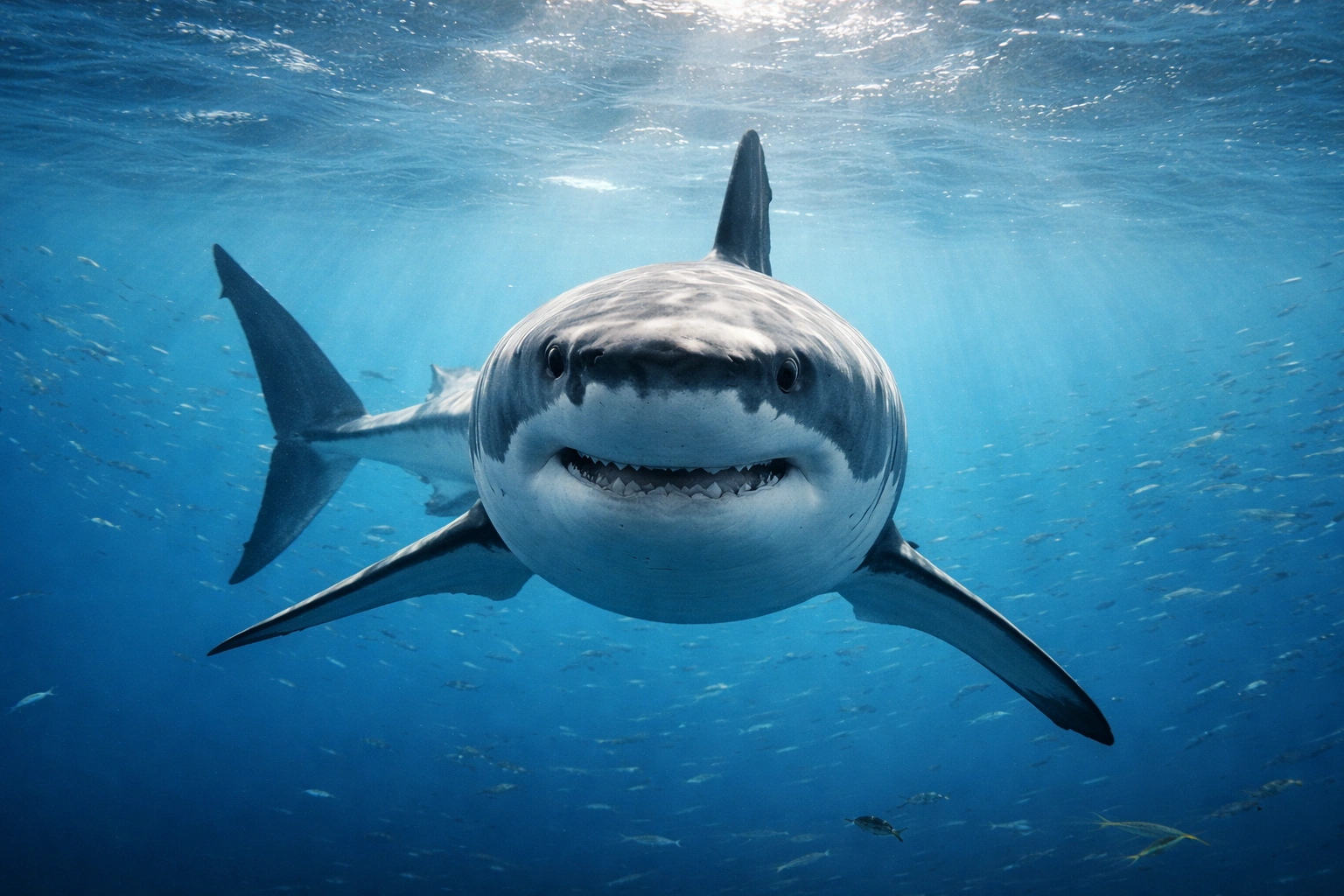
Australian great white shark
Scientific name: Carcharodon carcharias
is one of the ocean’s most powerful and recognisable predators. Growing up to 6 metres long and weighing over two tonnes, it’s built for speed and strength, with rows of serrated teeth designed for gripping prey. Despite its fearsome reputation, it’s a naturally cautious animal that doesn’t actively hunt humans.
Great whites are found along Australia’s southern coastline, particularly off South Australia, Victoria, Tasmania and parts of Western Australia. Areas near the Neptune Islands are especially famous for sightings and cage diving experiences. They prefer cooler waters and often patrol regions with large seal colonies, which are a primary food source.
Although shark bites do occur in Australia, they are rare compared to the millions of people who enter the water each year. Great white sharks are a protected species in Australian waters due to declining global populations, and they play a vital role in maintaining healthy marine ecosystems by regulating prey species.
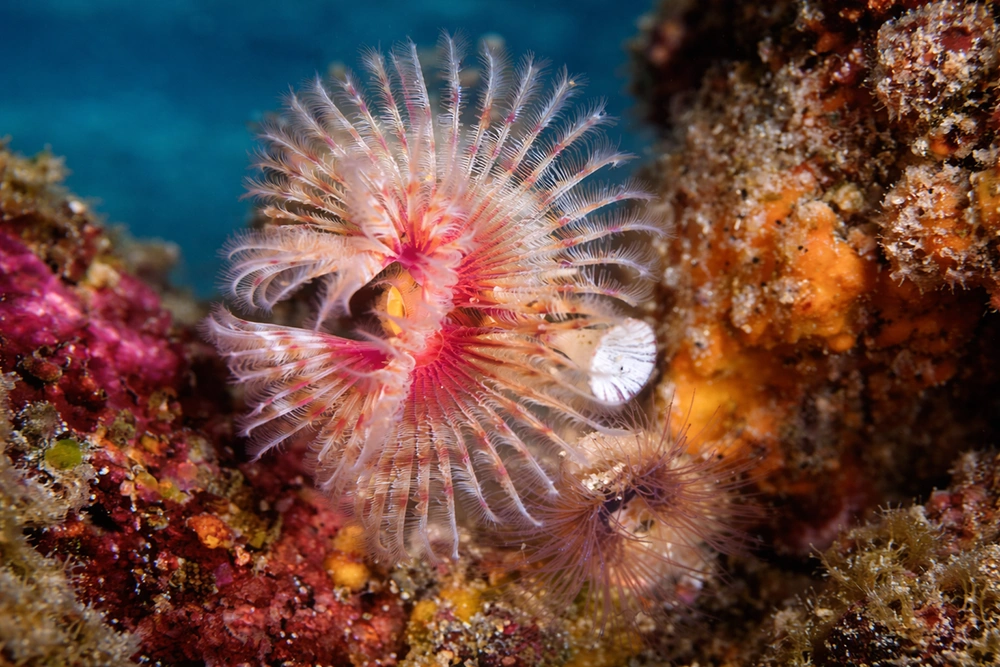
Red Trumpet Calcareous Tubeworm
Scientific Name: Serpula Columbiana
is a marine polychaete worm that belongs to the family Serpulidae, a group of worms known for building hard, calcareous tubes attached to rocks, shells, reefs, and other underwater surfaces. The worm lives permanently inside this protective tube, which it secretes from calcium carbonate, giving it a rigid, chalky structure. From the opening of the tube the animal extends a striking red, trumpet-shaped crown of feathery tentacles, which it uses to filter tiny plankton and organic particles from the surrounding water.
The colourful feeding crown also functions as a respiratory organ, helping the worm absorb oxygen from the water. When the animal senses danger—such as a passing fish or a diver’s movement—it can instantly retract back into its tube, sometimes sealing the opening with a small operculum (a lid-like structure). These worms are commonly found on rocky reefs, pier pylons, coral structures, and submerged surfaces in coastal waters, where they add bright splashes of colour to marine environments and contribute to the biodiversity of reef ecosystems.
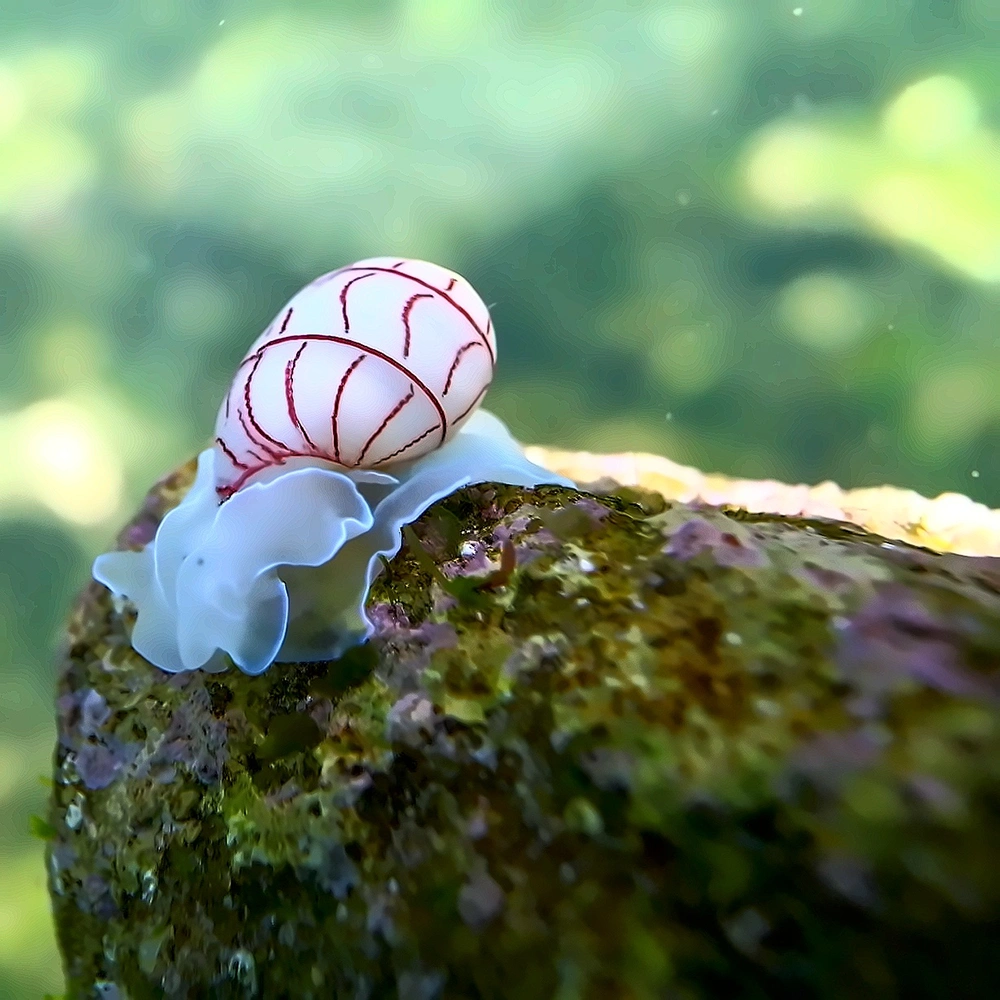
Red-lined Bubble Snail
Scientific Name: Bullina lineata
is a small marine sea snail belonging to the bubble snail family. It is easily recognised by its smooth, glossy, translucent shell decorated with fine red or reddish-brown lines, which give the species its common name. The shell is thin and delicate, shaped like a small bubble, and typically grows to about 1–2 centimetres long. Because the shell is partly transparent, the soft body of the snail can sometimes be seen through it.
This species is usually found on sandy or muddy seabeds in shallow coastal waters, often near reefs or seagrass beds in tropical and subtropical regions of the Indo-Pacific, including Australian waters. Like other bubble snails, Bullina lineata is a predatory gastropod, feeding mainly on small worms and other tiny invertebrates living in the sediment. It spends much of its time moving slowly across the seabed or partially buried in sand, where its subtle colouring helps it blend into the environment.
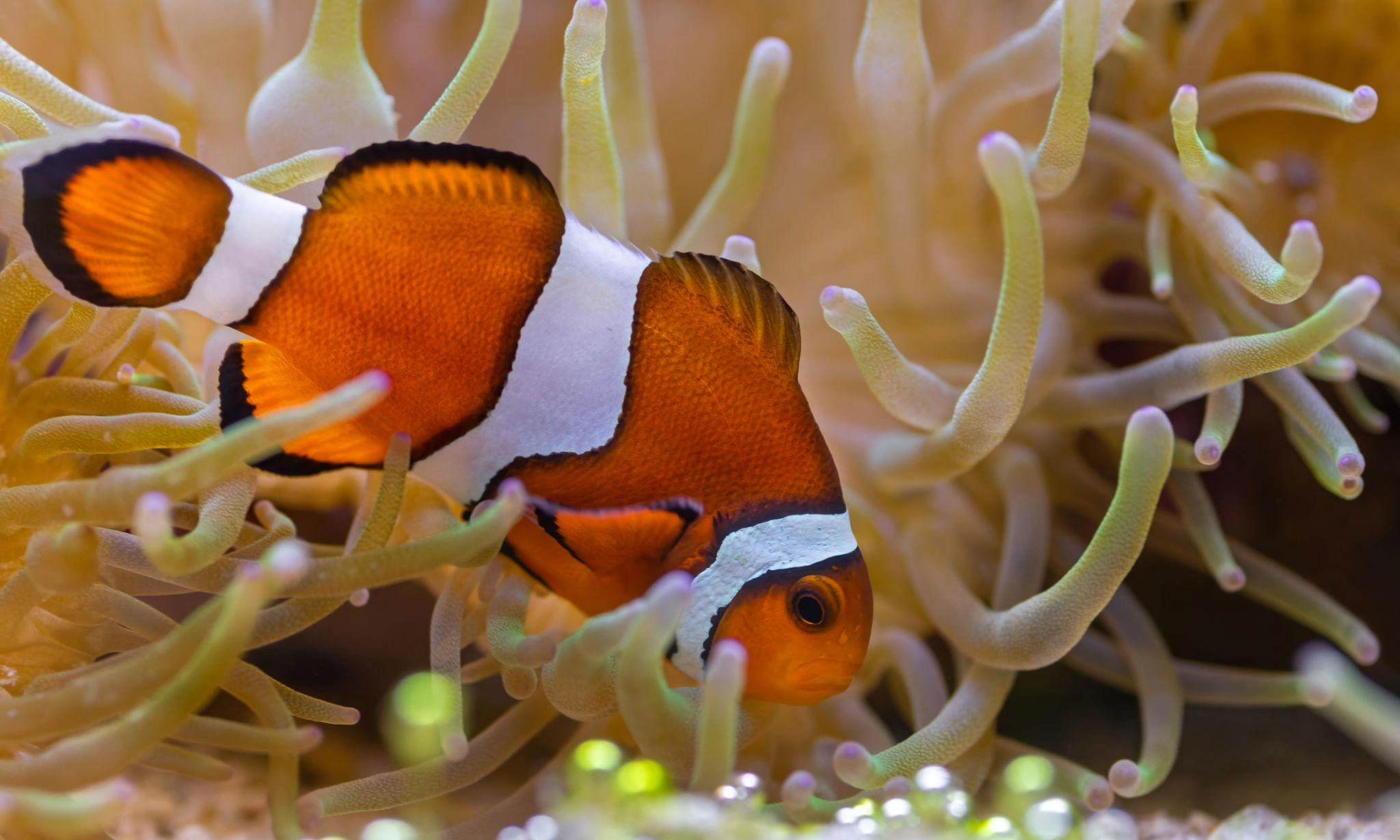
Clownfish
Scientific Name: Amphiprion ocellaris
also known as the anemonefish, is a small, brightly coloured marine fish famous for its orange body with white bands outlined in black. Clownfish live in warm waters of the Indian and Pacific Oceans, including the Great Barrier Reef and other Australian reefs. They are best known for their special relationship with sea anemones, whose stinging tentacles provide protection from predators. The clownfish is not harmed by the stings because of a protective mucus coating on its skin, allowing it to safely live among the tentacles where few other fish can survive.
Clownfish have a fascinating social structure. They live in small groups inside a single anemone, usually consisting of a dominant breeding female, a breeding male, and several smaller non-breeding males. If the female dies, the dominant male can change sex and become the new female, while another male moves up in rank. Clownfish feed on small plankton, algae, and tiny invertebrates, and in return for protection the fish help their host anemone by cleaning it, removing parasites, and improving water circulation around it. Their bright colours and unusual behaviour have made them one of the most recognisable reef fish in the world.
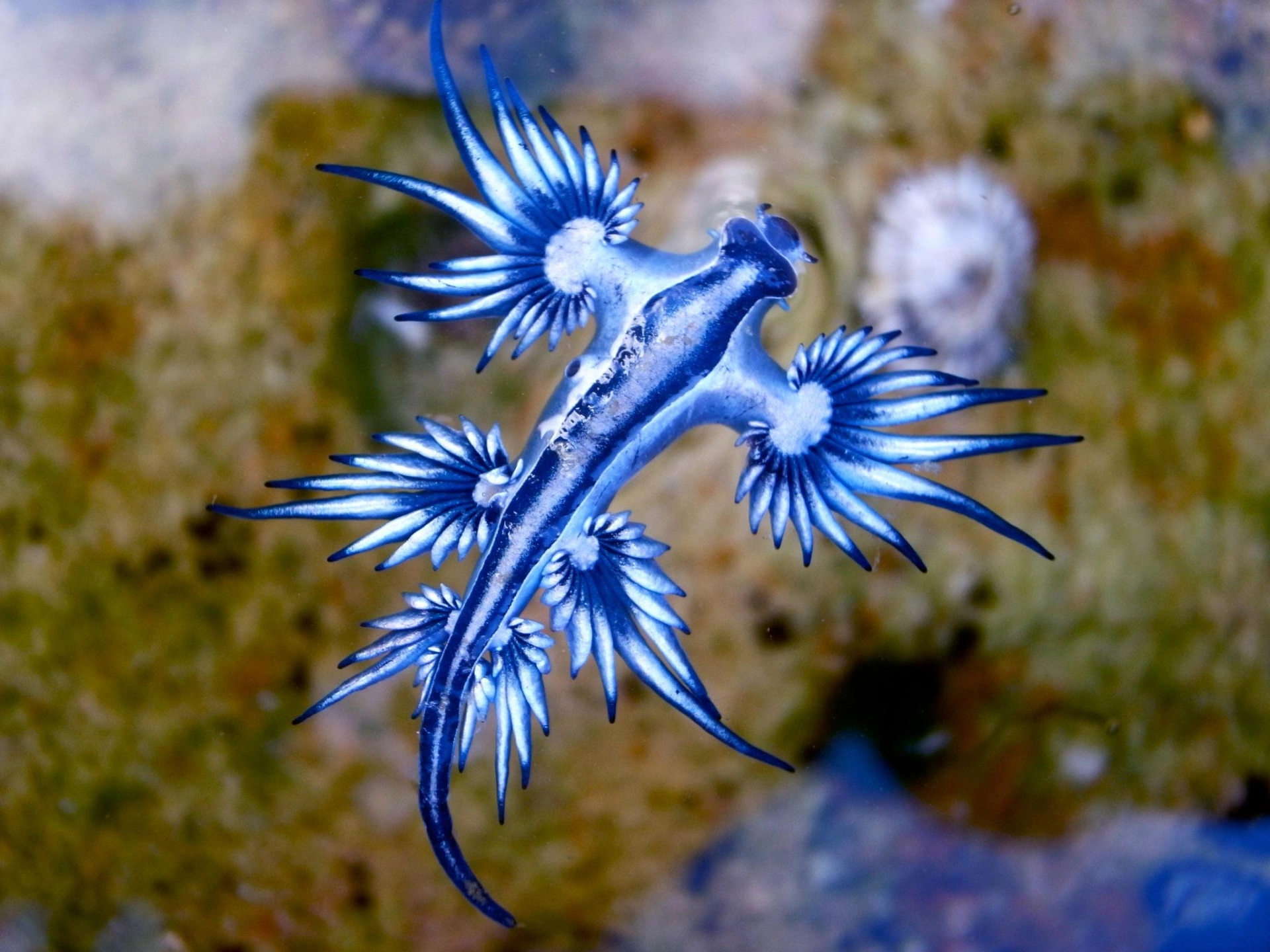
Blue Dragon
Scientific Name: Glaucus atlanticus
is a small but remarkable species of sea slug that floats on the surface of the open ocean. Found in warm and temperate waters around the world, including the waters off Australia, it usually grows to about 3–4 centimetres long. Its striking appearance includes a silver underside and vivid blue upper surface with finger-like appendages called cerata, which help it stay buoyant and blend into the ocean surface. This colouring acts as camouflage—when viewed from above it blends with the blue water, and from below it matches the bright surface light.
Despite its delicate appearance, the Blue Dragon is a predator that feeds on venomous creatures, especially the Portuguese man o’ war and other floating jellyfish-like animals. It has the unusual ability to store the stinging cells (nematocysts) from its prey in the tips of its cerata and reuse them for its own defence. Because of this, the Blue Dragon can deliver a painful sting if handled, sometimes even stronger than the sting of its prey. It floats upside down at the ocean surface using a small air bubble in its stomach, drifting with currents and winds across the open sea.
Australian sea life is some of the most diverse and spectacular in the world, thanks to the country’s enormous coastline and mix of tropical, temperate and southern oceans. The Great Barrier Reef alone is home to thousands of species — colourful coral, reef fish, sea turtles, reef sharks and giant clams. In tropical northern waters you’ll find vibrant clownfish, manta rays and even dugongs grazing on seagrass beds.
Further south, the marine life changes dramatically. Great white sharks patrol cooler waters, leafy seadragons drift through southern reefs, and playful Australian sea lions rest along rocky shores. Humpback whales migrate along the east and west coasts each year, putting on incredible breaching displays. From coral reefs to deep ocean trenches, Australia’s sea life reflects the country’s huge range of habitats — colourful, powerful and often surprisingly unique.
This stylistic image blends elements from multiple themes into one cohesive visual scene.
Blue-Ringed Octopus
Scientific name: Hapalochlaena fasciata
is small, beautiful, and extremely dangerous. Roughly the size of a golf ball, it inhabits rock pools and shallow coastal waters around Australia, particularly along the east and south coasts. When undisturbed, it appears beige or yellowish with subtle markings. However, when threatened, its bright electric blue rings flash vividly across its body — a clear warning signal to stay away.
Despite its tiny size, the Blue-Ringed Octopus carries tetrodotoxin, a powerful neurotoxin also found in pufferfish. The venom can cause rapid paralysis, respiratory failure, and leave a person conscious but unable to move. There is no antivenom available. Fortunately, bites are rare and fatalities are extremely uncommon, as prompt CPR can keep a person alive until the toxin naturally wears off. The bite itself is often painless, so some victims may not immediately realise they have been envenomated.
Blue-Ringed Octopuses are commonly found in rock pools, coral reefs, beneath shells and rocks, and in shallow coastal waters — environments frequently explored by swimmers and snorkellers. If a bite is suspected, emergency services should be contacted immediately, a pressure immobilisation bandage applied, and CPR started if breathing stops, continuing until medical assistance arrives. With rapid response and supportive care, recovery is possible once the effects of the toxin subside.
Australian great white shark
Scientific name: Carcharodon carcharias
is one of the ocean’s most powerful and recognisable predators. Growing up to 6 metres long and weighing over two tonnes, it’s built for speed and strength, with rows of serrated teeth designed for gripping prey. Despite its fearsome reputation, it’s a naturally cautious animal that doesn’t actively hunt humans.
Great whites are found along Australia’s southern coastline, particularly off South Australia, Victoria, Tasmania and parts of Western Australia. Areas near the Neptune Islands are especially famous for sightings and cage diving experiences. They prefer cooler waters and often patrol regions with large seal colonies, which are a primary food source.
Although shark bites do occur in Australia, they are rare compared to the millions of people who enter the water each year. Great white sharks are a protected species in Australian waters due to declining global populations, and they play a vital role in maintaining healthy marine ecosystems by regulating prey species.
Red Trumpet Calcareous Tubeworm
Scientific Name: Serpula Columbiana
is a marine polychaete worm that belongs to the family Serpulidae, a group of worms known for building hard, calcareous tubes attached to rocks, shells, reefs, and other underwater surfaces. The worm lives permanently inside this protective tube, which it secretes from calcium carbonate, giving it a rigid, chalky structure. From the opening of the tube the animal extends a striking red, trumpet-shaped crown of feathery tentacles, which it uses to filter tiny plankton and organic particles from the surrounding water.
The colourful feeding crown also functions as a respiratory organ, helping the worm absorb oxygen from the water. When the animal senses danger—such as a passing fish or a diver’s movement—it can instantly retract back into its tube, sometimes sealing the opening with a small operculum (a lid-like structure). These worms are commonly found on rocky reefs, pier pylons, coral structures, and submerged surfaces in coastal waters, where they add bright splashes of colour to marine environments and contribute to the biodiversity of reef ecosystems.
Red-lined Bubble Snail
Scientific Name: Bullina lineata
is a small marine sea snail belonging to the bubble snail family. It is easily recognised by its smooth, glossy, translucent shell decorated with fine red or reddish-brown lines, which give the species its common name. The shell is thin and delicate, shaped like a small bubble, and typically grows to about 1–2 centimetres long. Because the shell is partly transparent, the soft body of the snail can sometimes be seen through it.
This species is usually found on sandy or muddy seabeds in shallow coastal waters, often near reefs or seagrass beds in tropical and subtropical regions of the Indo-Pacific, including Australian waters. Like other bubble snails, Bullina lineata is a predatory gastropod, feeding mainly on small worms and other tiny invertebrates living in the sediment. It spends much of its time moving slowly across the seabed or partially buried in sand, where its subtle colouring helps it blend into the environment.
Clownfish
Scientific Name: Amphiprion ocellaris
also known as the anemonefish, is a small, brightly coloured marine fish famous for its orange body with white bands outlined in black. Clownfish live in warm waters of the Indian and Pacific Oceans, including the Great Barrier Reef and other Australian reefs. They are best known for their special relationship with sea anemones, whose stinging tentacles provide protection from predators. The clownfish is not harmed by the stings because of a protective mucus coating on its skin, allowing it to safely live among the tentacles where few other fish can survive.
Clownfish have a fascinating social structure. They live in small groups inside a single anemone, usually consisting of a dominant breeding female, a breeding male, and several smaller non-breeding males. If the female dies, the dominant male can change sex and become the new female, while another male moves up in rank. Clownfish feed on small plankton, algae, and tiny invertebrates, and in return for protection the fish help their host anemone by cleaning it, removing parasites, and improving water circulation around it. Their bright colours and unusual behaviour have made them one of the most recognisable reef fish in the world.
Blue Dragon
Scientific Name: Glaucus atlanticus
is a small but remarkable species of sea slug that floats on the surface of the open ocean. Found in warm and temperate waters around the world, including the waters off Australia, it usually grows to about 3–4 centimetres long. Its striking appearance includes a silver underside and vivid blue upper surface with finger-like appendages called cerata, which help it stay buoyant and blend into the ocean surface. This colouring acts as camouflage—when viewed from above it blends with the blue water, and from below it matches the bright surface light.
Despite its delicate appearance, the Blue Dragon is a predator that feeds on venomous creatures, especially the Portuguese man o’ war and other floating jellyfish-like animals. It has the unusual ability to store the stinging cells (nematocysts) from its prey in the tips of its cerata and reuse them for its own defence. Because of this, the Blue Dragon can deliver a painful sting if handled, sometimes even stronger than the sting of its prey. It floats upside down at the ocean surface using a small air bubble in its stomach, drifting with currents and winds across the open sea.
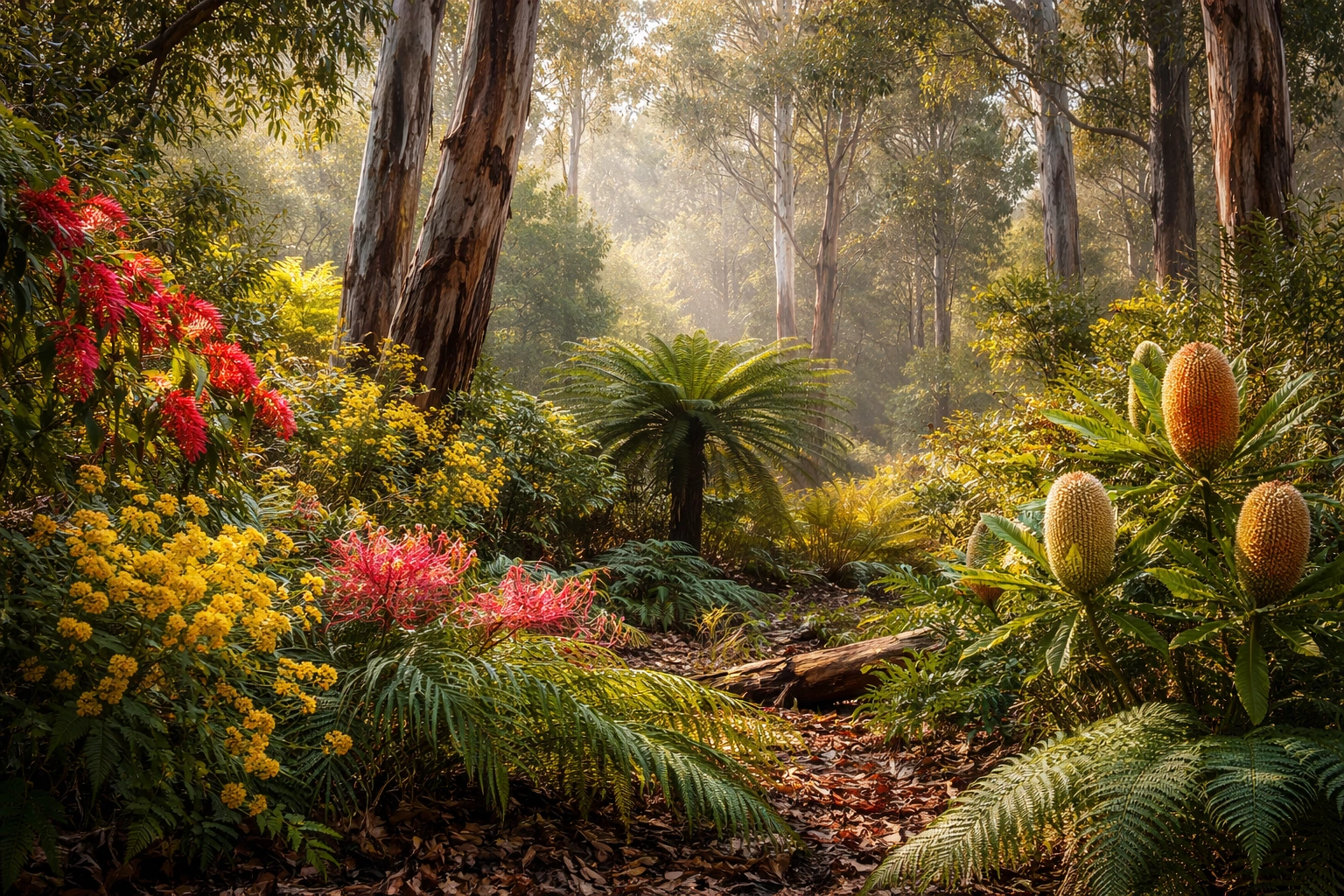
Our Plants
Australian plants are tough, diverse, and perfectly adapted to a harsh land.From fragrant eucalyptus forests to vibrant wildflowers, they shape the look, smell, and spirit of Australia.
Australian native plants are some of the toughest and most distinctive in the world, shaped by millions of years of isolation, harsh climates and frequent bushfires. From towering eucalyptus trees to delicate wildflowers, they’ve evolved to survive drought, poor soils and extreme heat. Many species have waxy leaves, deep root systems or fire-resistant bark, helping them cope with the often brutal Australian environment.
Iconic natives include eucalyptus (gum trees), which dominate much of the landscape and provide food for koalas; acacias (wattles), famous for their golden blooms and Australia’s national floral emblem; and banksias, with their striking cone-shaped flowers that attract birds and insects. In drier regions you’ll find spinifex grasses and hardy shrubs, while rainforests in the north support lush ferns and ancient plant species. Australian native plants not only shape the scenery but also support the country’s unique wildlife, forming the backbone of its ecosystems.
This stylistic image blends elements from multiple themes into one cohesive visual scene.
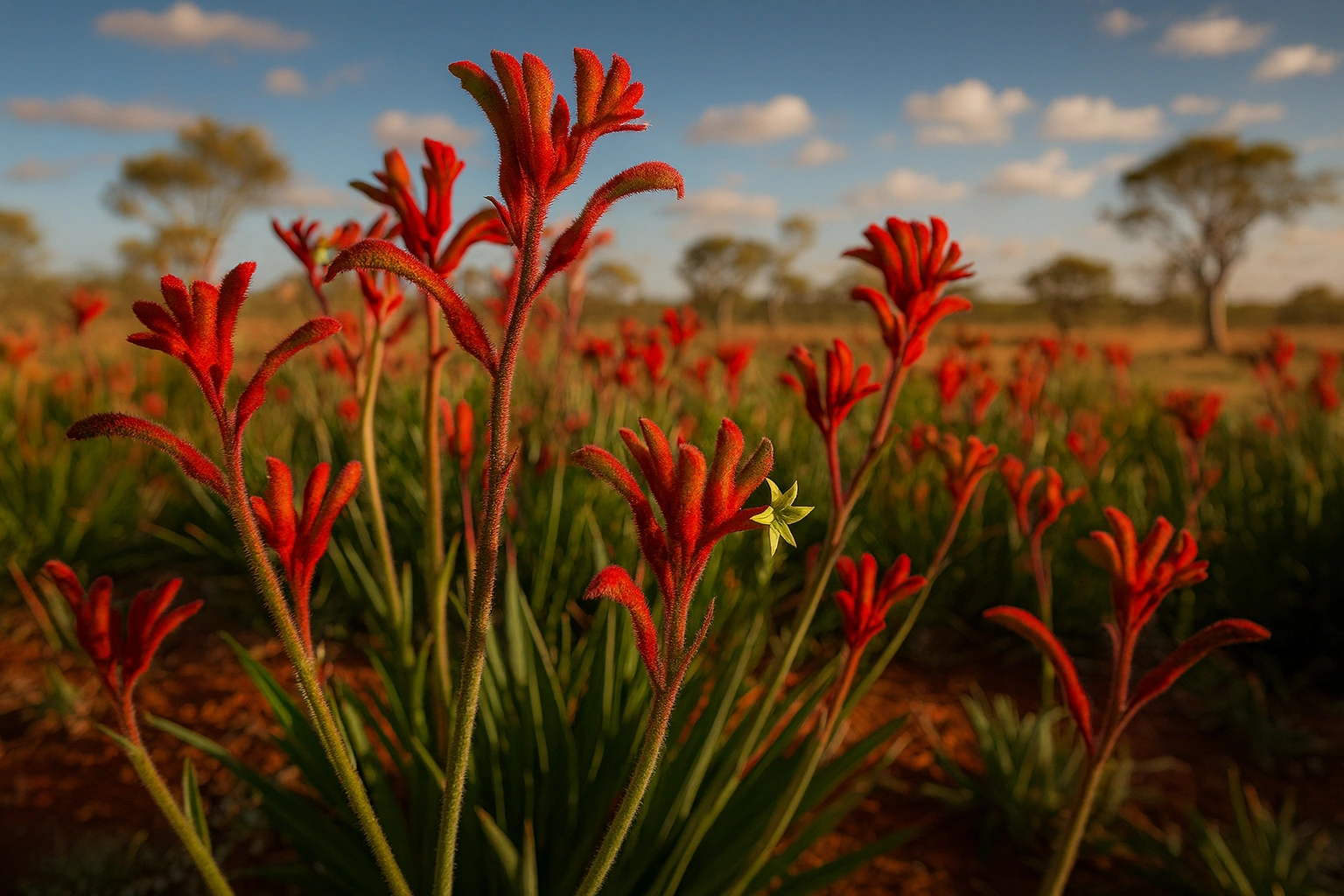
Sturt’s Desert Pea
Scientific name: Swainsona Formosa
is one of Australia’s most striking wildflowers, instantly recognisable by its vivid scarlet petals and dramatic dark centre. Native to the arid and semi-arid regions of central Australia, it thrives in harsh desert conditions, often blooming spectacularly after rainfall. The plant grows low to the ground with trailing stems, using its deep roots to survive extreme heat and drought. Chosen as the floral emblem of South Australia, the Sturt’s Desert Pea symbolises resilience, beauty, and the extraordinary colour found in Australia’s outback landscapes.
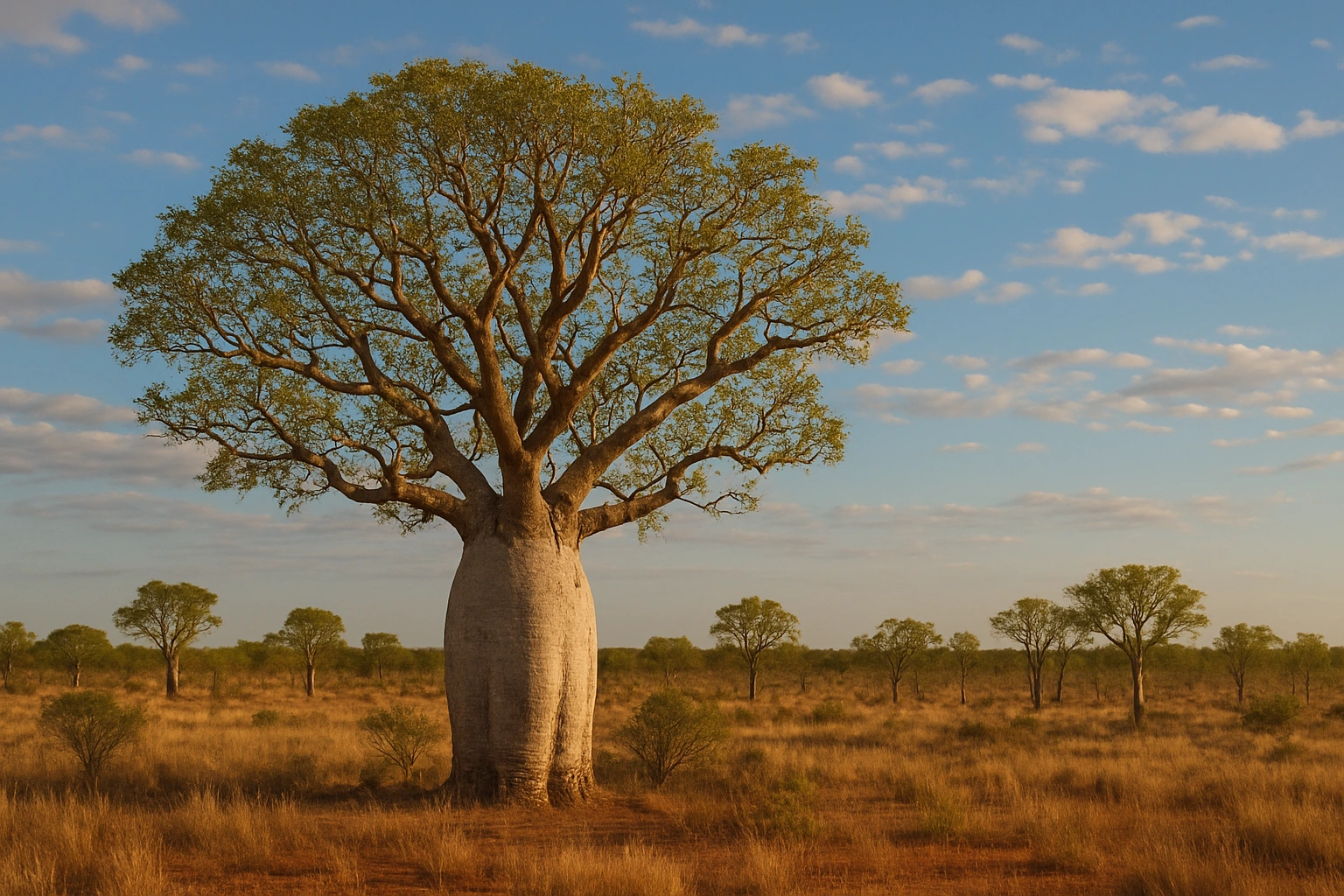
Boab
Scientific name: Adansonia gregorii
is an iconic and ancient tree of north-western Australia, instantly recognisable by its massive, bottle-shaped trunk and sparse, twisting branches. Perfectly adapted to harsh, dry environments, the boab stores water in its swollen trunk, allowing it to survive long droughts and extreme heat. Some boabs are thought to be over a thousand years old and hold deep cultural significance for Indigenous Australians, who traditionally used the tree for food, water, shelter, and medicine. Standing solitary across the Kimberley landscape, the boab is a powerful symbol of endurance and Australia’s unique natural heritage
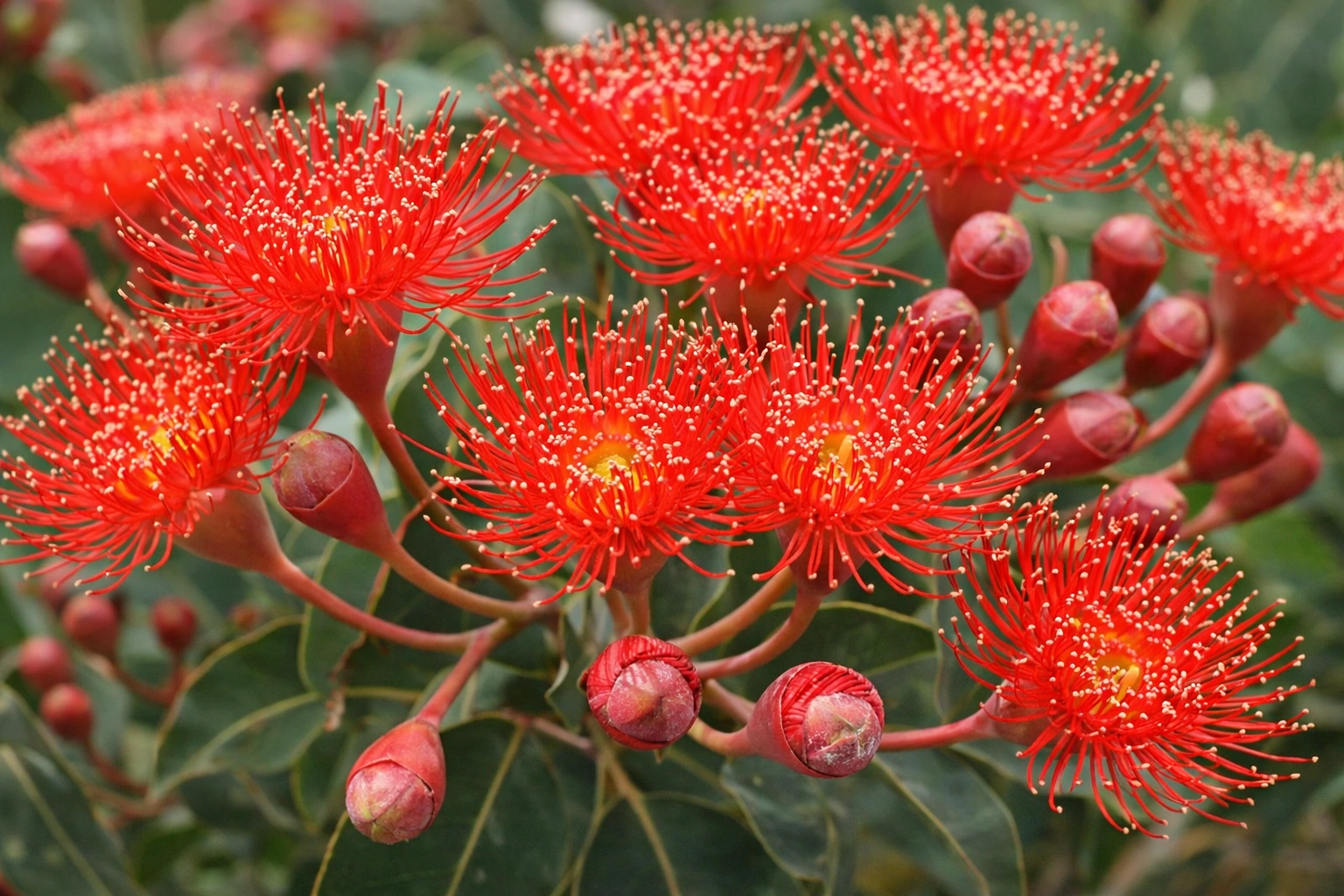
Red wattle
Scientific name: Acacia terminalis
is one of Australia’s most striking native plants, known for its vivid crimson, brush-like flowers that appear mainly from late winter to spring. It’s a hardy shrub or small tree found along the east coast, especially in New South Wales, thriving in bushland, open forests, and rocky soils. Beyond its beauty, the red wattle plays an important ecological role, providing nectar for birds and insects, while also enriching the soil through nitrogen fixation. Culturally, wattles are deeply significant to Aboriginal Australians, traditionally used for tools, food, medicine, and ceremony, and today the red wattle is widely celebrated as a symbol of Australia’s unique and resilient natural heritage.
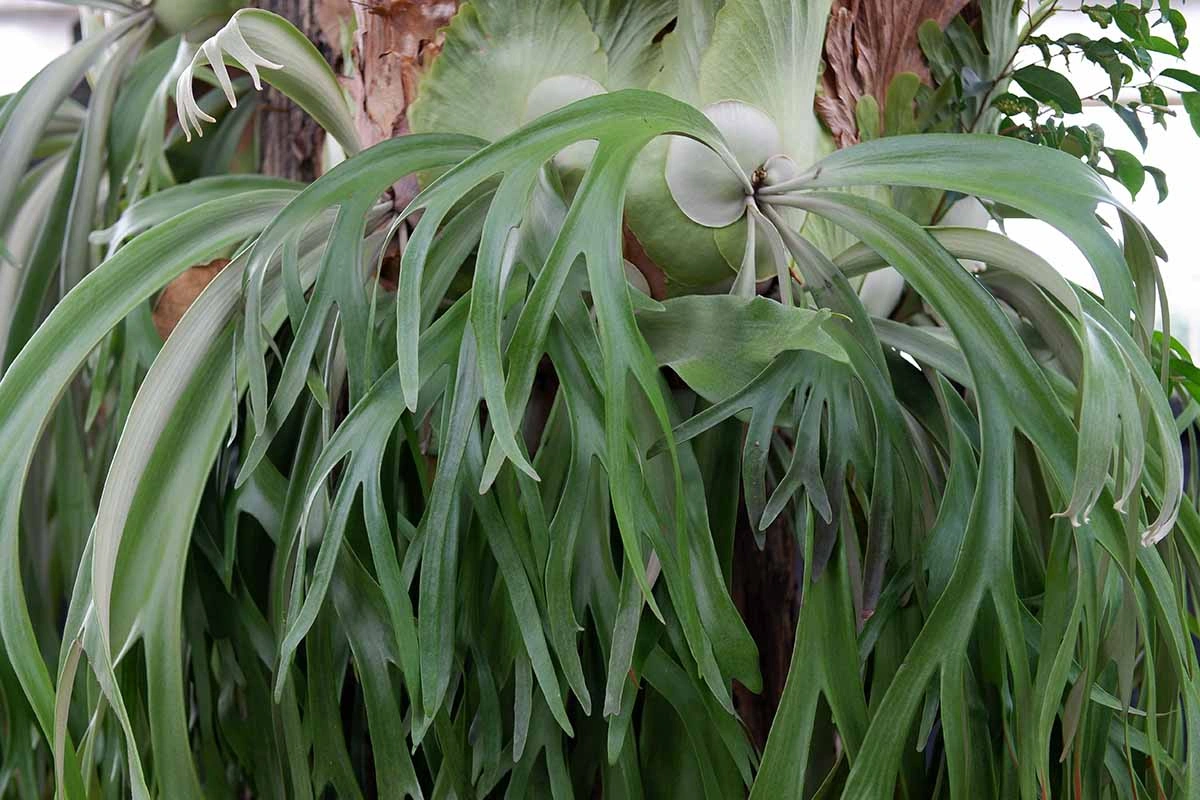
Elkhorn Fern
Scientific Name: Platycerium bifurcatum
is a distinctive epiphytic fern native to eastern Australia and New Guinea. It commonly grows on tree trunks, branches, or rocks, where it anchors itself without taking nutrients from the host plant. The fern gets its name from its forked, antler-shaped fronds, which resemble the antlers of an elk or deer. In addition to these large decorative fronds, it also produces rounded shield fronds that lie flat against the surface it grows on, helping collect organic material and moisture for nutrients.
Elkhorn ferns are popular garden and indoor plants because of their unusual appearance and relatively easy care. In nature they thrive in humid forests and sheltered coastal areas, where they receive filtered light and plenty of airflow. Gardeners often mount them on boards or hang them in baskets to mimic their natural growing conditions. The plant reproduces through tiny spores rather than seeds, like other ferns, and over time it can grow into large clusters that create a striking natural display.
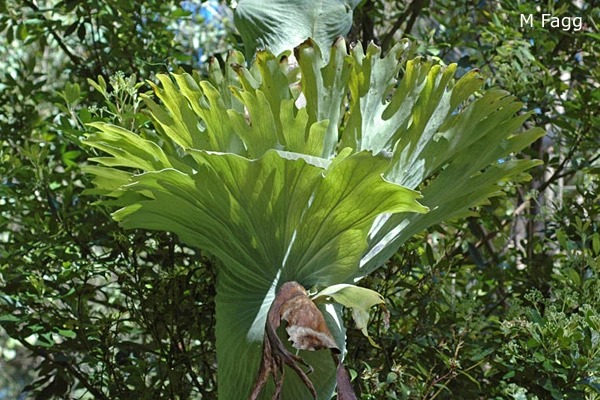
Staghorn Fern
Scienticic Name: Platycerium superbum
is a spectacular epiphytic fern native to eastern Australia, particularly Queensland and northern New South Wales. It grows naturally on tree trunks and large branches, where it anchors itself without harming the host tree. The plant gets its name from its large, forked antler-shaped fronds, which resemble the antlers of a stag. In addition to these dramatic fronds, the fern produces large shield fronds that form a round, protective base that helps collect fallen leaves, moisture, and nutrients.
Staghorn ferns can grow very large, sometimes reaching more than a metre across, and are popular in Australian gardens where they are often mounted on timber boards or hung from trees. In the wild they thrive in warm, humid forests with filtered light and good air circulation. Like all ferns, they reproduce using spores rather than seeds, which develop on the underside of the fronds. Over time a mature staghorn becomes a striking living feature, often forming a large hanging mass of foliage in rainforest environments.
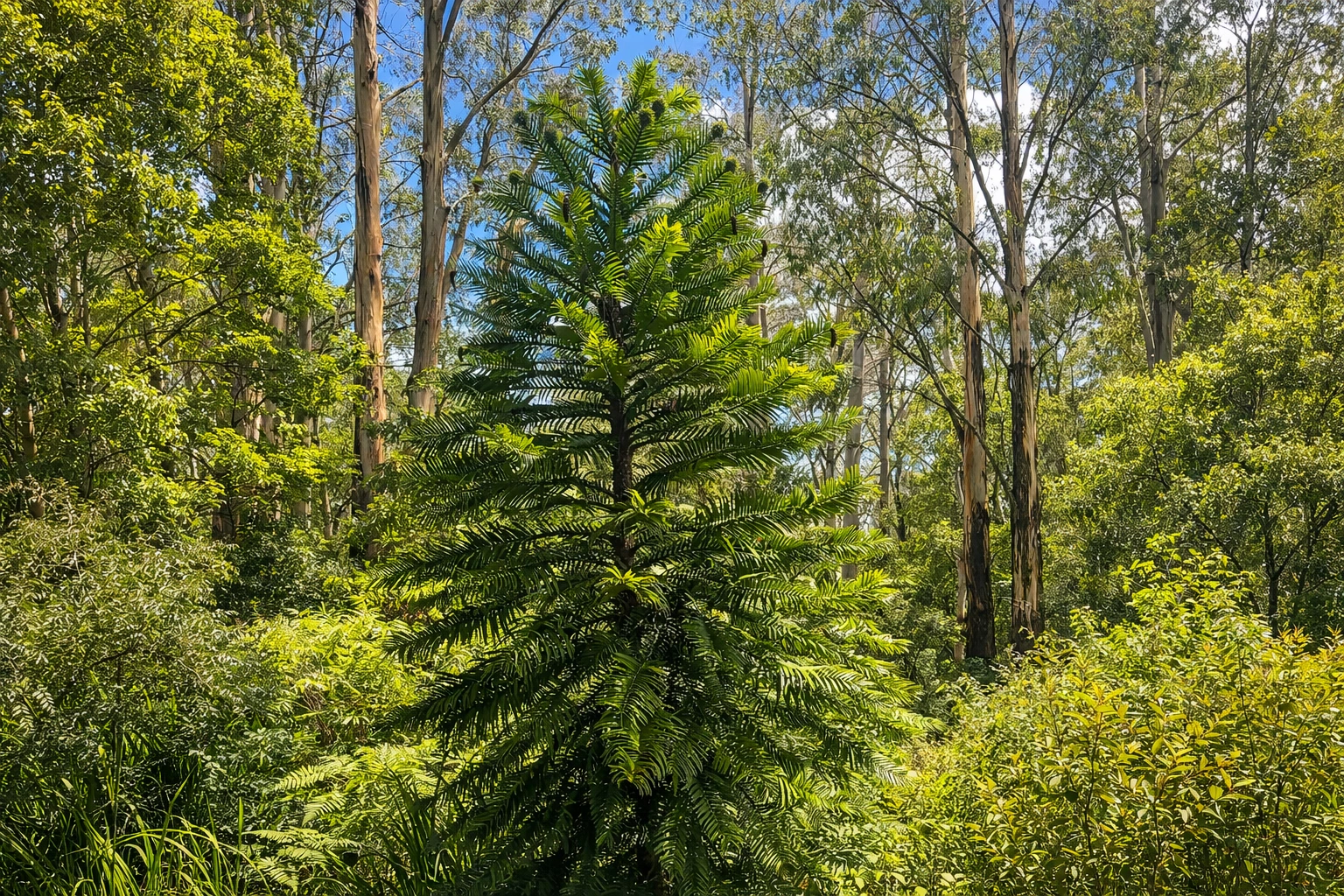
Wollemi Pine
Scientific Name: Wollemia nobilis
is one of the rarest and most remarkable trees in the world. It was discovered in 1994 in a remote canyon within Wollemi National Park, part of the greater Blue Mountains World Heritage Area. Before its discovery, the species was known only from fossils dating back around 90 million years, meaning the tree was thought to be extinct. Its unusual bark, which looks like dark brown bubbling chocolate, and its distinctive fern-like foliage make it unlike any other modern tree.
Only a very small number of wild trees survive in the secret canyon where they were discovered, and their exact location is carefully protected to prevent damage or disease. To help conserve the species, the tree has been successfully propagated and sold around the world, allowing people to grow Wollemi Pines in gardens while reducing pressure on the wild population. Today the Wollemi Pine is considered a living fossil and one of Australia’s most important botanical discoveries.
Australian native plants are some of the toughest and most distinctive in the world, shaped by millions of years of isolation, harsh climates and frequent bushfires. From towering eucalyptus trees to delicate wildflowers, they’ve evolved to survive drought, poor soils and extreme heat. Many species have waxy leaves, deep root systems or fire-resistant bark, helping them cope with the often brutal Australian environment.
Iconic natives include eucalyptus (gum trees), which dominate much of the landscape and provide food for koalas; acacias (wattles), famous for their golden blooms and Australia’s national floral emblem; and banksias, with their striking cone-shaped flowers that attract birds and insects. In drier regions you’ll find spinifex grasses and hardy shrubs, while rainforests in the north support lush ferns and ancient plant species. Australian native plants not only shape the scenery but also support the country’s unique wildlife, forming the backbone of its ecosystems.
This stylistic image blends elements from multiple themes into one cohesive visual scene.
Sturt’s Desert Pea
Scientific name: Swainsona Formosa
is one of Australia’s most striking wildflowers, instantly recognisable by its vivid scarlet petals and dramatic dark centre. Native to the arid and semi-arid regions of central Australia, it thrives in harsh desert conditions, often blooming spectacularly after rainfall. The plant grows low to the ground with trailing stems, using its deep roots to survive extreme heat and drought. Chosen as the floral emblem of South Australia, the Sturt’s Desert Pea symbolises resilience, beauty, and the extraordinary colour found in Australia’s outback landscapes.
Boab
Scientific name: Adansonia gregorii
is an iconic and ancient tree of north-western Australia, instantly recognisable by its massive, bottle-shaped trunk and sparse, twisting branches. Perfectly adapted to harsh, dry environments, the boab stores water in its swollen trunk, allowing it to survive long droughts and extreme heat. Some boabs are thought to be over a thousand years old and hold deep cultural significance for Indigenous Australians, who traditionally used the tree for food, water, shelter, and medicine. Standing solitary across the Kimberley landscape, the boab is a powerful symbol of endurance and Australia’s unique natural heritage
Red wattle
Scientific name: Acacia terminalis
is one of Australia’s most striking native plants, known for its vivid crimson, brush-like flowers that appear mainly from late winter to spring. It’s a hardy shrub or small tree found along the east coast, especially in New South Wales, thriving in bushland, open forests, and rocky soils. Beyond its beauty, the red wattle plays an important ecological role, providing nectar for birds and insects, while also enriching the soil through nitrogen fixation. Culturally, wattles are deeply significant to Aboriginal Australians, traditionally used for tools, food, medicine, and ceremony, and today the red wattle is widely celebrated as a symbol of Australia’s unique and resilient natural heritage.
Elkhorn Fern
Scientific Name: Platycerium bifurcatum
is a distinctive epiphytic fern native to eastern Australia and New Guinea. It commonly grows on tree trunks, branches, or rocks, where it anchors itself without taking nutrients from the host plant. The fern gets its name from its forked, antler-shaped fronds, which resemble the antlers of an elk or deer. In addition to these large decorative fronds, it also produces rounded shield fronds that lie flat against the surface it grows on, helping collect organic material and moisture for nutrients.
Elkhorn ferns are popular garden and indoor plants because of their unusual appearance and relatively easy care. In nature they thrive in humid forests and sheltered coastal areas, where they receive filtered light and plenty of airflow. Gardeners often mount them on boards or hang them in baskets to mimic their natural growing conditions. The plant reproduces through tiny spores rather than seeds, like other ferns, and over time it can grow into large clusters that create a striking natural display.
Staghorn Fern
Scienticic Name: Platycerium superbum
is a spectacular epiphytic fern native to eastern Australia, particularly Queensland and northern New South Wales. It grows naturally on tree trunks and large branches, where it anchors itself without harming the host tree. The plant gets its name from its large, forked antler-shaped fronds, which resemble the antlers of a stag. In addition to these dramatic fronds, the fern produces large shield fronds that form a round, protective base that helps collect fallen leaves, moisture, and nutrients.
Staghorn ferns can grow very large, sometimes reaching more than a metre across, and are popular in Australian gardens where they are often mounted on timber boards or hung from trees. In the wild they thrive in warm, humid forests with filtered light and good air circulation. Like all ferns, they reproduce using spores rather than seeds, which develop on the underside of the fronds. Over time a mature staghorn becomes a striking living feature, often forming a large hanging mass of foliage in rainforest environments.
Wollemi Pine
Scientific Name: Wollemia nobilis
is one of the rarest and most remarkable trees in the world. It was discovered in 1994 in a remote canyon within Wollemi National Park, part of the greater Blue Mountains World Heritage Area. Before its discovery, the species was known only from fossils dating back around 90 million years, meaning the tree was thought to be extinct. Its unusual bark, which looks like dark brown bubbling chocolate, and its distinctive fern-like foliage make it unlike any other modern tree.
Only a very small number of wild trees survive in the secret canyon where they were discovered, and their exact location is carefully protected to prevent damage or disease. To help conserve the species, the tree has been successfully propagated and sold around the world, allowing people to grow Wollemi Pines in gardens while reducing pressure on the wild population. Today the Wollemi Pine is considered a living fossil and one of Australia’s most important botanical discoveries.
The Beauty of Australia
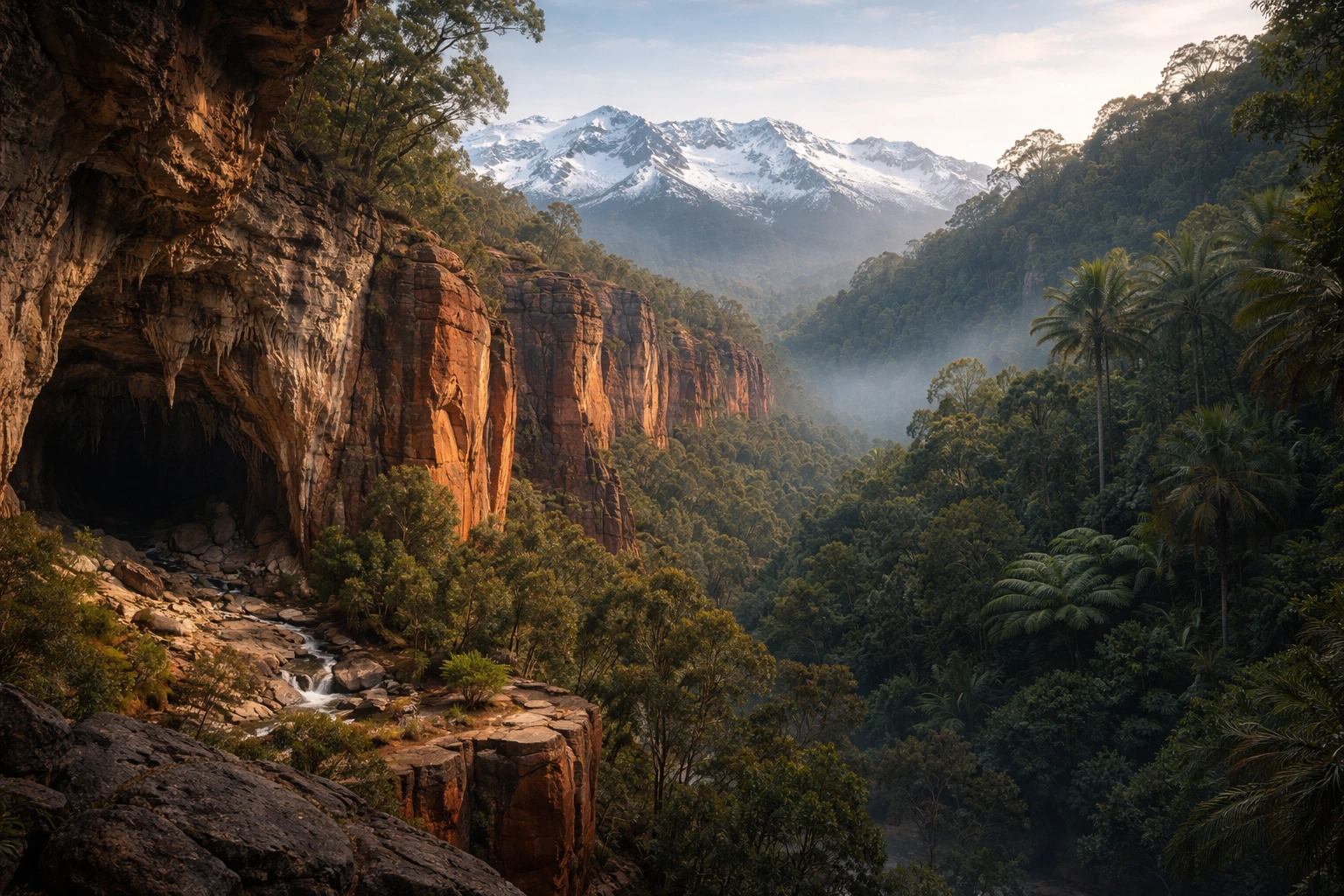
Our Diverse Landscapes
From the limestone depths of Jenolan Caves and the red cliffs of Kings Canyon to the snowy Australian Alps and the lush Daintree Rainforest, Australia showcases extraordinary natural diversity in one continent.
Australia’s landscapes are wildly diverse, shifting from ancient underground worlds to towering sandstone chasms and alpine peaks dusted in winter snow. Beneath the surface, vast cave systems like those found at Jenolan Caves reveal limestone chambers sculpted over millions of years, filled with delicate stalactites and underground rivers. Above ground, dramatic escarpments such as Kings Canyon showcase sheer red rock walls carved by time, glowing intensely at sunrise and sunset. Further south-east, the Australian Alps transform into snowfields during winter, creating a rare alpine environment where gum trees meet frosted ridgelines and crisp mountain air replaces the heat many associate with the continent.
In striking contrast, Australia’s tropical north is home to some of the oldest surviving rainforest on Earth. The lush canopy of the Daintree Rainforest is thick with towering palms, ancient ferns, and dense green layers alive with birdlife and humidity. Mist often hangs between the trees at dawn, softening the landscape in a way completely different from the sharp lines of desert canyons or snowy peaks. Together, these environments — caves, canyons, snowfields, and rainforests — reveal a continent shaped by immense geological time and climatic extremes, offering an extraordinary range of scenery within one nation.
This stylistic image blends elements from multiple themes into one cohesive visual scene.
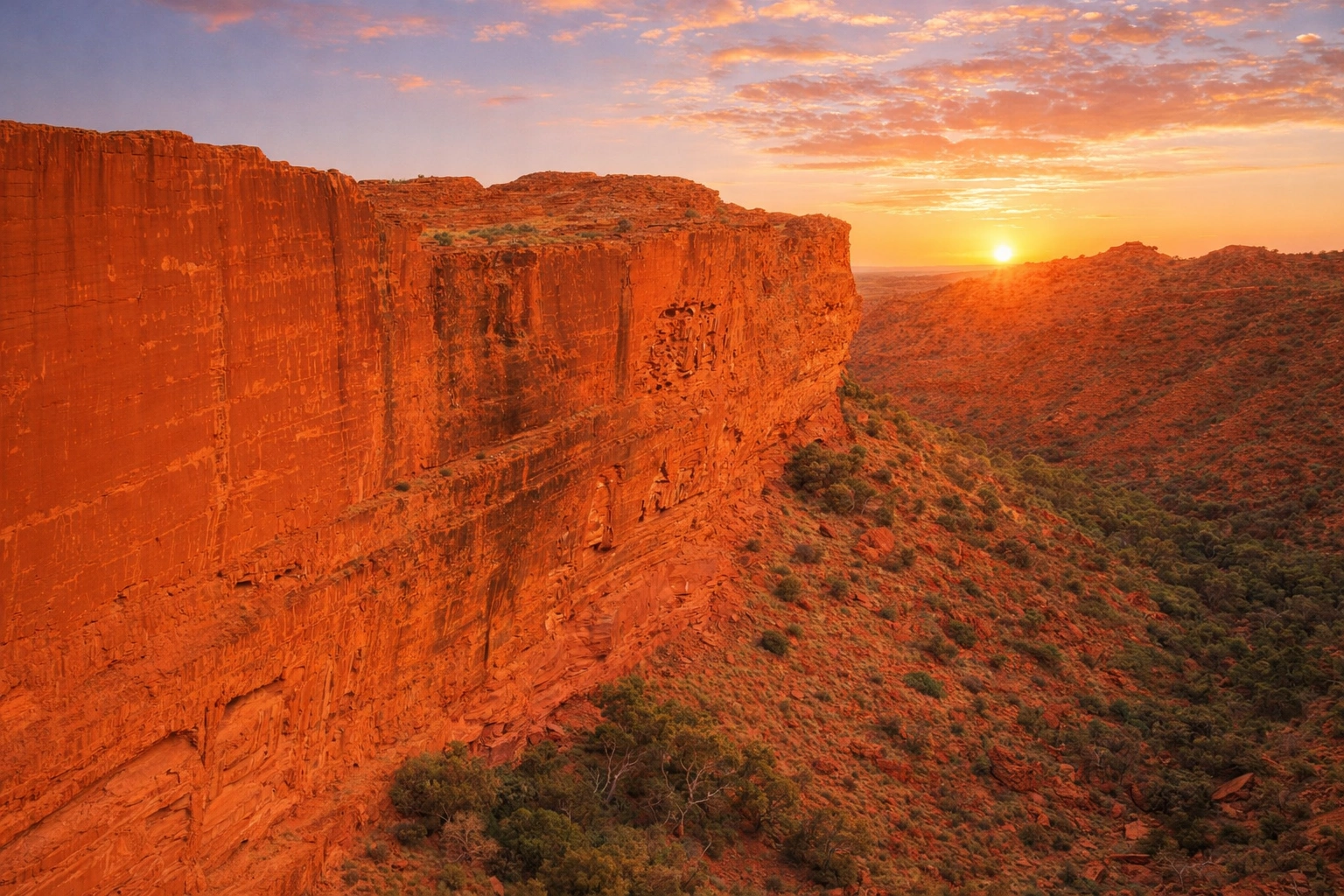
Kings Canyon, Northern Territory
is a dramatic sandstone gorge located in Watarrka National Park in the Northern Territory, roughly halfway between Uluru and Alice Springs. Its towering red cliffs rise more than 100 metres above the canyon floor, creating one of Australia’s most spectacular outback landscapes. The rock formations glow especially beautifully at sunrise and sunset, when the desert light turns the canyon walls deep shades of orange and red.
The famous Rim Walk is the highlight — a challenging but unforgettable hike that takes you along the top of the canyon with sweeping views across the desert. Along the way you’ll find the lush “Garden of Eden,” a shaded waterhole surrounded by cycads and ancient plant life that feels almost hidden from the harsh outback environment. It’s a place that feels rugged, vast and quietly powerful — very classic Red Centre energy.
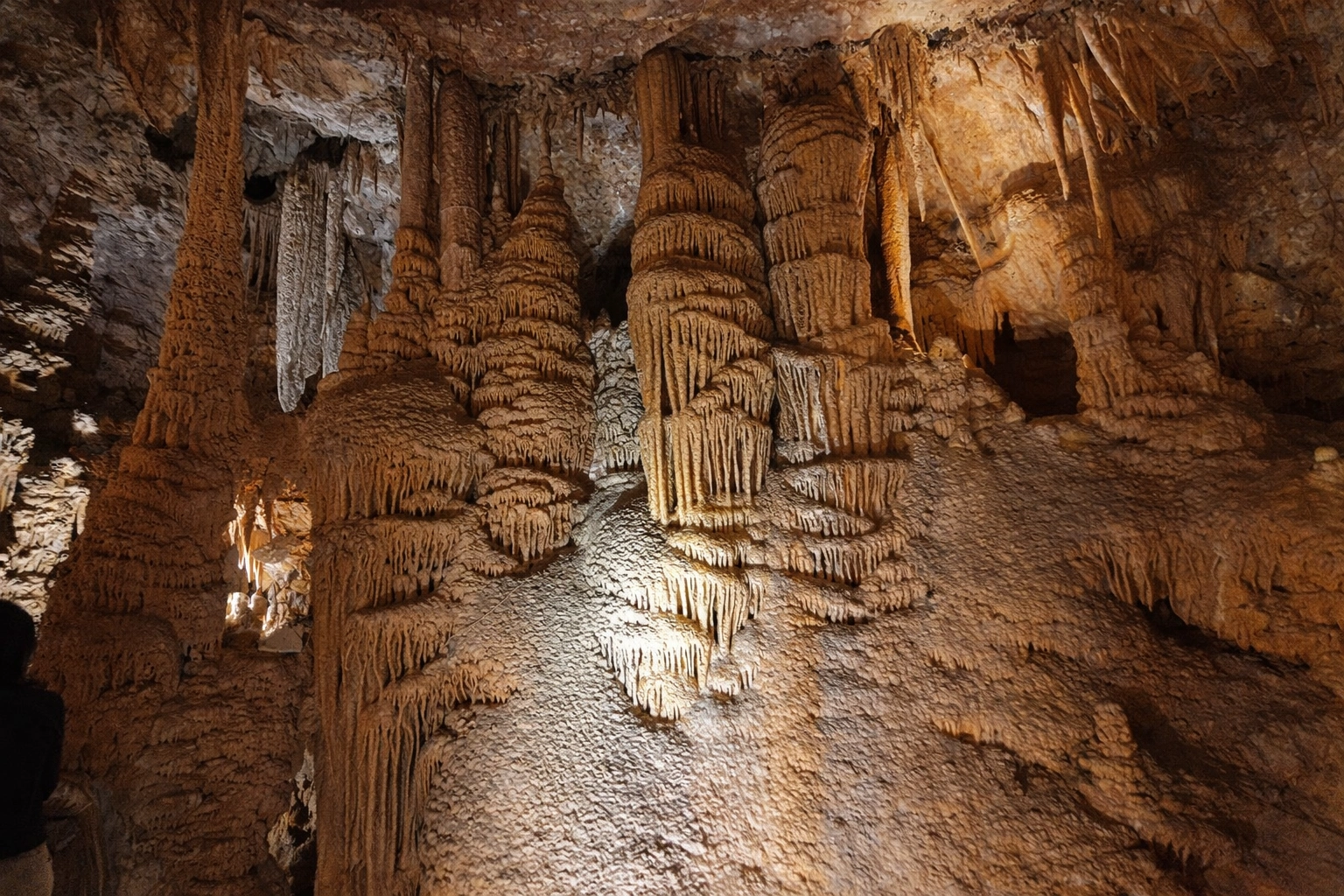
Jenolan Caves, New South Wales
The Egyptian Colonnades
Jenolan Caves are one of Australia’s most spectacular natural wonders, tucked away on the western edge of the Blue Mountains in New South Wales. They’re among the oldest cave systems in the world — estimated at over 340 million years old — and have been welcoming visitors since the 1800s, making them Australia’s oldest tourist attraction. The caves were formed from limestone and are famous for their dramatic stalactites, stalagmites, crystal formations and vast underground chambers that feel almost cathedral-like in scale.
There are several show caves to explore, each with its own personality — from the richly decorated Lucas Cave to the river-carved passages of the Chifley Cave. Guided tours take you deep underground through illuminated chambers, narrow passageways and along subterranean rivers, while above ground, the surrounding valley is stunning in its own right, with bushwalks, native wildlife and that classic Blue Mountains scenery. It’s one of those places that genuinely feels ancient and a little bit magical at the same time.
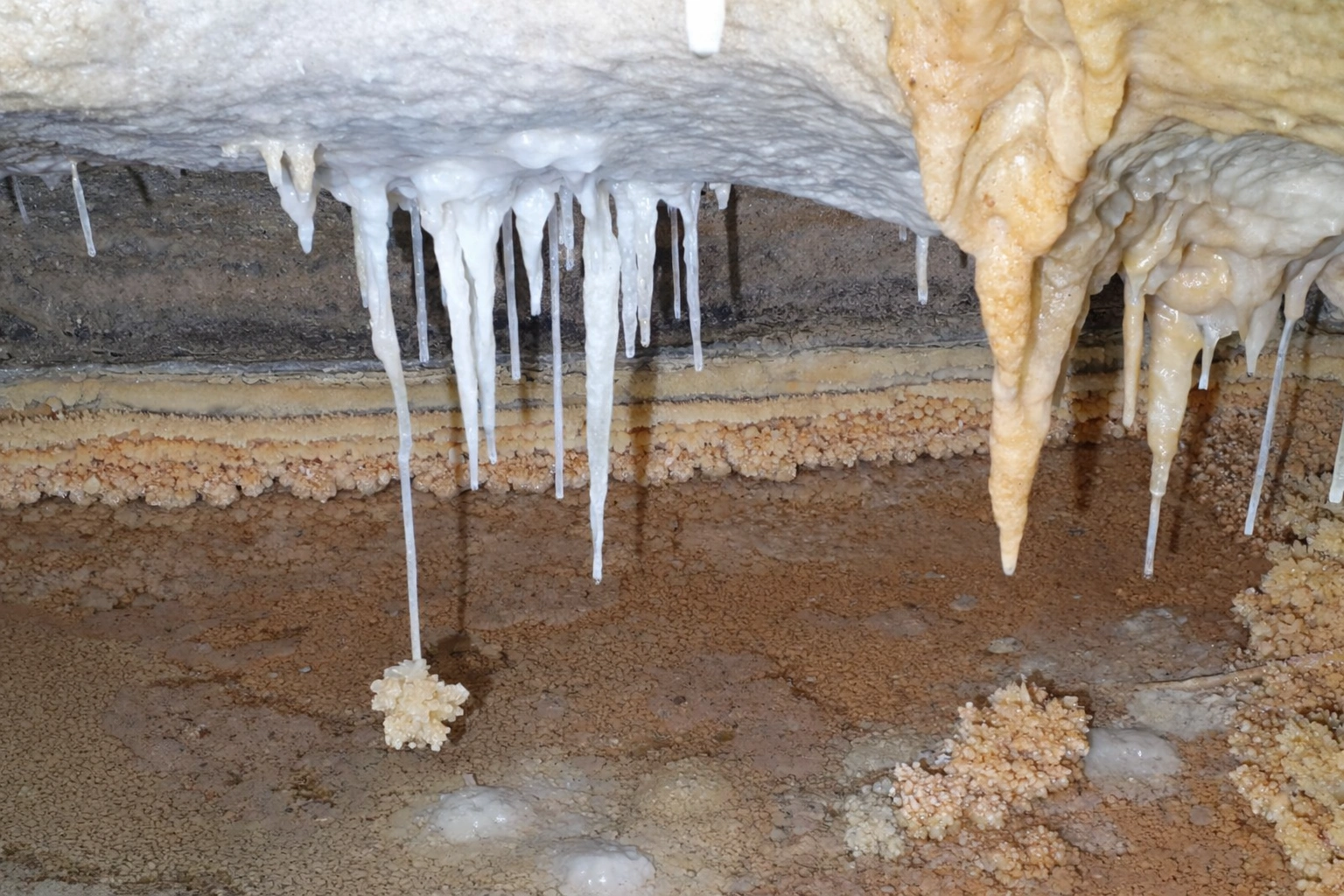
Yarrangobilly Caves, New South Wales
Pendulite formation in Castle Cave
Yarrangobilly Caves sit tucked away in the northern part of Kosciuszko National Park, and they feel wonderfully remote compared to some of the more famous cave systems. The limestone caves are estimated to be around 440–500 million years old, making them some of the oldest in Australia. Inside, you’ll find delicate stalactites, shawls, flowstone and beautifully preserved formations, especially in the self-guided Jillabenan Cave and the guided tours through South Glory and Harrie Wood Cave.
The natural thermal pool just outside the caves is fed by a natural hot water spring, it remains around 27°C year-round — even when there’s snow on the surrounding mountains. So you can literally soak in warm, crystal-clear water while looking out over alpine bushland. Add in walking tracks, kangaroos grazing nearby, and that quiet Snowy Mountains atmosphere, and it’s one of those hidden NSW gems that feels peaceful, wild and a little bit special.
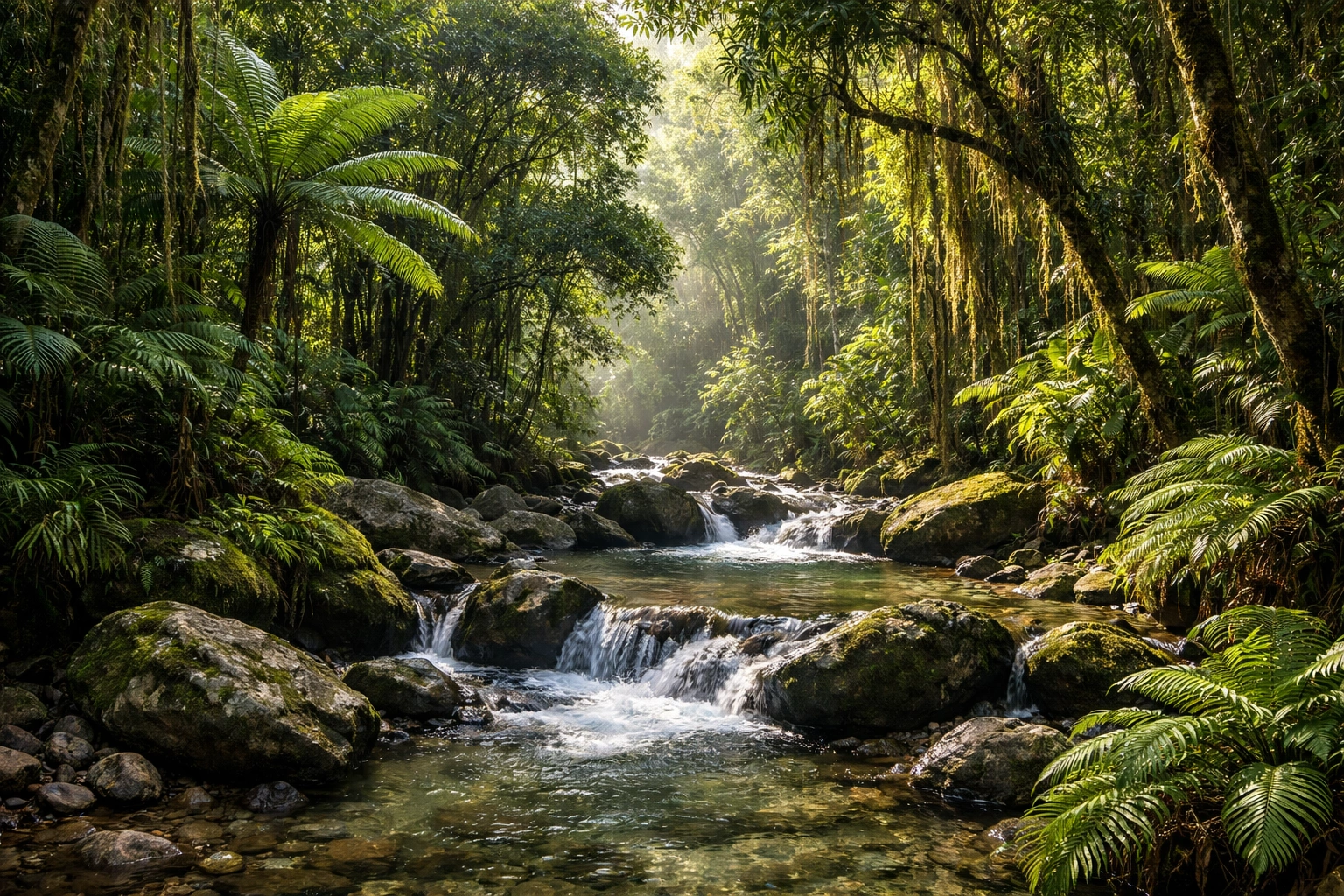
The Daintree Rainforest
Far North Queensland
is one of the oldest surviving tropical rainforests on Earth, estimated to be around 180 million years old. Covering more than 1,200 square kilometres, it forms part of the Wet Tropics of Queensland World Heritage Area and is renowned for its extraordinary biodiversity. The forest is home to thousands of plant species, many found nowhere else in the world, as well as unique wildlife such as the cassowary, tree kangaroos, and countless reptiles, insects, and birds. Its dense canopy, ancient ferns, towering trees, and winding creeks create a rich ecosystem that has remained largely unchanged since the age of the dinosaurs.
One of the most remarkable features of the Daintree is the way the rainforest meets the reef. At places like Cape Tribulation, the lush jungle reaches right down to the white sandy beaches of the Coral Sea, making it one of the few places on Earth where two World Heritage areas—the Daintree Rainforest and the Great Barrier Reef—sit side by side. The area also holds deep cultural significance for the Eastern Kuku Yalanji people, the Traditional Owners who have lived in and cared for this land for thousands of years. Today the rainforest is a major eco-tourism destination, offering visitors opportunities to explore walking tracks, river cruises, and pristine wilderness while highlighting the importance of conservation.
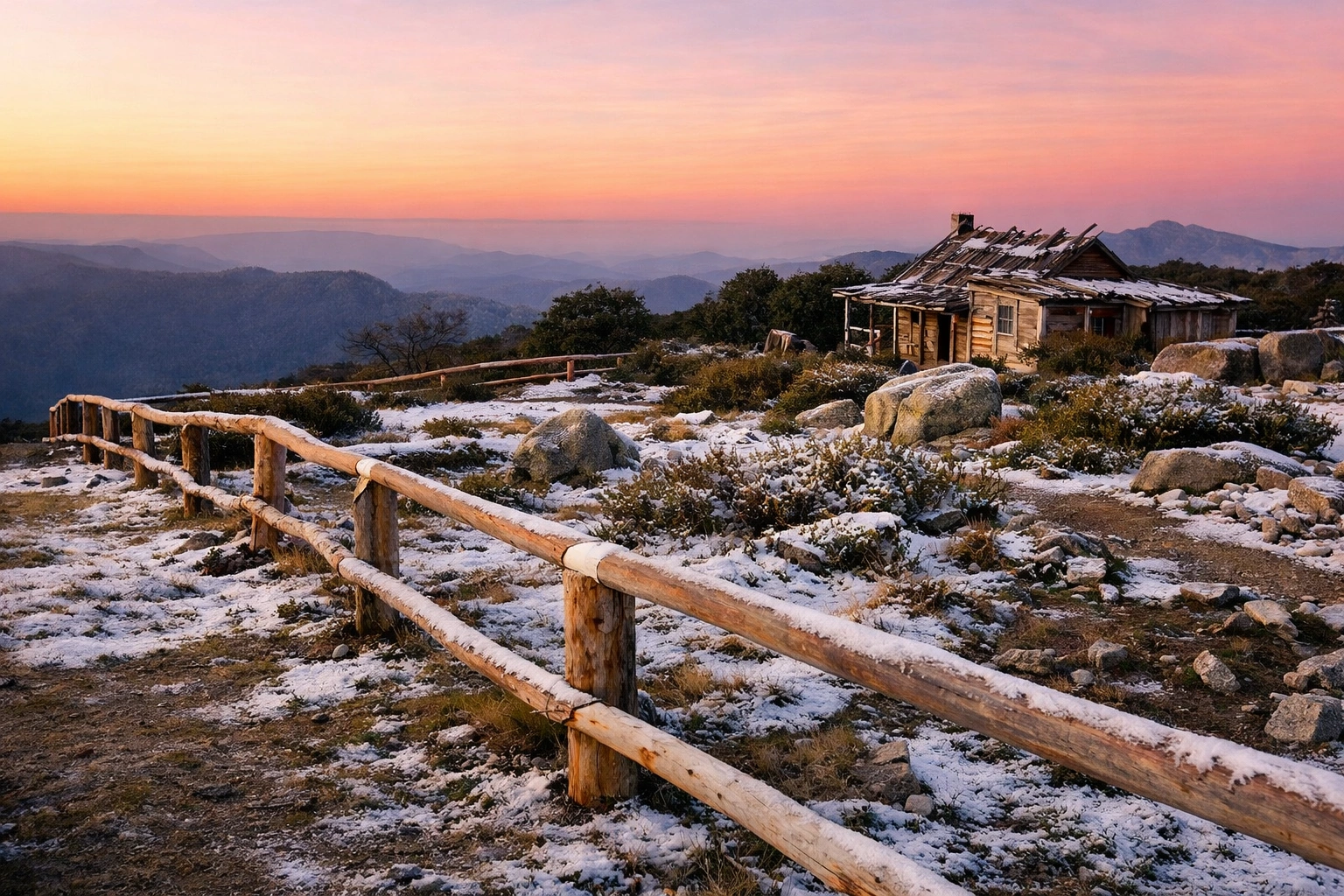
The Victorian High Country
is a spectacular alpine and mountain region in northeast Victoria known for its rugged peaks, sweeping valleys, and historic mountain heritage. Part of the Australian Alps, the area includes famous destinations such as Mount Hotham, Falls Creek, Mount Buller, and the Alpine National Park. Snow-covered in winter and lush with wildflowers in summer, the region offers year-round outdoor adventures including skiing, hiking, mountain biking, horse riding, and four-wheel driving through dramatic highland landscapes. Snow gums, alpine meadows, clear rivers, and panoramic mountain views make it one of Australia’s most striking natural regions.
The High Country is also deeply connected to Australia’s pastoral and bush heritage. In the 1800s, cattlemen grazed their livestock on the alpine plains during the summer months, living in simple mountain huts that still stand today as historic landmarks. The region’s folklore inspired stories and legends such as The Man from Snowy River, reflecting the tough and independent spirit of the mountain stockmen. Today, towns like Bright, Beechworth, Mansfield, and Omeo serve as gateways to the High Country, attracting visitors with scenic drives, wineries, historic gold-rush sites, and some of the most dramatic mountain scenery in Australia.
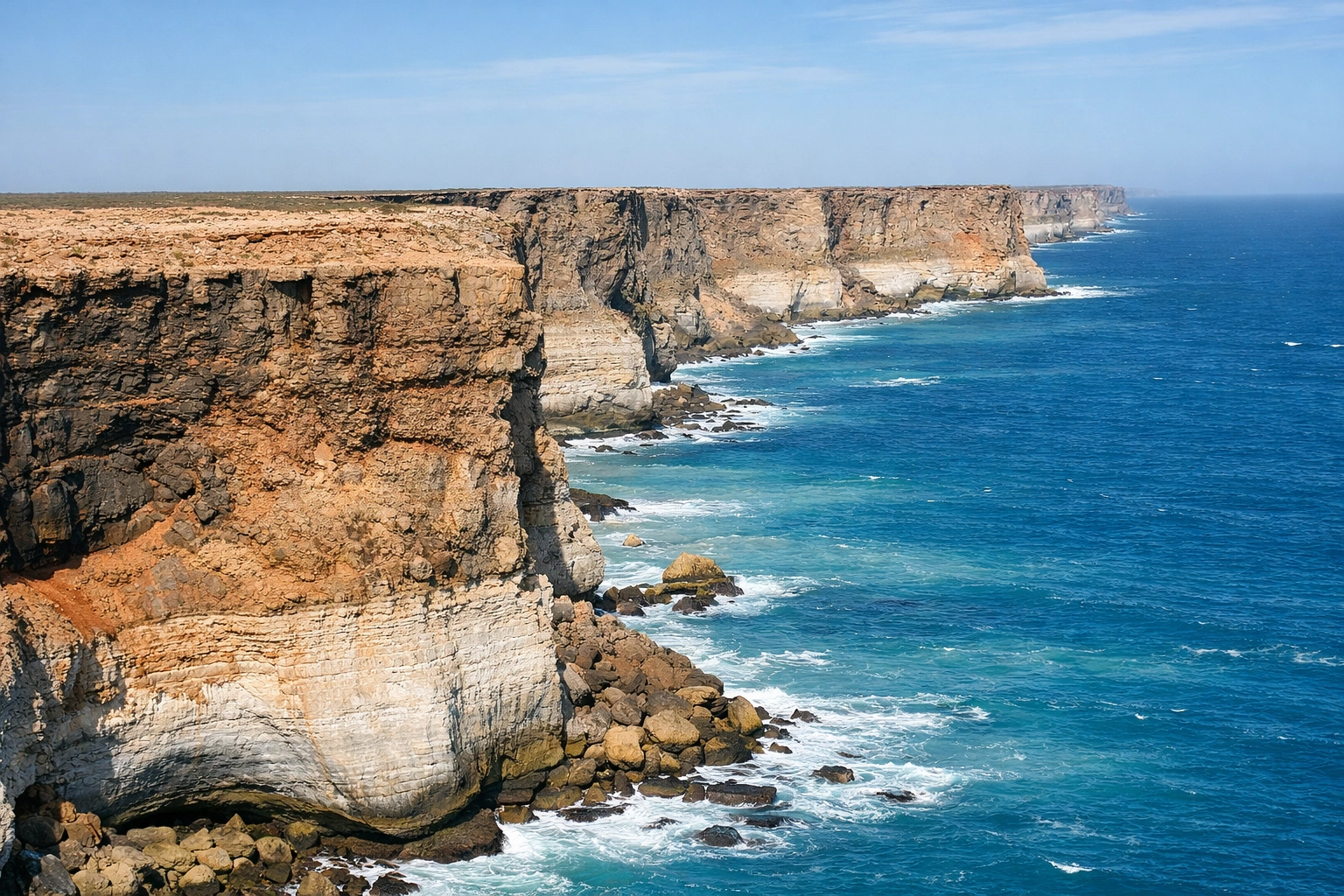
The Great Australian Bight
is a vast open bay along the southern coast of Australia, stretching for more than 1,100 kilometres from Western Australia to South Australia. It is famous for its dramatic coastal scenery, particularly the towering Bunda Cliffs, which rise up to 120 metres above the Southern Ocean and extend for hundreds of kilometres along the edge of the Nullarbor Plain. The coastline is remote, wild, and largely untouched, with powerful waves, rugged cliffs, and sweeping ocean views that make it one of Australia’s most striking natural landscapes.
The waters of the Great Australian Bight are also internationally significant for marine wildlife. Each winter, southern right whales migrate to the sheltered waters near the Head of the Bight to breed and raise their calves, providing one of the best land-based whale watching experiences in Australia. The region is also home to sea lions, dolphins, sharks, and a wide range of seabirds. Because of its ecological importance and fragile environment, large areas of the Bight are protected within marine parks and conservation zones, helping preserve this unique and remote part of Australia’s coastline.
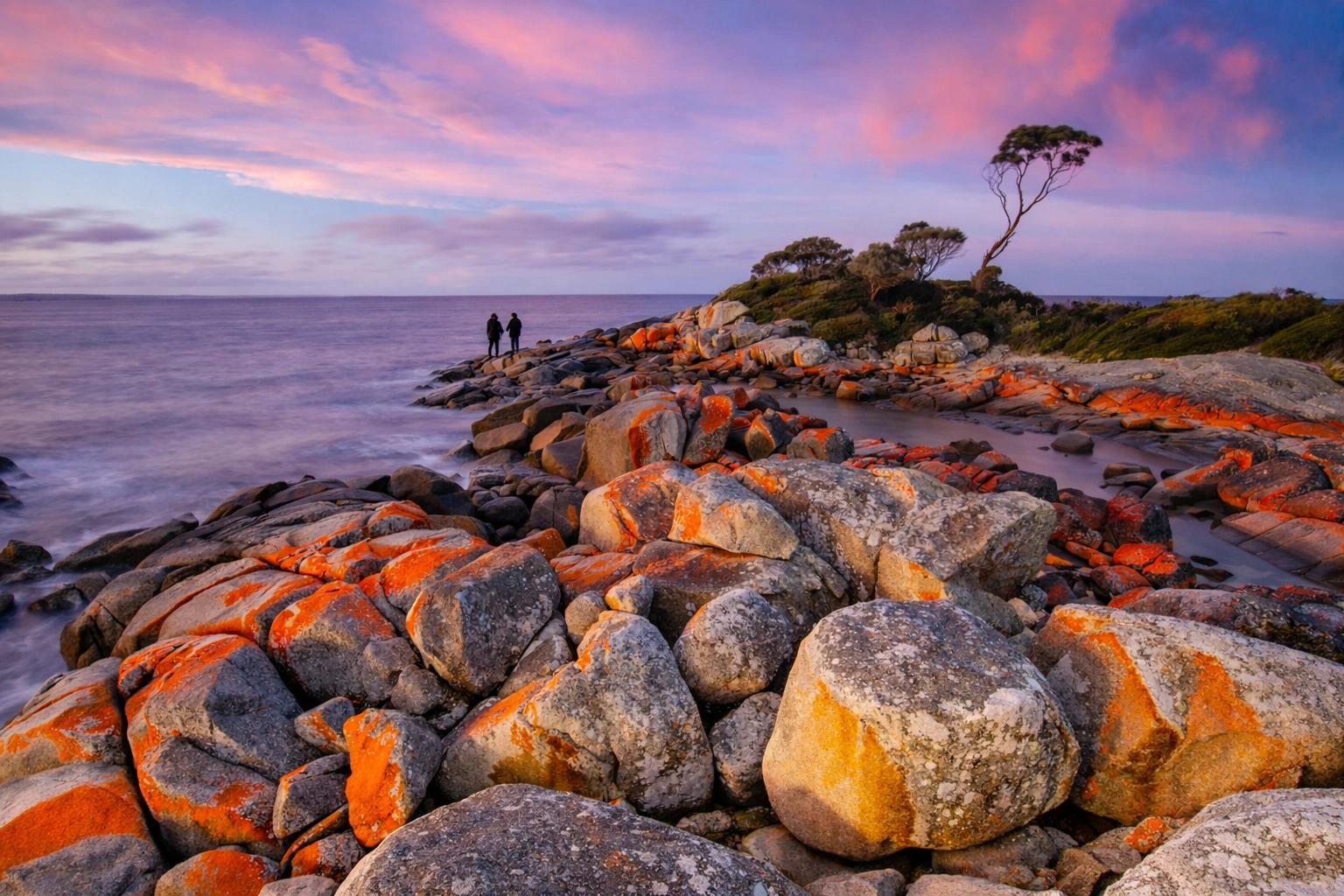
The Bay of Fires
is one of Tasmania’s most stunning coastal regions, located along the island’s northeast coast between Binalong Bay and Eddystone Point. The area is famous for its dazzling white sand beaches, crystal-clear turquoise water, and the striking orange lichen that coats the granite boulders scattered along the shoreline. This vivid contrast of colours—bright orange rocks, white sand, and deep blue sea—creates one of the most photogenic coastal landscapes in Australia.
Despite its fiery name, the Bay of Fires was named by the explorer Captain Tobias Furneaux in 1773 after seeing the smoke from many Aboriginal fires burning along the coast. The region has long been home to the Palawa people, Tasmania’s Aboriginal community, who lived along these shores for thousands of years. Today the Bay of Fires is a popular destination for camping, fishing, swimming, and beach walking, while still feeling wonderfully remote and unspoiled. Its natural beauty and peaceful atmosphere make it one of Tasmania’s true coastal treasures.
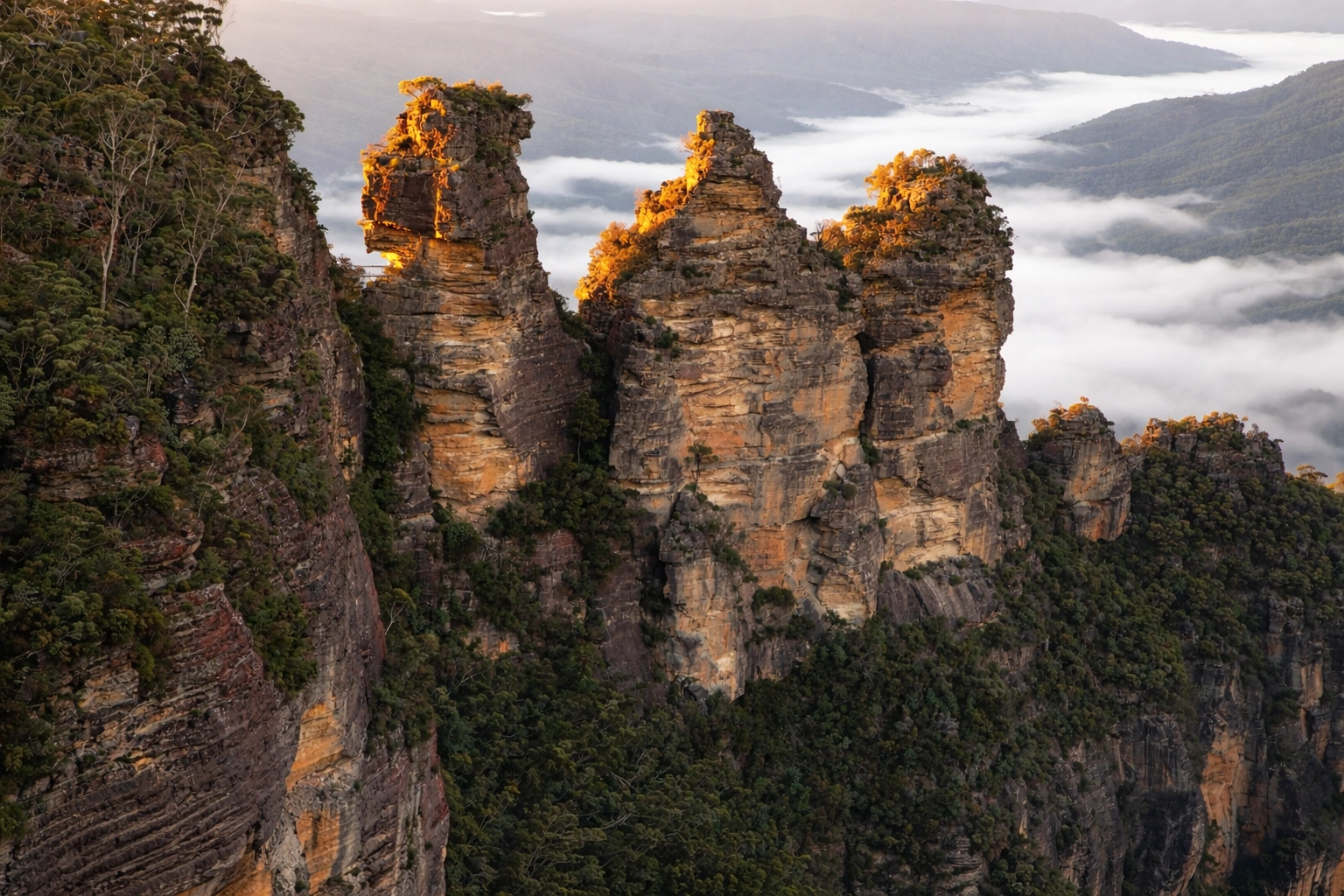
The Three Sisters are one of Australia’s most famous natural landmarks, located at Echo Point in Katoomba within the Blue Mountains National Park in New South Wales. The formation consists of three towering sandstone peaks that rise dramatically above the vast Jamison Valley. Shaped over millions of years by wind, rain, and erosion, the cliffs and surrounding escarpments create a spectacular landscape of deep valleys, eucalyptus forests, and rugged sandstone ridges. The site attracts millions of visitors each year who come to admire the sweeping views and watch the colours of the cliffs change throughout the day as the light shifts.
The rock formation is closely linked to a well-known Aboriginal legend of the Gundungurra people, which tells the story of three sisters—Meehni, Wimlah, and Gunnedoo—who were turned to stone to protect them during a tribal conflict. Although the story is widely shared with visitors today, the Blue Mountains region itself has been home to Aboriginal peoples for thousands of years and holds deep cultural significance. Today the Three Sisters remain one of the most iconic symbols of the Blue Mountains and a highlight for travellers exploring this World Heritage-listed landscape just west of Sydney.
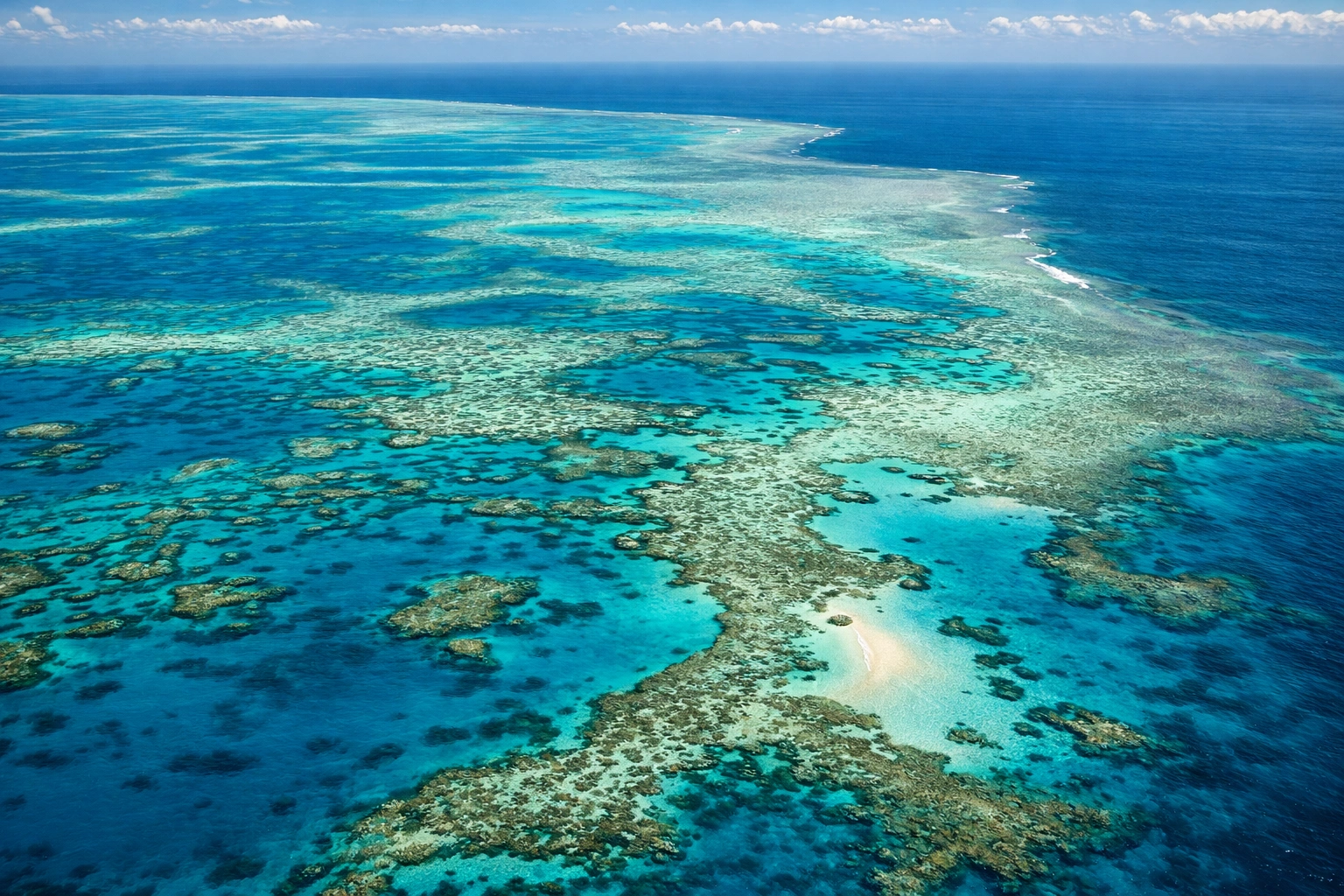
The Great Barrier Reef is the largest coral reef system in the world, stretching more than 2,300 kilometres along the coast of Queensland in northeastern Australia. Made up of around 3,000 individual reefs and 900 islands, it covers an area larger than many countries and can even be seen from space. Beneath its clear tropical waters lies an extraordinary underwater ecosystem filled with colourful coral gardens, tropical fish, sea turtles, sharks, rays, and giant clams. Because of its incredible biodiversity and natural beauty, the reef was listed as a UNESCO World Heritage Site in 1981.
The reef is also culturally significant to many Aboriginal and Torres Strait Islander peoples, who have strong connections to the sea and its resources dating back thousands of years. Today it is one of Australia’s most famous natural attractions, drawing visitors from around the world for snorkelling, scuba diving, sailing, and scenic flights. However, the reef faces ongoing environmental challenges such as coral bleaching, climate change, and pollution, making conservation efforts essential to protect this remarkable natural wonder for future generations.
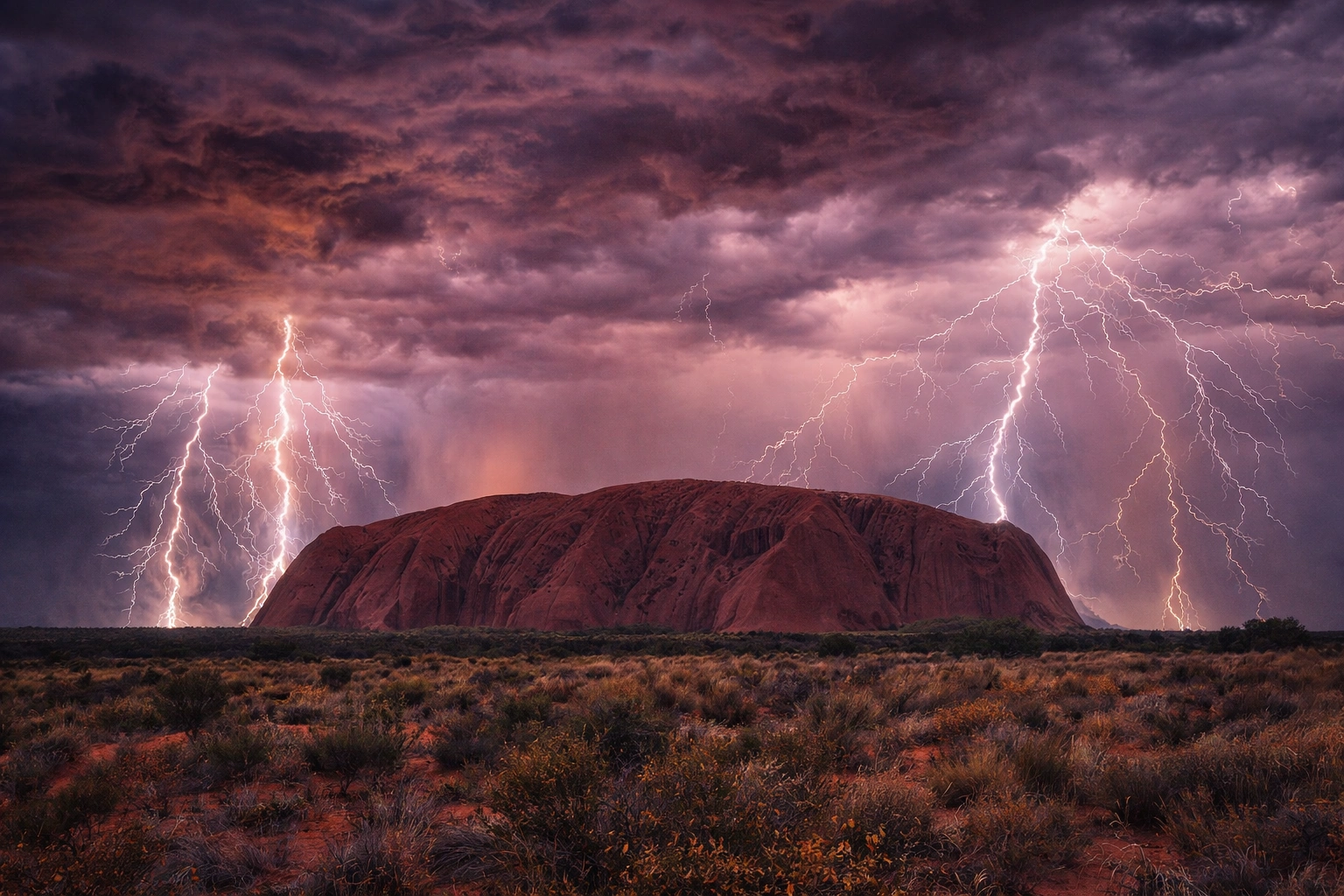
Uluru, also known as Ayers Rock
is one of Australia’s most iconic natural landmarks, located in the heart of the Northern Territory within Uluru–Kata Tjuta National Park. Rising about 348 metres above the surrounding desert plain, this enormous sandstone monolith stretches nearly 3.6 kilometres long and is believed to have formed over 500 million years ago. Uluru is famous for its rich red colour, which changes dramatically throughout the day as the sunlight shifts—glowing deep orange at sunrise and sunset against the vast outback landscape.
Uluru holds profound cultural and spiritual significance for the Anangu people, the Traditional Owners of the land. For thousands of years it has been central to their culture, law, and Dreaming stories, with many sacred sites located around its base. Visitors can explore walking trails that reveal caves, rock art, and natural waterholes that have sustained life in the desert for generations. In recognition of its cultural importance, climbing Uluru was officially closed in 2019, allowing the site to be respected and preserved while still welcoming visitors to experience its remarkable natural and cultural heritage.
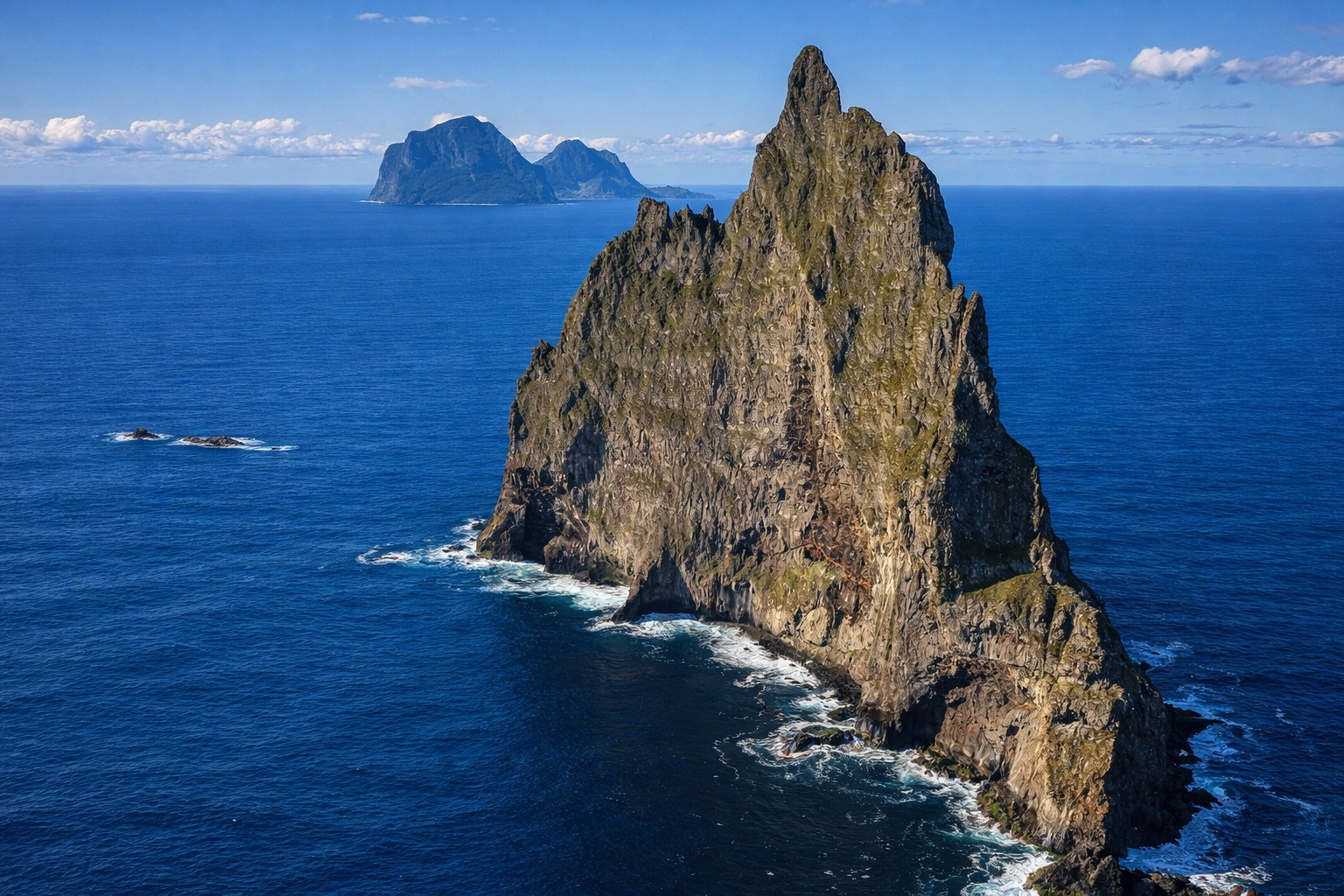
Ball’s Pyramid
Lord Howe Island
is a dramatic volcanic sea stack rising from the Tasman Sea about 20 kilometres southeast of Lord Howe Island, off the coast of New South Wales. Standing around 562 metres high, it is the tallest volcanic sea stack in the world and appears as a steep, blade-like spire of dark rock surrounded by deep ocean. The formation is the eroded remnant of an ancient volcano that formed about 7 million years ago, and today it stands as one of Australia’s most striking and remote natural landmarks.
Despite its rugged and almost inaccessible appearance, Ball’s Pyramid is famous for an extraordinary scientific discovery. In 2001, researchers found a small population of the Lord Howe Island stick insect, often called the “tree lobster,” surviving on the isolated rock after it was thought to be extinct for decades. Because of its fragile ecosystem, access to Ball’s Pyramid is highly restricted, although experienced climbers are permitted to scale the rock under strict conditions. Its towering shape and remote setting make it one of the most unique geological features in Australian waters.
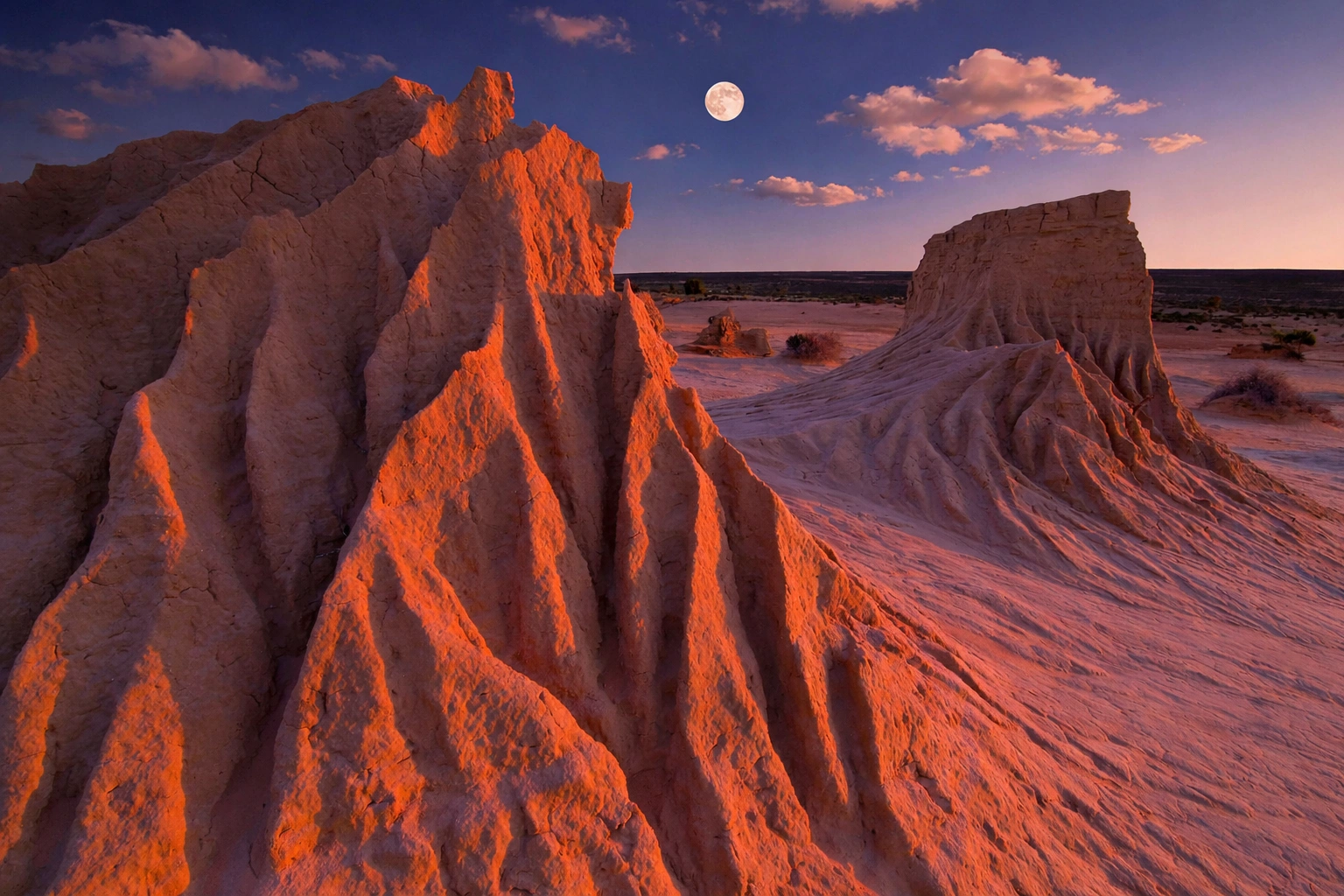
The Walls of China
Mungo, NSW
are a striking series of eroded sand and clay formations located in Mungo National Park in southwestern New South Wales. These sculpted ridges form part of the ancient Willandra Lakes Region, a World Heritage–listed landscape that was once a system of large freshwater lakes thousands of years ago. Over time, wind and erosion carved the exposed lakebed sediments into dramatic wave-like shapes, creating the pale, layered formations that resemble crumbling walls stretching along the edge of the dry lake basin.
The area is also one of the most important archaeological sites in Australia. Human remains known as Mungo Man and Mungo Lady, dating back more than 40,000 years, were discovered here, providing some of the earliest evidence of human cremation and long-term Aboriginal occupation on the continent. For the Paakantji, Mutthi Mutthi, and Ngyiampaa peoples, the Traditional Custodians of the region, the Walls of China hold deep cultural and spiritual significance. Today visitors can explore the area on guided tours or designated viewing areas, where the changing light at sunrise and sunset highlights the dramatic shapes and colours of this ancient landscape.
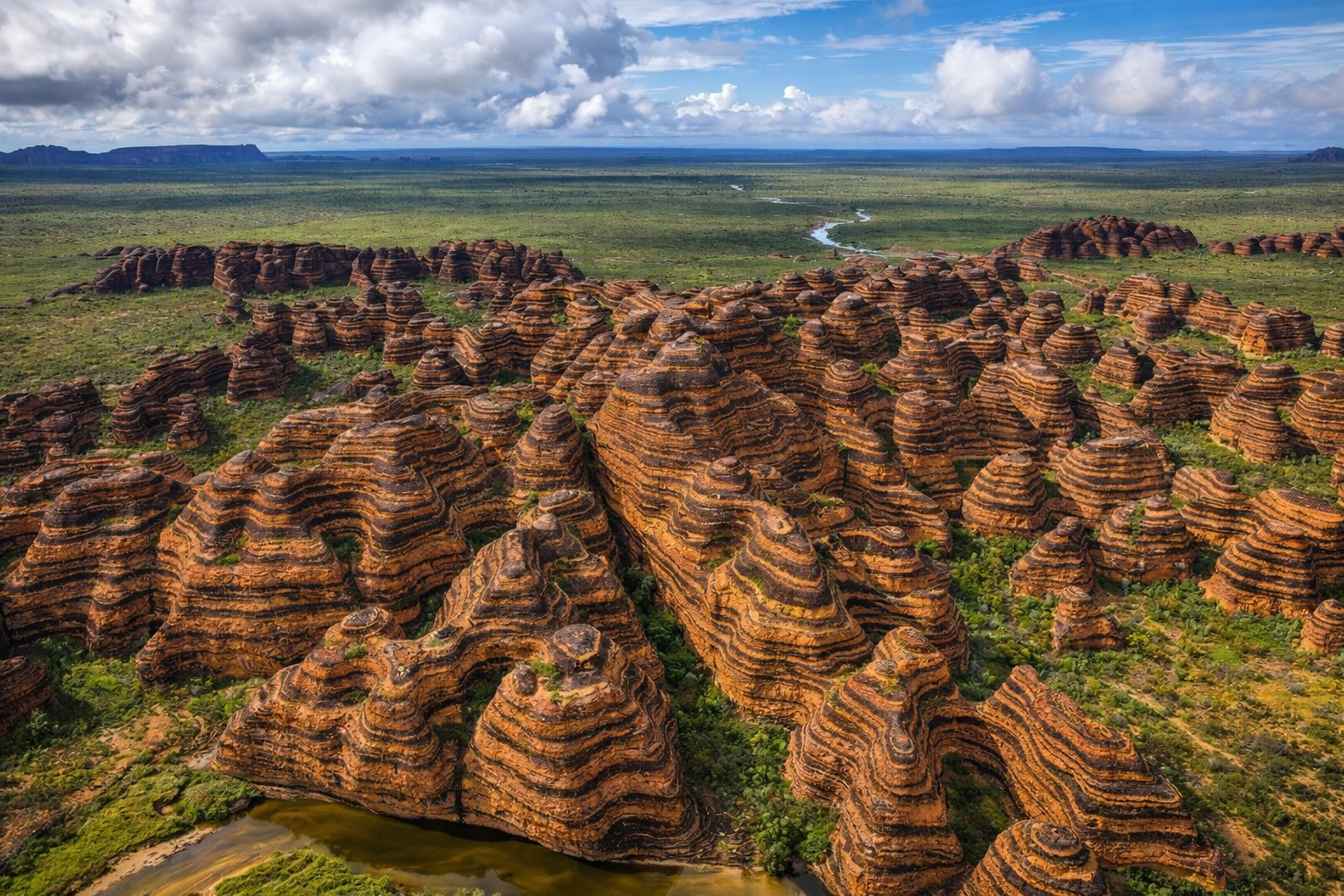
The Bungle Bungles
are a spectacular range of sandstone domes located in Purnululu National Park in the Kimberley region of Western Australia. These distinctive formations are famous for their striking orange and black striped patterns, created by layers of sandstone and algae that developed over millions of years. The beehive-shaped domes rise up to about 250 metres high and stretch across a vast area of rugged wilderness, forming one of Australia’s most unusual and visually dramatic landscapes.
Although known to local Aboriginal people for thousands of years, the Bungle Bungles remained largely unknown to the wider world until aerial photographs revealed them in the early 1980s. The area was later declared Purnululu National Park and listed as a UNESCO World Heritage Site in 2003 for its geological and cultural significance. For the Kija and Jaru peoples, the Traditional Owners of the land, the region holds deep spiritual meaning and features many important cultural sites. Today visitors explore the area through walking tracks and gorges such as Cathedral Gorge and Echidna Chasm, where towering rock walls and dramatic light create unforgettable outback scenery.
Australia’s landscapes are wildly diverse, shifting from ancient underground worlds to towering sandstone chasms and alpine peaks dusted in winter snow. Beneath the surface, vast cave systems like those found at Jenolan Caves reveal limestone chambers sculpted over millions of years, filled with delicate stalactites and underground rivers. Above ground, dramatic escarpments such as Kings Canyon showcase sheer red rock walls carved by time, glowing intensely at sunrise and sunset. Further south-east, the Australian Alps transform into snowfields during winter, creating a rare alpine environment where gum trees meet frosted ridgelines and crisp mountain air replaces the heat many associate with the continent.
In striking contrast, Australia’s tropical north is home to some of the oldest surviving rainforest on Earth. The lush canopy of the Daintree Rainforest is thick with towering palms, ancient ferns, and dense green layers alive with birdlife and humidity. Mist often hangs between the trees at dawn, softening the landscape in a way completely different from the sharp lines of desert canyons or snowy peaks. Together, these environments — caves, canyons, snowfields, and rainforests — reveal a continent shaped by immense geological time and climatic extremes, offering an extraordinary range of scenery within one nation.
This stylistic image blends elements from multiple themes into one cohesive visual scene.
Kings Canyon, Northern Territory
is a dramatic sandstone gorge located in Watarrka National Park in the Northern Territory, roughly halfway between Uluru and Alice Springs. Its towering red cliffs rise more than 100 metres above the canyon floor, creating one of Australia’s most spectacular outback landscapes. The rock formations glow especially beautifully at sunrise and sunset, when the desert light turns the canyon walls deep shades of orange and red.
The famous Rim Walk is the highlight — a challenging but unforgettable hike that takes you along the top of the canyon with sweeping views across the desert. Along the way you’ll find the lush “Garden of Eden,” a shaded waterhole surrounded by cycads and ancient plant life that feels almost hidden from the harsh outback environment. It’s a place that feels rugged, vast and quietly powerful — very classic Red Centre energy.
Jenolan Caves, New South Wales
The Egyptian Colonnades
Jenolan Caves are one of Australia’s most spectacular natural wonders, tucked away on the western edge of the Blue Mountains in New South Wales. They’re among the oldest cave systems in the world — estimated at over 340 million years old — and have been welcoming visitors since the 1800s, making them Australia’s oldest tourist attraction. The caves were formed from limestone and are famous for their dramatic stalactites, stalagmites, crystal formations and vast underground chambers that feel almost cathedral-like in scale.
There are several show caves to explore, each with its own personality — from the richly decorated Lucas Cave to the river-carved passages of the Chifley Cave. Guided tours take you deep underground through illuminated chambers, narrow passageways and along subterranean rivers, while above ground, the surrounding valley is stunning in its own right, with bushwalks, native wildlife and that classic Blue Mountains scenery. It’s one of those places that genuinely feels ancient and a little bit magical at the same time.
Yarrangobilly Caves, New South Wales
Pendulite formation in Castle Cave
Yarrangobilly Caves sit tucked away in the northern part of Kosciuszko National Park, and they feel wonderfully remote compared to some of the more famous cave systems. The limestone caves are estimated to be around 440–500 million years old, making them some of the oldest in Australia. Inside, you’ll find delicate stalactites, shawls, flowstone and beautifully preserved formations, especially in the self-guided Jillabenan Cave and the guided tours through South Glory and Harrie Wood Cave.
The natural thermal pool just outside the caves is fed by a natural hot water spring, it remains around 27°C year-round — even when there’s snow on the surrounding mountains. So you can literally soak in warm, crystal-clear water while looking out over alpine bushland. Add in walking tracks, kangaroos grazing nearby, and that quiet Snowy Mountains atmosphere, and it’s one of those hidden NSW gems that feels peaceful, wild and a little bit special.
The Daintree Rainforest
Far North Queensland
is one of the oldest surviving tropical rainforests on Earth, estimated to be around 180 million years old. Covering more than 1,200 square kilometres, it forms part of the Wet Tropics of Queensland World Heritage Area and is renowned for its extraordinary biodiversity. The forest is home to thousands of plant species, many found nowhere else in the world, as well as unique wildlife such as the cassowary, tree kangaroos, and countless reptiles, insects, and birds. Its dense canopy, ancient ferns, towering trees, and winding creeks create a rich ecosystem that has remained largely unchanged since the age of the dinosaurs.
One of the most remarkable features of the Daintree is the way the rainforest meets the reef. At places like Cape Tribulation, the lush jungle reaches right down to the white sandy beaches of the Coral Sea, making it one of the few places on Earth where two World Heritage areas—the Daintree Rainforest and the Great Barrier Reef—sit side by side. The area also holds deep cultural significance for the Eastern Kuku Yalanji people, the Traditional Owners who have lived in and cared for this land for thousands of years. Today the rainforest is a major eco-tourism destination, offering visitors opportunities to explore walking tracks, river cruises, and pristine wilderness while highlighting the importance of conservation.
The Victorian High Country
is a spectacular alpine and mountain region in northeast Victoria known for its rugged peaks, sweeping valleys, and historic mountain heritage. Part of the Australian Alps, the area includes famous destinations such as Mount Hotham, Falls Creek, Mount Buller, and the Alpine National Park. Snow-covered in winter and lush with wildflowers in summer, the region offers year-round outdoor adventures including skiing, hiking, mountain biking, horse riding, and four-wheel driving through dramatic highland landscapes. Snow gums, alpine meadows, clear rivers, and panoramic mountain views make it one of Australia’s most striking natural regions.
The High Country is also deeply connected to Australia’s pastoral and bush heritage. In the 1800s, cattlemen grazed their livestock on the alpine plains during the summer months, living in simple mountain huts that still stand today as historic landmarks. The region’s folklore inspired stories and legends such as The Man from Snowy River, reflecting the tough and independent spirit of the mountain stockmen. Today, towns like Bright, Beechworth, Mansfield, and Omeo serve as gateways to the High Country, attracting visitors with scenic drives, wineries, historic gold-rush sites, and some of the most dramatic mountain scenery in Australia.
The Great Australian Bight
is a vast open bay along the southern coast of Australia, stretching for more than 1,100 kilometres from Western Australia to South Australia. It is famous for its dramatic coastal scenery, particularly the towering Bunda Cliffs, which rise up to 120 metres above the Southern Ocean and extend for hundreds of kilometres along the edge of the Nullarbor Plain. The coastline is remote, wild, and largely untouched, with powerful waves, rugged cliffs, and sweeping ocean views that make it one of Australia’s most striking natural landscapes.
The waters of the Great Australian Bight are also internationally significant for marine wildlife. Each winter, southern right whales migrate to the sheltered waters near the Head of the Bight to breed and raise their calves, providing one of the best land-based whale watching experiences in Australia. The region is also home to sea lions, dolphins, sharks, and a wide range of seabirds. Because of its ecological importance and fragile environment, large areas of the Bight are protected within marine parks and conservation zones, helping preserve this unique and remote part of Australia’s coastline.
The Bay of Fires
is one of Tasmania’s most stunning coastal regions, located along the island’s northeast coast between Binalong Bay and Eddystone Point. The area is famous for its dazzling white sand beaches, crystal-clear turquoise water, and the striking orange lichen that coats the granite boulders scattered along the shoreline. This vivid contrast of colours—bright orange rocks, white sand, and deep blue sea—creates one of the most photogenic coastal landscapes in Australia.
Despite its fiery name, the Bay of Fires was named by the explorer Captain Tobias Furneaux in 1773 after seeing the smoke from many Aboriginal fires burning along the coast. The region has long been home to the Palawa people, Tasmania’s Aboriginal community, who lived along these shores for thousands of years. Today the Bay of Fires is a popular destination for camping, fishing, swimming, and beach walking, while still feeling wonderfully remote and unspoiled. Its natural beauty and peaceful atmosphere make it one of Tasmania’s true coastal treasures.
The Three Sisters are one of Australia’s most famous natural landmarks, located at Echo Point in Katoomba within the Blue Mountains National Park in New South Wales. The formation consists of three towering sandstone peaks that rise dramatically above the vast Jamison Valley. Shaped over millions of years by wind, rain, and erosion, the cliffs and surrounding escarpments create a spectacular landscape of deep valleys, eucalyptus forests, and rugged sandstone ridges. The site attracts millions of visitors each year who come to admire the sweeping views and watch the colours of the cliffs change throughout the day as the light shifts.
The rock formation is closely linked to a well-known Aboriginal legend of the Gundungurra people, which tells the story of three sisters—Meehni, Wimlah, and Gunnedoo—who were turned to stone to protect them during a tribal conflict. Although the story is widely shared with visitors today, the Blue Mountains region itself has been home to Aboriginal peoples for thousands of years and holds deep cultural significance. Today the Three Sisters remain one of the most iconic symbols of the Blue Mountains and a highlight for travellers exploring this World Heritage-listed landscape just west of Sydney.
The Great Barrier Reef is the largest coral reef system in the world, stretching more than 2,300 kilometres along the coast of Queensland in northeastern Australia. Made up of around 3,000 individual reefs and 900 islands, it covers an area larger than many countries and can even be seen from space. Beneath its clear tropical waters lies an extraordinary underwater ecosystem filled with colourful coral gardens, tropical fish, sea turtles, sharks, rays, and giant clams. Because of its incredible biodiversity and natural beauty, the reef was listed as a UNESCO World Heritage Site in 1981.
The reef is also culturally significant to many Aboriginal and Torres Strait Islander peoples, who have strong connections to the sea and its resources dating back thousands of years. Today it is one of Australia’s most famous natural attractions, drawing visitors from around the world for snorkelling, scuba diving, sailing, and scenic flights. However, the reef faces ongoing environmental challenges such as coral bleaching, climate change, and pollution, making conservation efforts essential to protect this remarkable natural wonder for future generations.
Uluru, also known as Ayers Rock
is one of Australia’s most iconic natural landmarks, located in the heart of the Northern Territory within Uluru–Kata Tjuta National Park. Rising about 348 metres above the surrounding desert plain, this enormous sandstone monolith stretches nearly 3.6 kilometres long and is believed to have formed over 500 million years ago. Uluru is famous for its rich red colour, which changes dramatically throughout the day as the sunlight shifts—glowing deep orange at sunrise and sunset against the vast outback landscape.
Uluru holds profound cultural and spiritual significance for the Anangu people, the Traditional Owners of the land. For thousands of years it has been central to their culture, law, and Dreaming stories, with many sacred sites located around its base. Visitors can explore walking trails that reveal caves, rock art, and natural waterholes that have sustained life in the desert for generations. In recognition of its cultural importance, climbing Uluru was officially closed in 2019, allowing the site to be respected and preserved while still welcoming visitors to experience its remarkable natural and cultural heritage.
Ball’s Pyramid
Lord Howe Island
is a dramatic volcanic sea stack rising from the Tasman Sea about 20 kilometres southeast of Lord Howe Island, off the coast of New South Wales. Standing around 562 metres high, it is the tallest volcanic sea stack in the world and appears as a steep, blade-like spire of dark rock surrounded by deep ocean. The formation is the eroded remnant of an ancient volcano that formed about 7 million years ago, and today it stands as one of Australia’s most striking and remote natural landmarks.
Despite its rugged and almost inaccessible appearance, Ball’s Pyramid is famous for an extraordinary scientific discovery. In 2001, researchers found a small population of the Lord Howe Island stick insect, often called the “tree lobster,” surviving on the isolated rock after it was thought to be extinct for decades. Because of its fragile ecosystem, access to Ball’s Pyramid is highly restricted, although experienced climbers are permitted to scale the rock under strict conditions. Its towering shape and remote setting make it one of the most unique geological features in Australian waters.
The Walls of China
Mungo, NSW
are a striking series of eroded sand and clay formations located in Mungo National Park in southwestern New South Wales. These sculpted ridges form part of the ancient Willandra Lakes Region, a World Heritage–listed landscape that was once a system of large freshwater lakes thousands of years ago. Over time, wind and erosion carved the exposed lakebed sediments into dramatic wave-like shapes, creating the pale, layered formations that resemble crumbling walls stretching along the edge of the dry lake basin.
The area is also one of the most important archaeological sites in Australia. Human remains known as Mungo Man and Mungo Lady, dating back more than 40,000 years, were discovered here, providing some of the earliest evidence of human cremation and long-term Aboriginal occupation on the continent. For the Paakantji, Mutthi Mutthi, and Ngyiampaa peoples, the Traditional Custodians of the region, the Walls of China hold deep cultural and spiritual significance. Today visitors can explore the area on guided tours or designated viewing areas, where the changing light at sunrise and sunset highlights the dramatic shapes and colours of this ancient landscape.
The Bungle Bungles
are a spectacular range of sandstone domes located in Purnululu National Park in the Kimberley region of Western Australia. These distinctive formations are famous for their striking orange and black striped patterns, created by layers of sandstone and algae that developed over millions of years. The beehive-shaped domes rise up to about 250 metres high and stretch across a vast area of rugged wilderness, forming one of Australia’s most unusual and visually dramatic landscapes.
Although known to local Aboriginal people for thousands of years, the Bungle Bungles remained largely unknown to the wider world until aerial photographs revealed them in the early 1980s. The area was later declared Purnululu National Park and listed as a UNESCO World Heritage Site in 2003 for its geological and cultural significance. For the Kija and Jaru peoples, the Traditional Owners of the land, the region holds deep spiritual meaning and features many important cultural sites. Today visitors explore the area through walking tracks and gorges such as Cathedral Gorge and Echidna Chasm, where towering rock walls and dramatic light create unforgettable outback scenery.
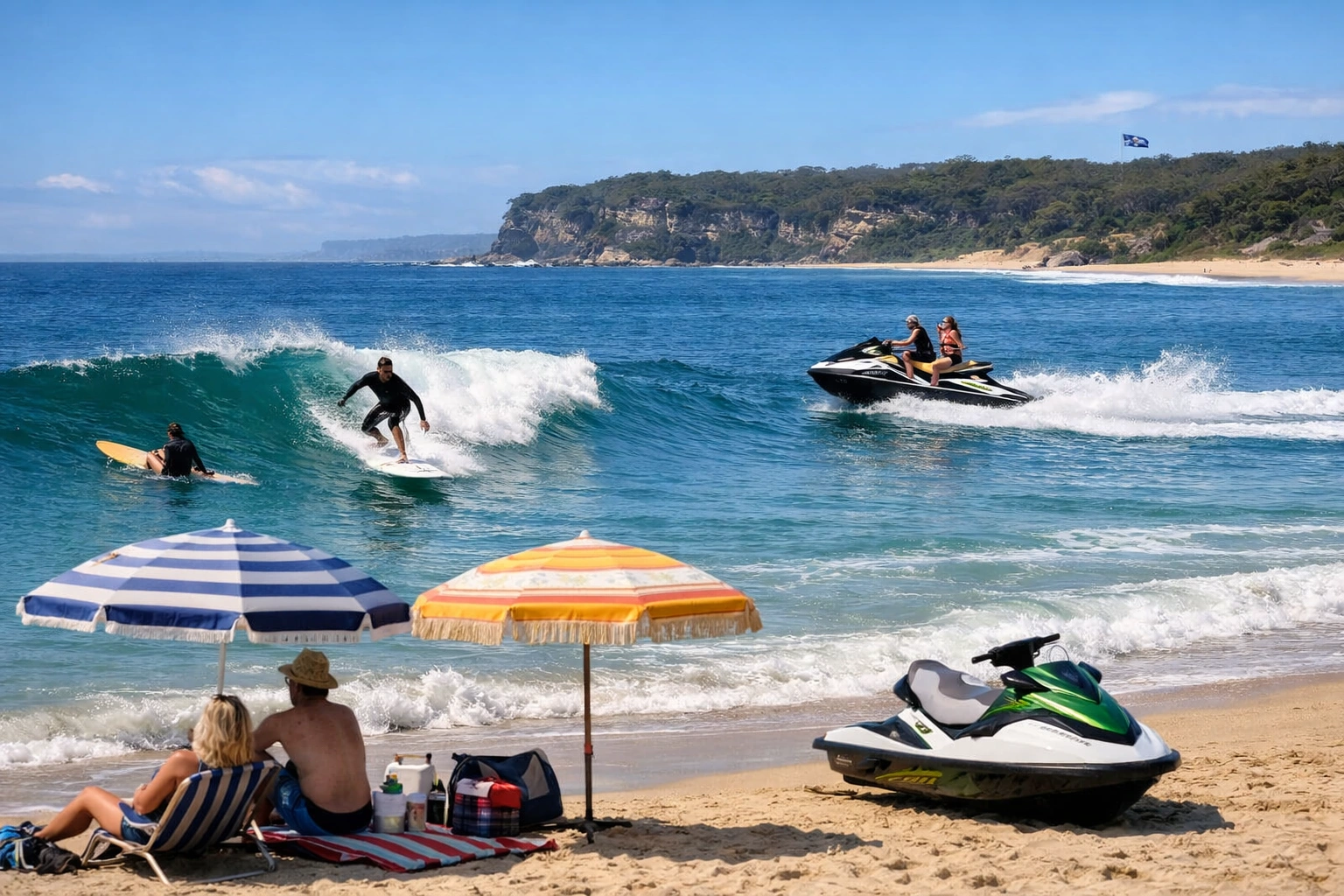
Our Golden Beaches
Australian beaches are famous for their white sand, clear water, and endless horizons.From world-class surf breaks to quiet coastal escapes, they capture the relaxed spirit of Australia.
Australian beaches are world-famous for their scale, beauty and variety. With more than 10,000 beaches wrapping around the continent, you’ll find everything from long, open surf beaches with rolling waves to calm, turquoise bays protected by headlands. The sand is often fine and pale gold, and under the bright Australian sun it almost glows against the deep blue ocean.
Surf culture is a huge part of beach life here. From Bondi and the Gold Coast to Margaret River and Bells Beach, surfing, swimming and coastal walks are woven into everyday life. But beyond the famous names, there are countless quiet stretches of coastline where you might have the sand almost to yourself. Whether it’s sunrise over the Pacific, sunset over the Indian Ocean, or a lazy afternoon swim, Australian beaches capture that relaxed, outdoor spirit the country is known for.
This stylistic image blends elements from multiple themes into one cohesive visual scene.
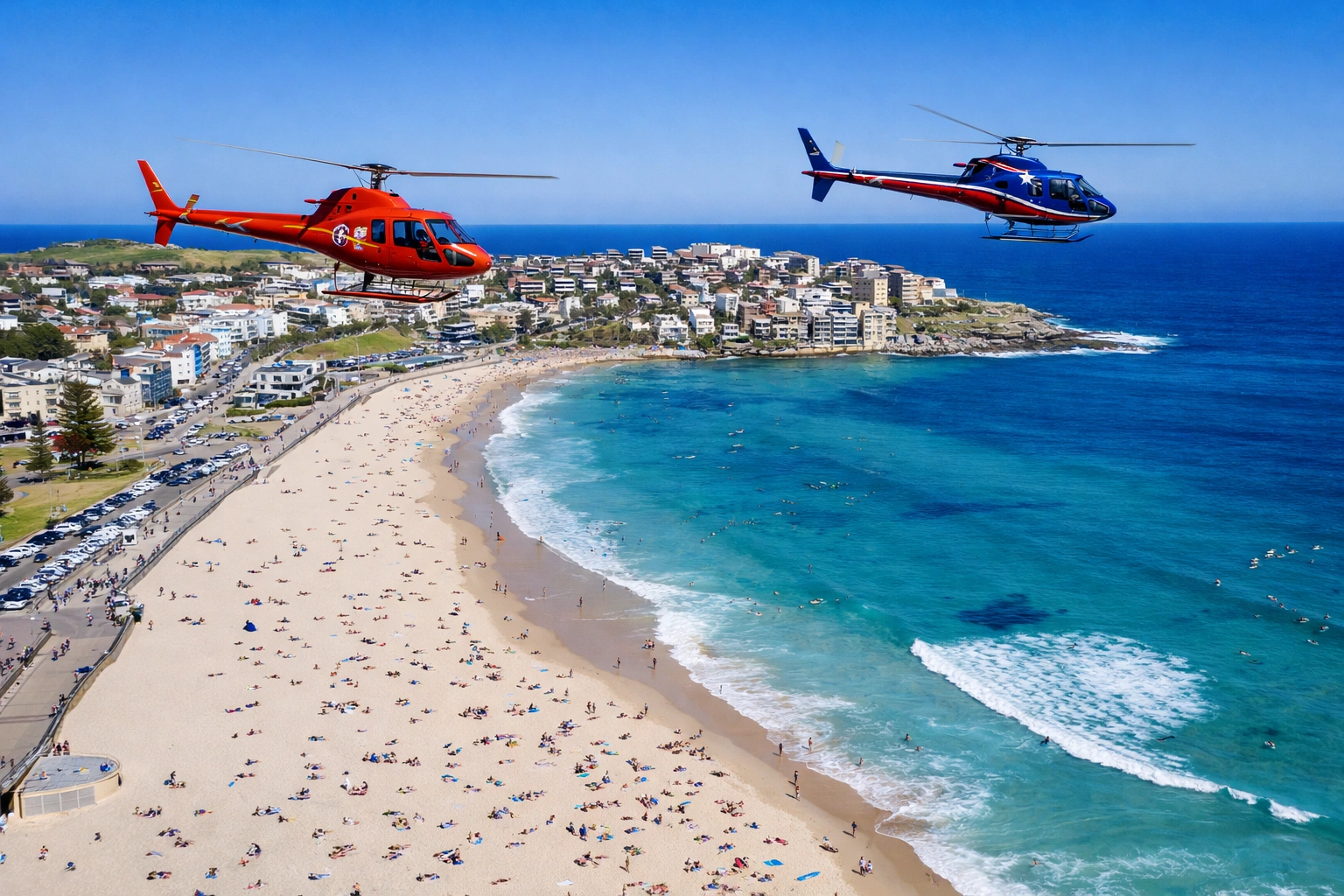
Bondi Beach, New South Wales
is Australia’s most famous stretch of sand—an energetic blend of surf culture, coastal beauty, and laid-back lifestyle just minutes from Sydney’s city centre. Known for its reliable waves, golden shoreline, and the iconic Bondi Icebergs Pool, it’s a place where locals swim laps at sunrise, surfers chase breaks year-round, and visitors soak up the buzz of cafés, markets, and coastal walks. Bondi isn’t just a beach—it’s a symbol of Australia’s love affair with the ocean.
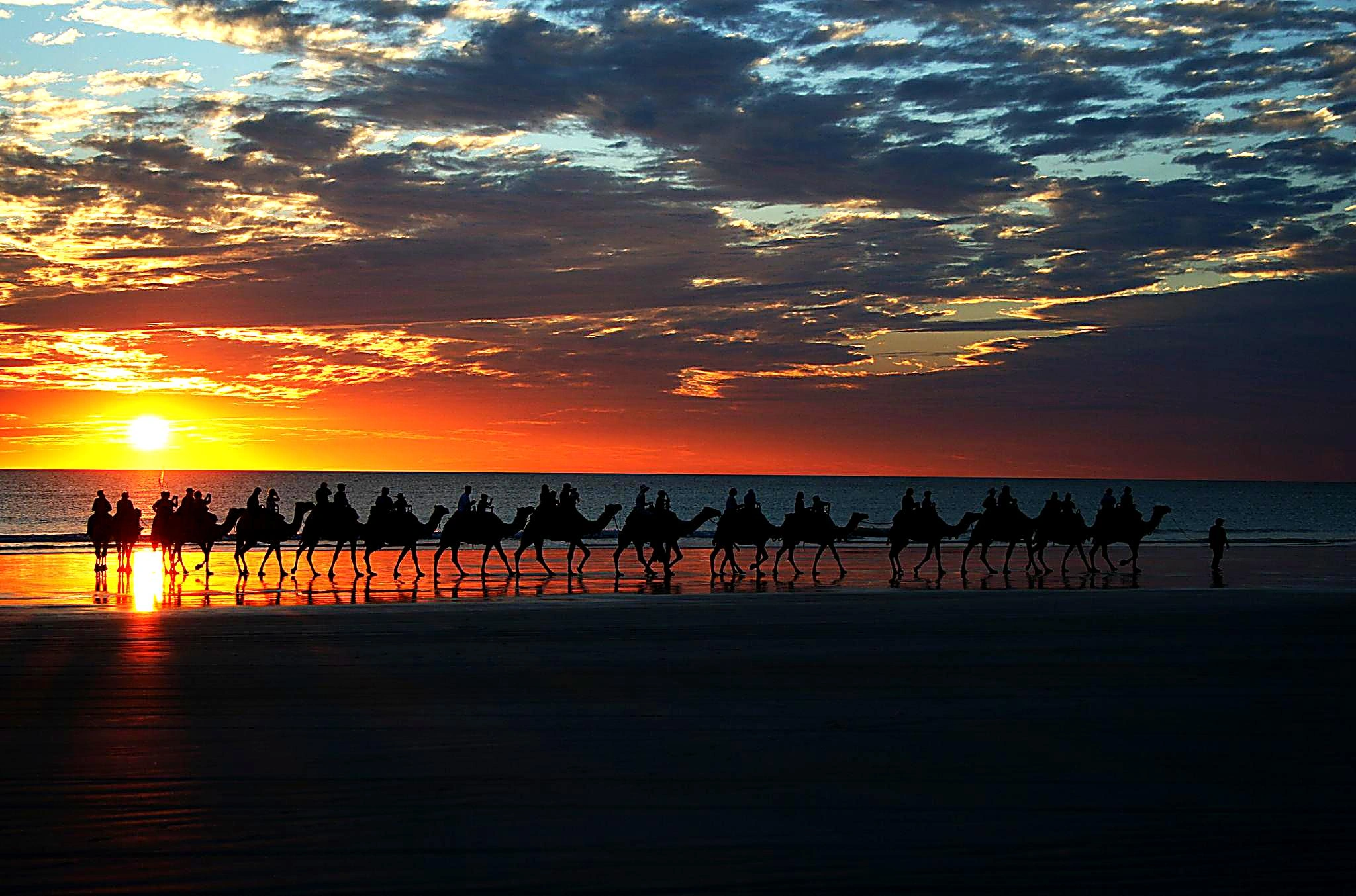
Cable Beach, Broome, Western Australia
is one of Australia’s most famous and spectacular beaches, located near the town of Broome in the far north of Western Australia. The beach stretches for about 22 kilometres along the edge of the Indian Ocean, and is renowned for its soft white sand, turquoise water, and dramatic sunsets. Its wide, flat shoreline and warm climate make it ideal for long walks, swimming, and beach driving, while the clear horizons over the ocean create some of the most photographed sunsets in Australia.
Cable Beach gets its name from the telegraph cable laid between Broome and Java in 1889, which connected Australia with the rest of the world via submarine telegraph communications. Today the beach is best known for its iconic sunset camel rides, where trains of camels walk along the shoreline as the sun sinks into the Indian Ocean. Visitors also come to watch the natural phenomenon of the Staircase to the Moon nearby in Broome, and during the wet season the area can experience spectacular tropical storms that light up the ocean horizon.
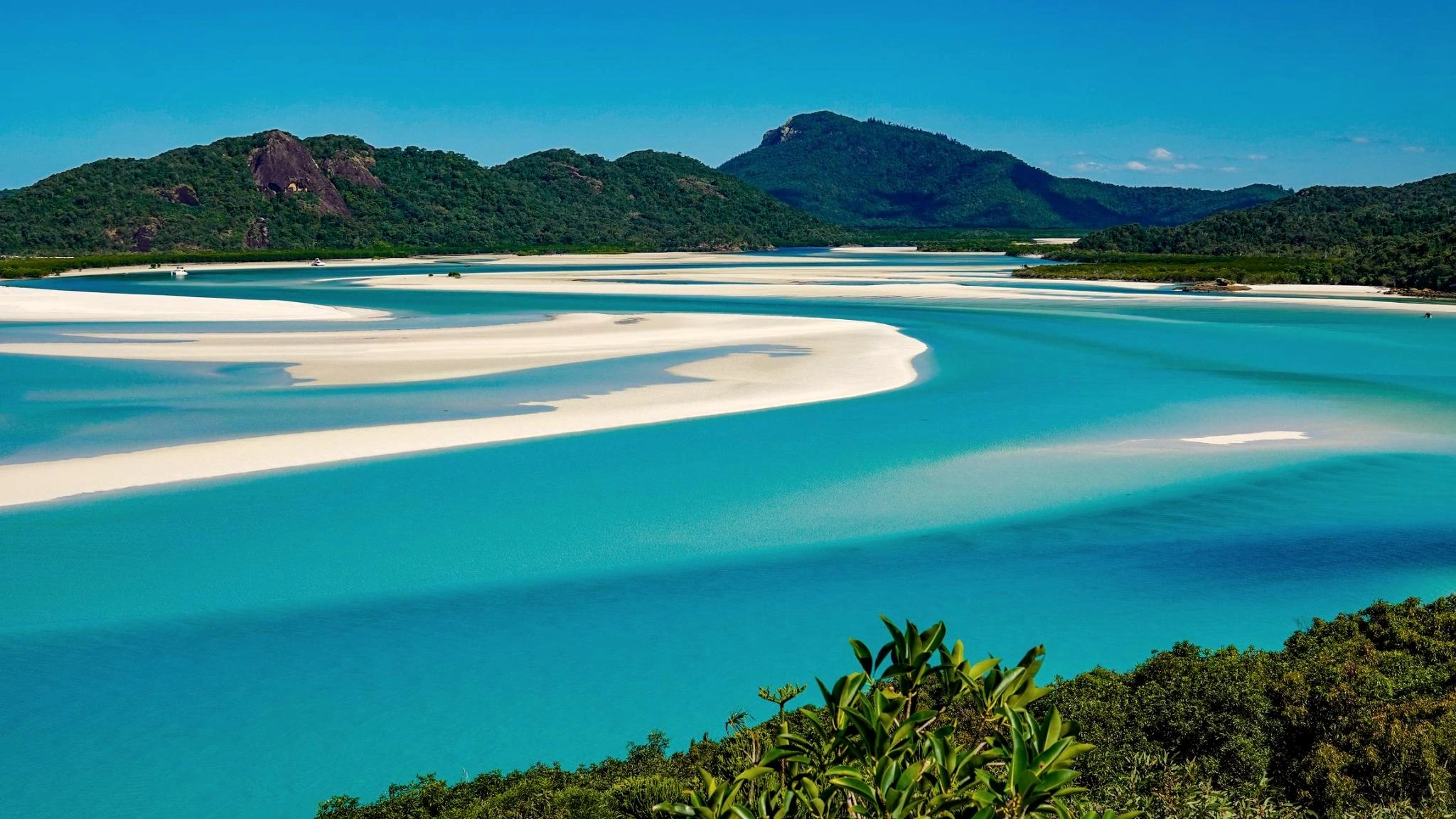
Whitehaven Beach, Whitsunday Island, Queensland
is one of Australia’s most famous and beautiful beaches, located on Whitsunday Island in the heart of the Whitsunday Islands. Stretching for about 7 kilometres, the beach is celebrated for its brilliant white sand and clear turquoise water along the edge of the Great Barrier Reef. The sand is made of almost pure silica (around 98%), giving it an incredibly bright white colour and a soft, cool feel even on hot days.
At the northern end of the beach lies Hill Inlet, where the tide shifts the fine white sand and shallow water to create stunning swirling patterns that can be best viewed from the lookout above. Because the area is protected within Whitsunday Islands National Park, the beach remains largely untouched, with no hotels or permanent development. Visitors usually arrive by boat, seaplane, or helicopter from nearby Airlie Beach or Hamilton Island, making it a pristine destination for swimming, snorkelling, and exploring one of Australia’s most iconic coastal landscapes.
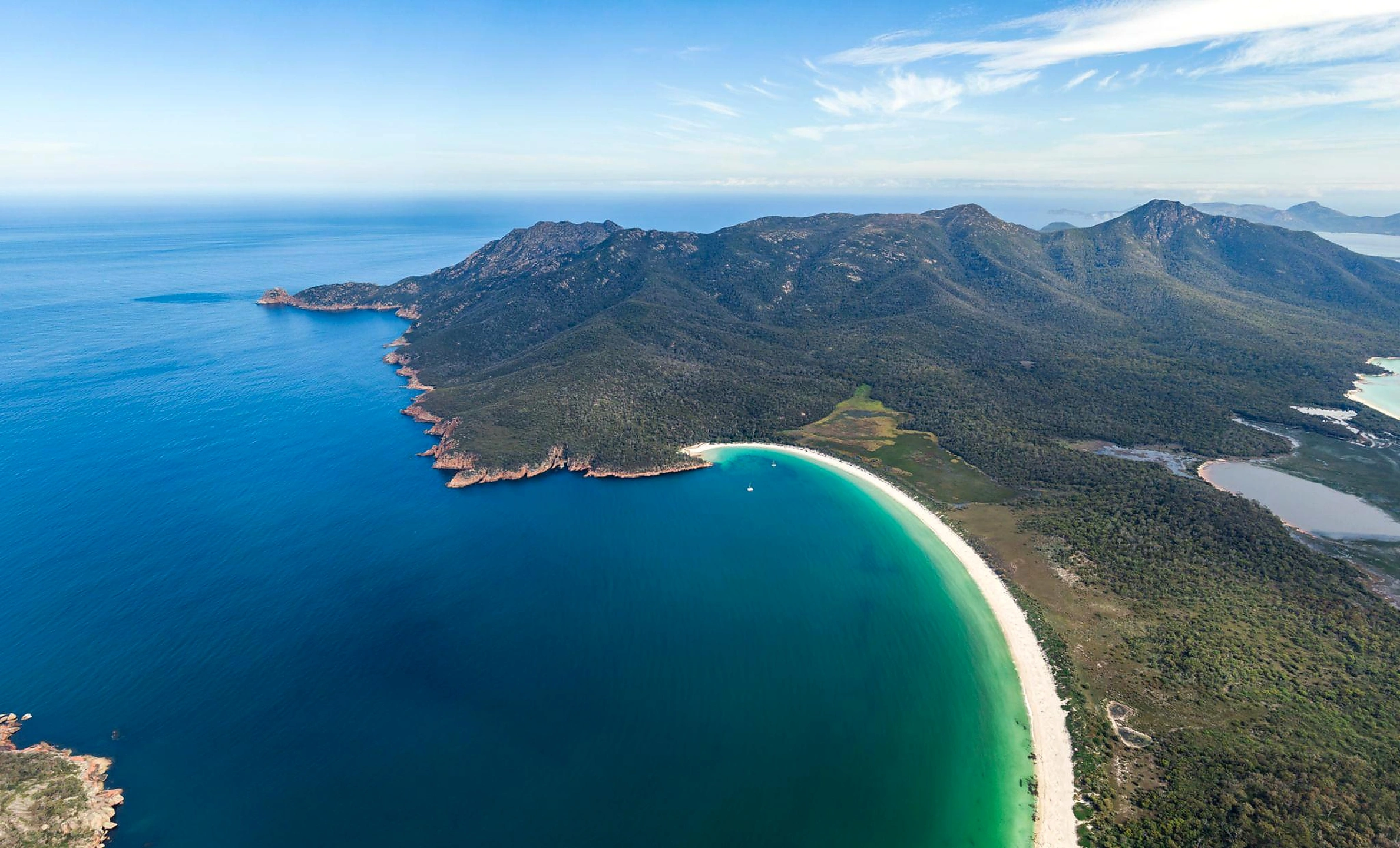
Wineglass Bay, Freycinet National Park, Tasmania
is one of the most iconic coastal landscapes in Australia, located within Freycinet National Park on the east coast of Tasmania. The bay is famous for its perfect crescent shape, brilliant white sand, and the clear turquoise waters of the Tasman Sea. Surrounded by the pink granite peaks of The Hazards mountain range, the beach is often ranked among the most beautiful beaches in the world.
The best view of Wineglass Bay is from the Wineglass Bay Lookout, reached via a popular walking track that climbs through coastal bushland before revealing the stunning curved shoreline below. Visitors can continue the hike down to the beach itself or explore longer trails around the Freycinet Peninsula. The area is also rich in wildlife, with frequent sightings of wallabies, seabirds, dolphins, and even migrating whales offshore during the winter months.
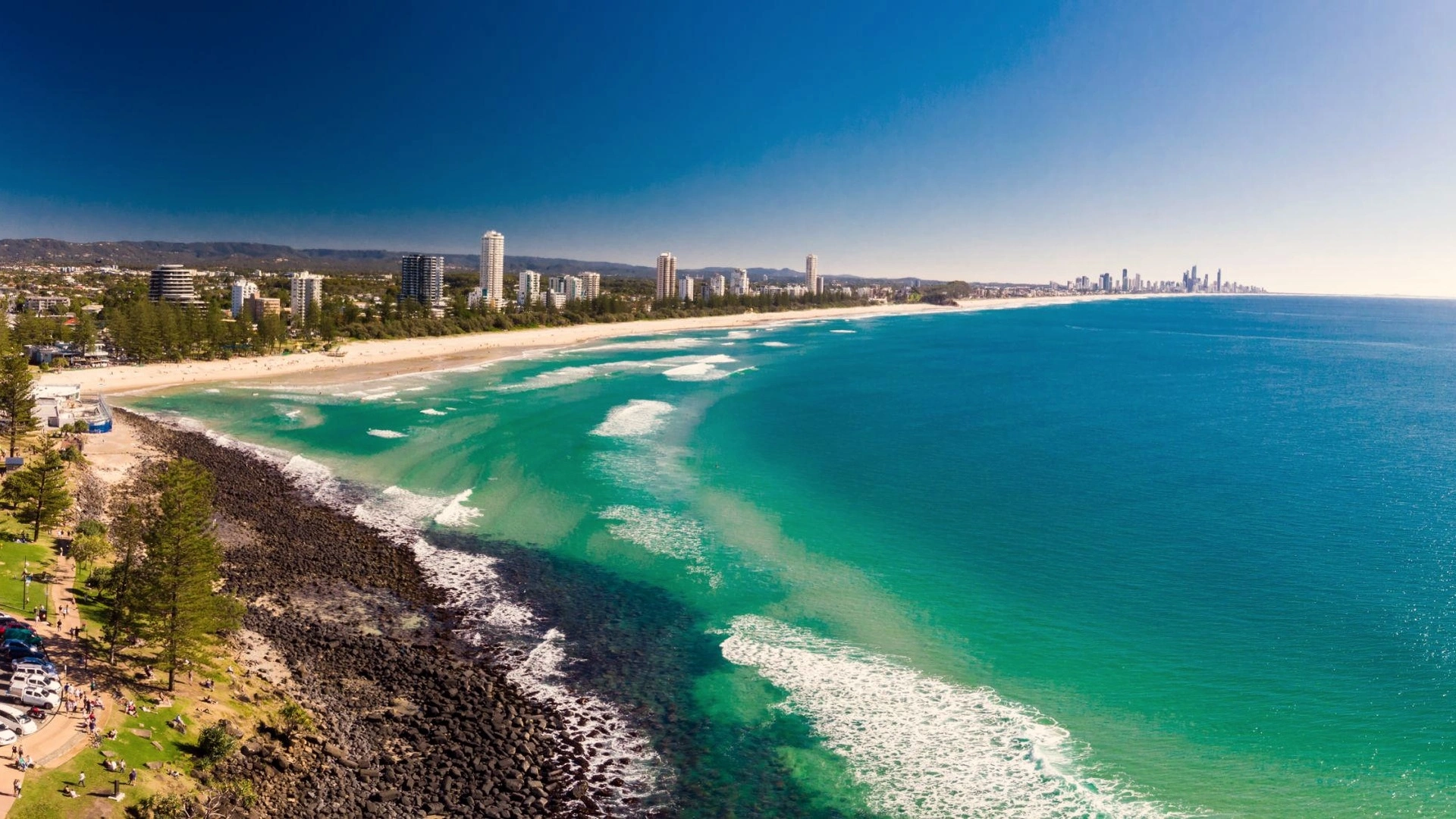
Burleigh Heads Beach, Gold Coast, Queensland
is one of the most loved beaches on the Gold Coast, located in the suburb of Burleigh Heads. Known for its golden sand, clear water and world-class surf break, the beach sits beside the scenic Burleigh Head National Park, where lush rainforest meets the ocean. The combination of rolling surf, shady parklands and relaxed village atmosphere makes it a favourite with both locals and visitors.
Burleigh Heads Beach is internationally recognised among surfers for its long right-hand point break, which attracts surfers from around the world and regularly hosts major competitions. The grassy foreshore park behind the beach is lined with pandanus trees and picnic areas, making it a popular place for barbecues, markets and sunset gatherings. From the nearby headland walking tracks, visitors can enjoy spectacular coastal views and occasionally spot dolphins or migrating whales passing along the coastline.
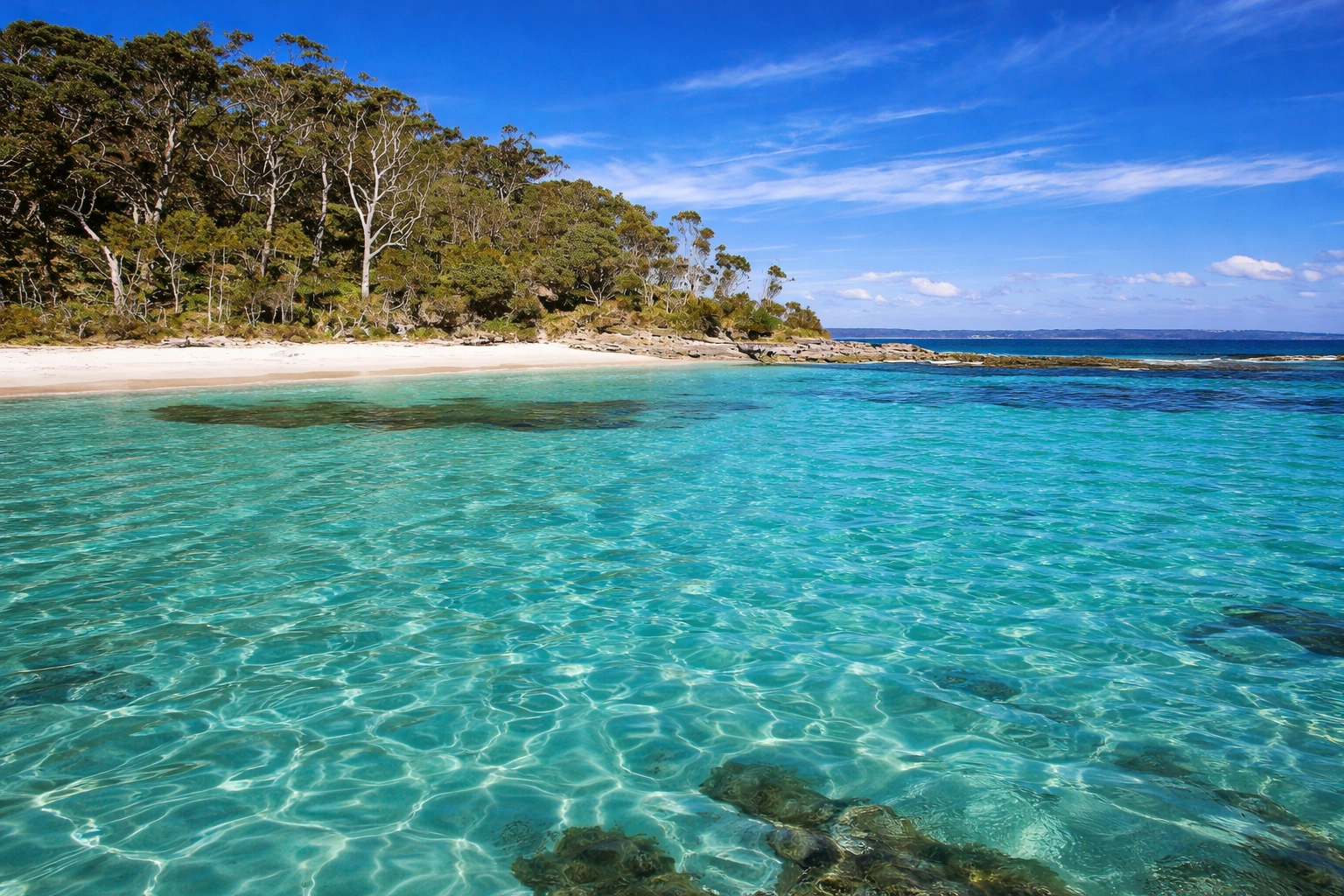
Murray’s Beach, Booderee National Park, Jervis Bay Territory
is one of the most beautiful and sheltered beaches in Jervis Bay, located inside Booderee National Park on Australia’s south coast. The beach is famous for its clear turquoise water, soft white sand, and calm conditions, making it ideal for swimming, snorkelling and relaxing by the water. Surrounded by coastal bushland and overlooking Bowen Island, the setting feels secluded and natural despite being easily accessible by road.
The beach sits within the Jervis Bay Territory, an area known for having some of the whitest sand in the world due to its high silica content. Murray’s Beach is also a starting point for several scenic walks, including the track that leads to the ruins of the historic Cape St George Lighthouse. The area is rich in wildlife, with frequent sightings of kangaroos, seabirds, dolphins, and migrating whales offshore during the winter months, making it a favourite destination for nature lovers exploring the Jervis Bay region.
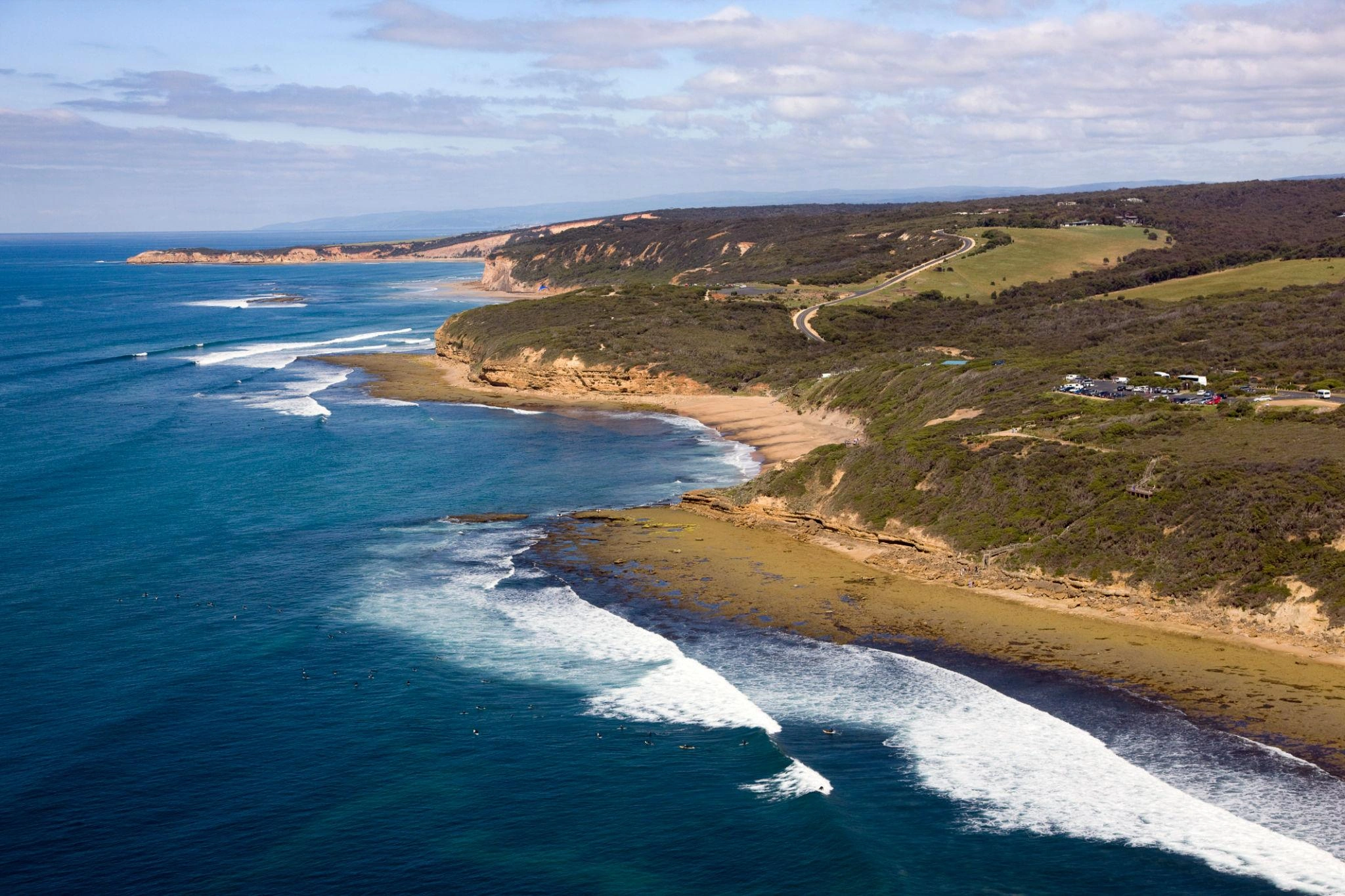
Bells Beach, Torquay, Victoria
is one of Australia’s most famous surf beaches, located on the Surf Coast near Torquay in Victoria, about 100 km southwest of Melbourne. The beach sits beneath dramatic sandstone and limestone cliffs and is renowned worldwide for its powerful, long-running right-hand surf break. When viewed from above, the sweeping curve of the coastline and deep blue Southern Ocean waves rolling toward the shore create a striking aerial scene.
Bells Beach is best known as the home of the Rip Curl Pro Bells Beach, one of the longest-running professional surfing competitions in the world, first held in 1961. Each year around Easter, elite surfers compete for the chance to “ring the Bell,” a trophy that has become a symbol of victory in the surfing world. The beach is also a key stop along the Great Ocean Road, making it a popular destination for travellers exploring Victoria’s spectacular southern coastline.
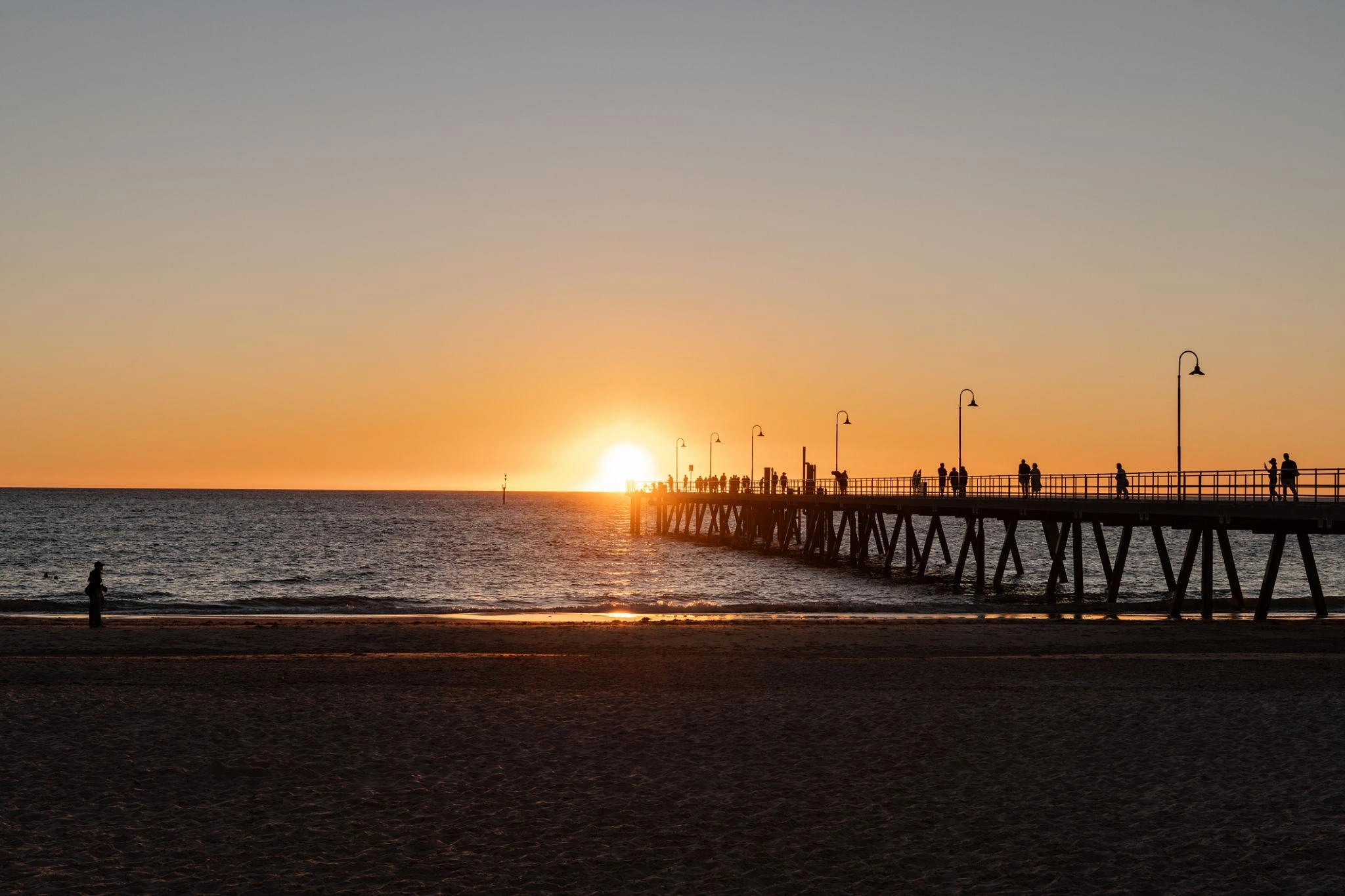
Glenelg Beach, Adelaide, South Australia
is Adelaide’s most famous seaside destination, located about 10 kilometres southwest of the city centre on the shores of Gulf St Vincent. Known for its long sandy shoreline, calm waters, and vibrant beachfront precinct, Glenelg has been a popular coastal escape since the 1800s. Its wide promenade, lined with cafés, restaurants, and shops, makes it one of the most lively and accessible beaches in Adelaide.
A standout feature of the beach is the historic Glenelg Jetty, which stretches into the gulf and provides beautiful views of the coastline, particularly at sunset. The area around Moseley Square is the heart of Glenelg’s activity, where visitors arrive via the historic Glenelg Tram Line that runs directly from the city centre to the beach. Today, Glenelg blends historic charm with a modern seaside atmosphere, making it one of South Australia’s most visited coastal attractions.
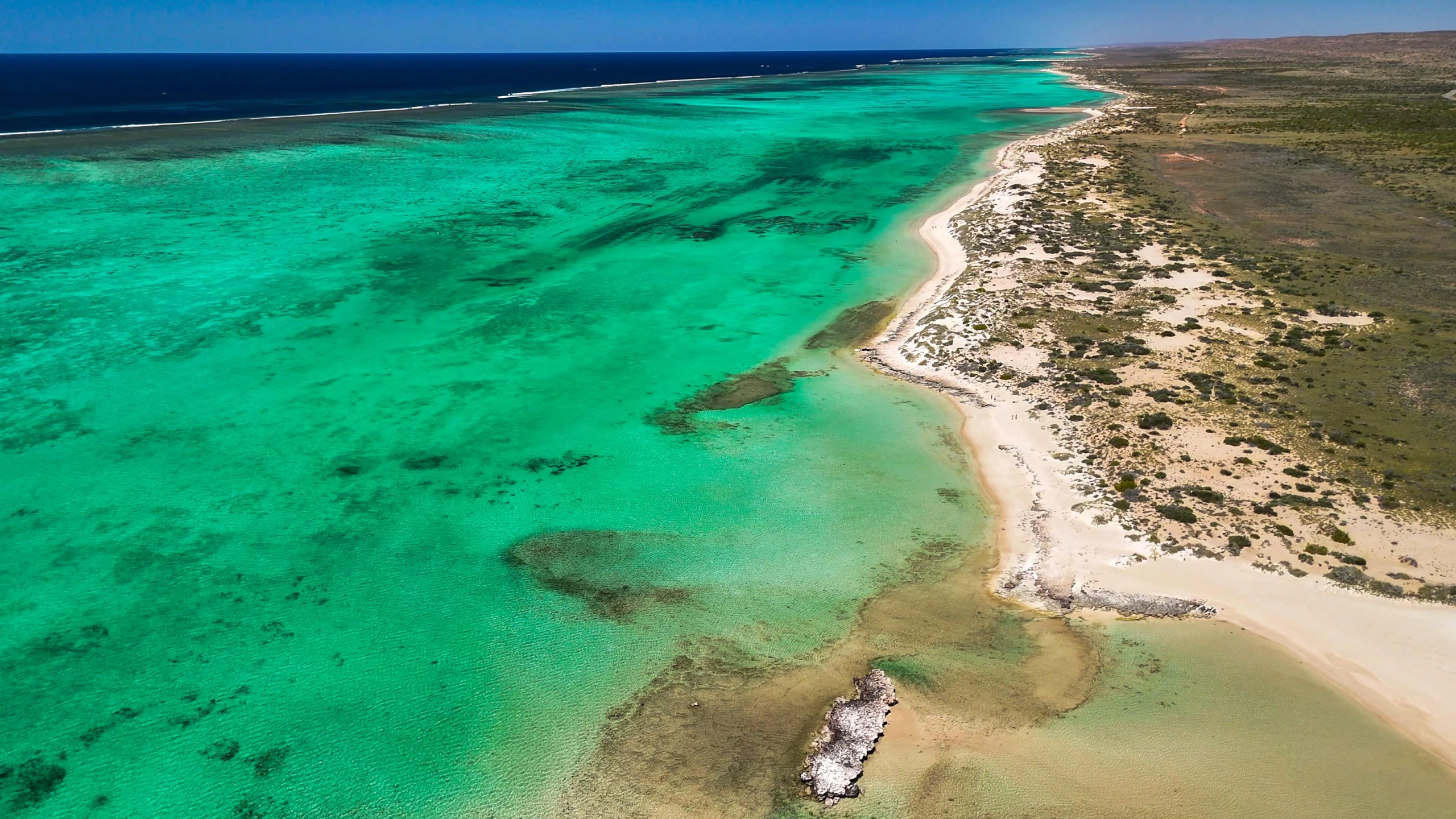
Turquoise Bay, Exmouth, Western Australia
is one of Western Australia’s most breathtaking beaches, located in Cape Range National Park near the town of Exmouth. Overlooking the spectacular Ningaloo Reef, the bay is famous for its brilliant turquoise waters, powdery white sand, and vibrant coral reef that lies just metres from the shore. From the air, the colour contrast between the deep blue ocean, bright reef flats, and pale sand makes Turquoise Bay one of the most striking coastal scenes in Australia.
The beach is particularly popular for its unique “drift snorkel” experience. Visitors enter the water at the southern end of the beach and allow the gentle current to carry them naturally along the reef, passing coral gardens and colourful marine life before exiting further down the beach. Because of the calm, clear water and easy access to the reef, Turquoise Bay is often regarded as one of the best shore-snorkelling locations in the country and a highlight of the Ningaloo Coast.
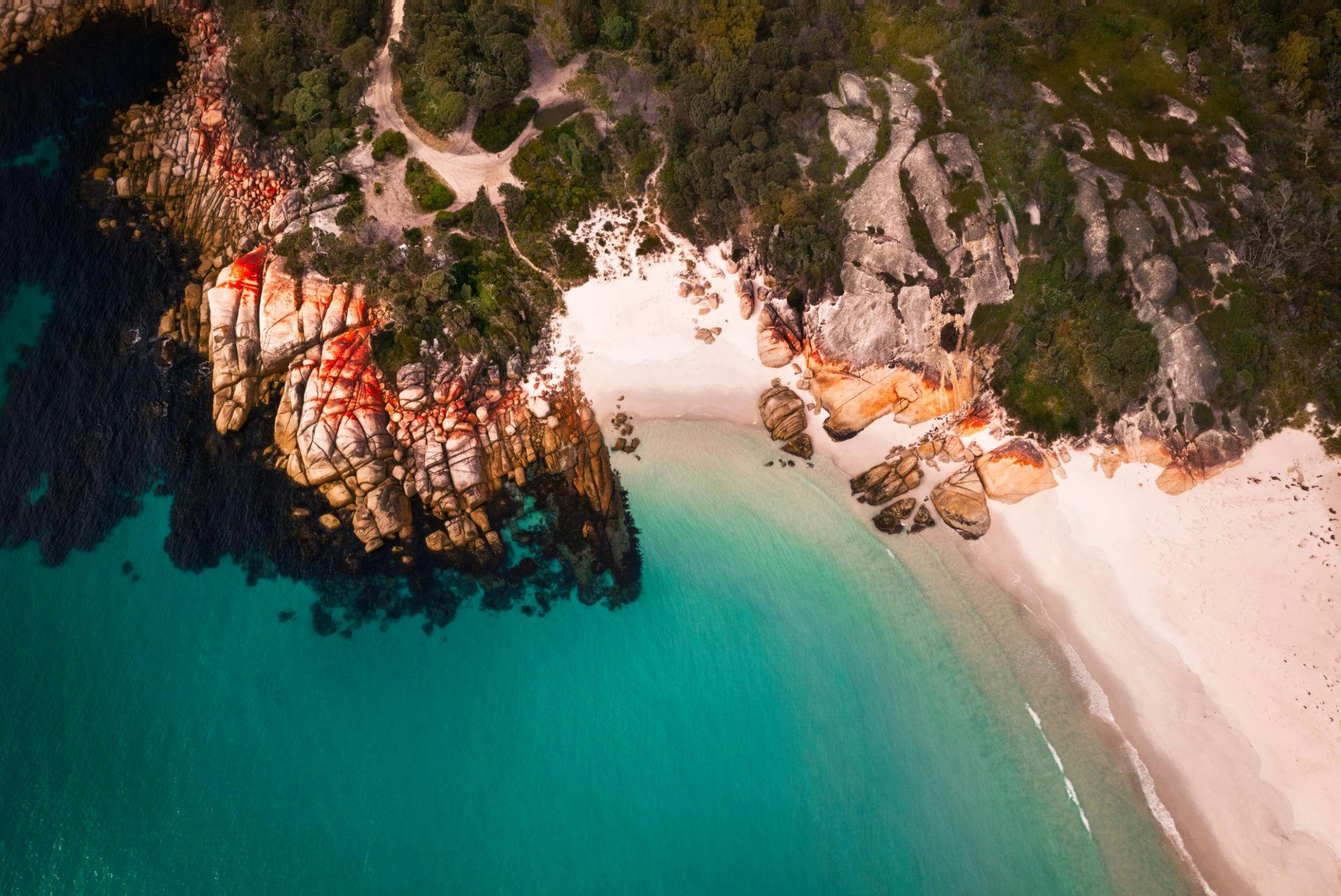
Bay of Fires, Tasmania
is one of Tasmania’s most visually striking coastal regions, stretching along the northeast coast of the island between Binalong Bay and Eddystone Point. The coastline is famous for its brilliant white beaches, crystal-clear turquoise water, and large granite boulders covered in vivid orange lichen, creating a dramatic colour contrast that makes the area instantly recognisable from both land and air.
Despite its fiery name, the bay was named in 1773 by Captain Tobias Furneaux, who observed numerous Aboriginal fires burning along the shoreline when sailing past. Today the Bay of Fires is known for its untouched wilderness, quiet beaches, and abundant wildlife, making it one of Tasmania’s most celebrated natural landscapes and a highlight for travellers exploring the state’s rugged northeast coast.
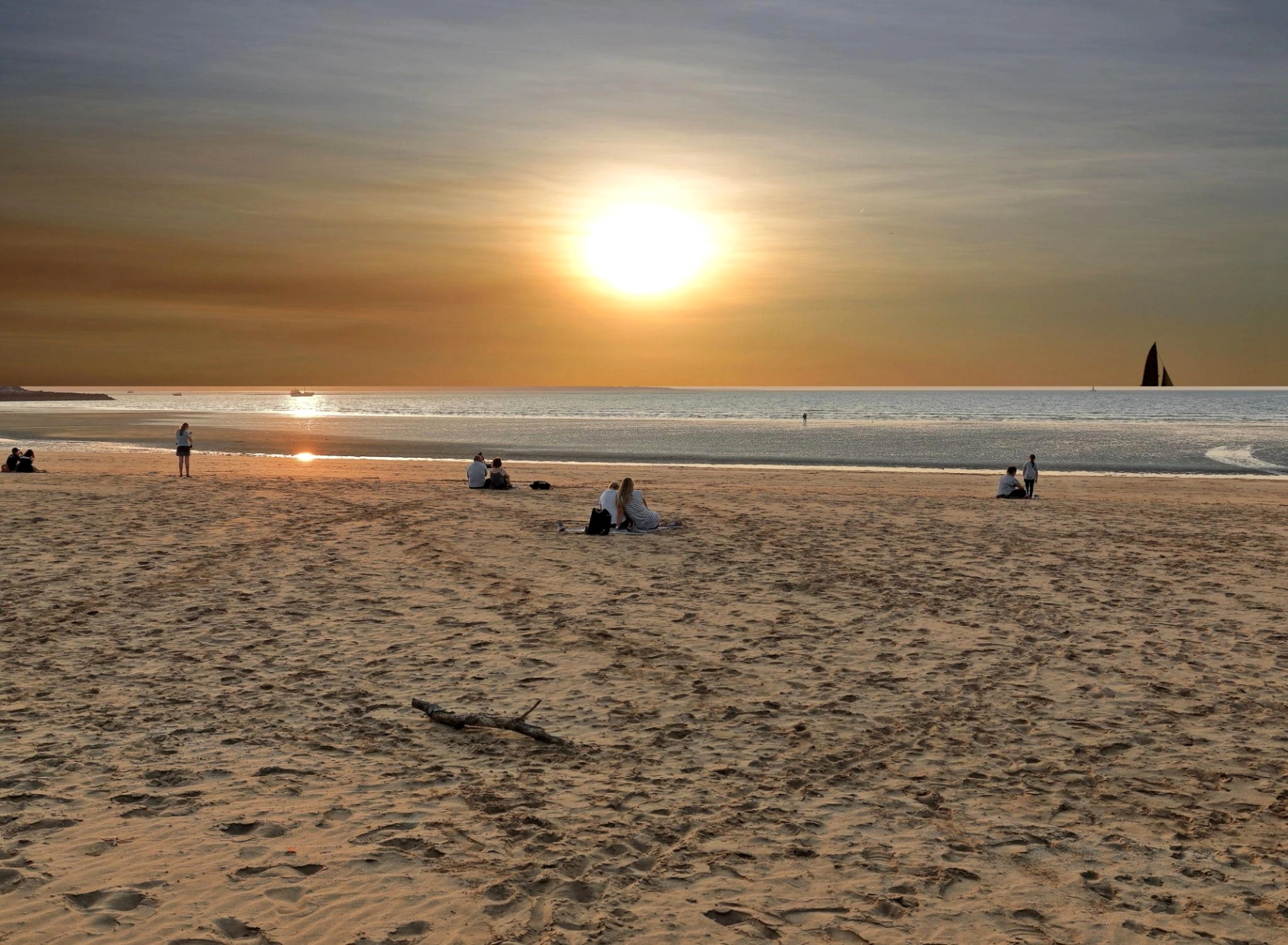
Mindil Beach (sometimes written as “Mindi”), Darwin, Northern Territory
is one of the most famous beaches in Darwin, located just a few minutes from the city centre along the Timor Sea. The beach is best known for its spectacular sunsets, where the sun drops directly into the sea, creating brilliant orange and purple skies reflected across the wet sand.
The beach is also home to the iconic Mindil Beach Sunset Market, held during the dry season from April to October. These markets attract thousands of locals and visitors who gather on the sand to enjoy international street food, live music, arts and crafts, and the famous tropical sunset. With its relaxed atmosphere, palm-fringed shoreline, and vibrant evening markets, Mindil Beach is considered one of Darwin’s most beloved coastal spots.
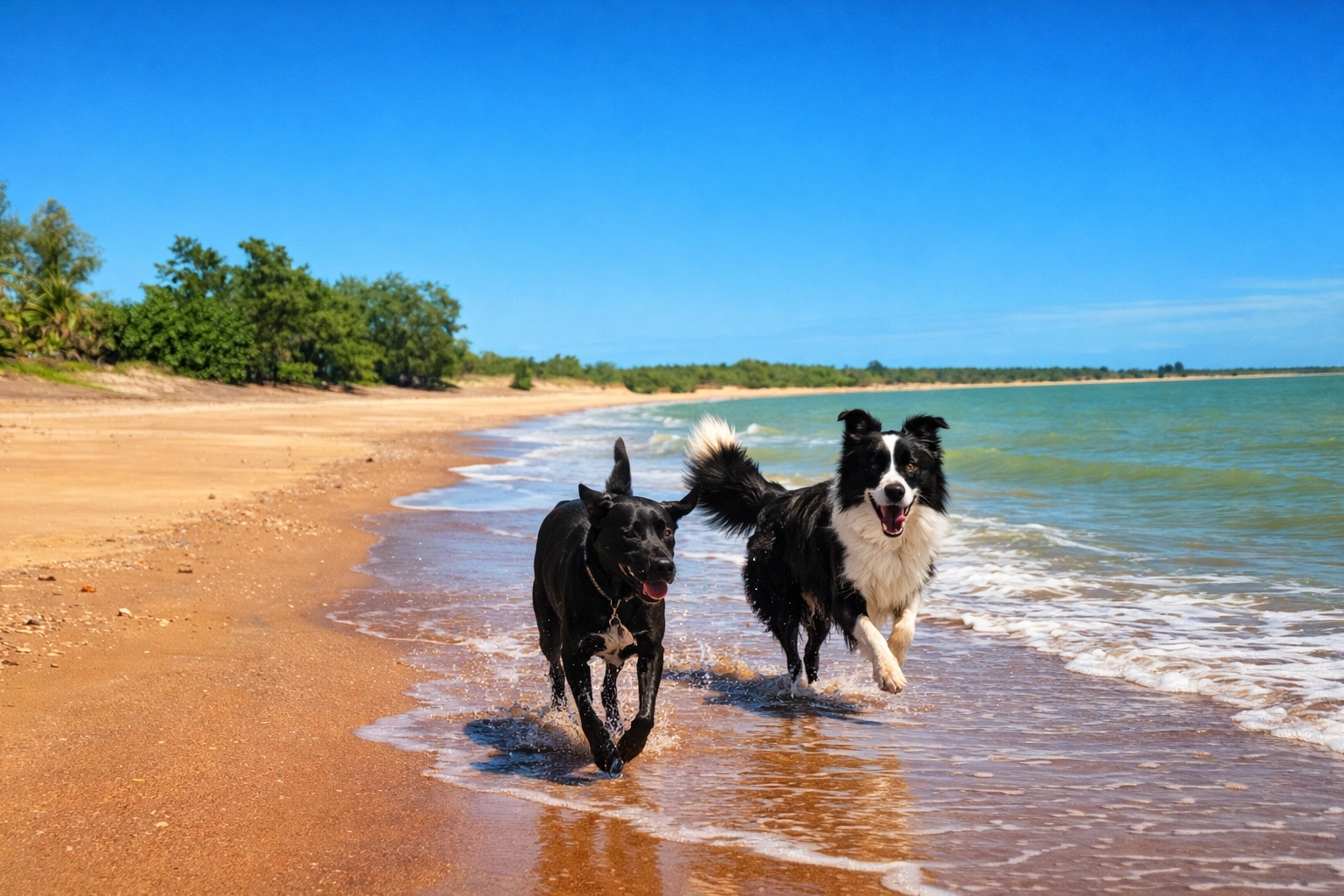
Wagait Beach, Northern Territory
is a quiet coastal community on the Cox Peninsula, directly across the harbour from Darwin. Overlooking the Beagle Gulf, the beach offers long stretches of sand, tropical vegetation, and a peaceful atmosphere far removed from the bustle of the city. Although it appears close to Darwin on a map, the peninsula is separated by water, so most visitors reach Wagait Beach either by a ferry crossing Darwin Harbour or by a longer drive around the peninsula.
The area has a small, friendly community and is known for its relaxed lifestyle, fishing spots, and spectacular sunsets over the Timor Sea. Because it sits in the tropical north, the beach is surrounded by mangroves and coastal bushland, and visitors need to be mindful of the region’s wildlife, including the possibility of Saltwater Crocodile in nearby waters. Wagait Beach remains one of the Northern Territory’s lesser-known coastal escapes, offering a tranquil alternative to Darwin’s more popular beaches.
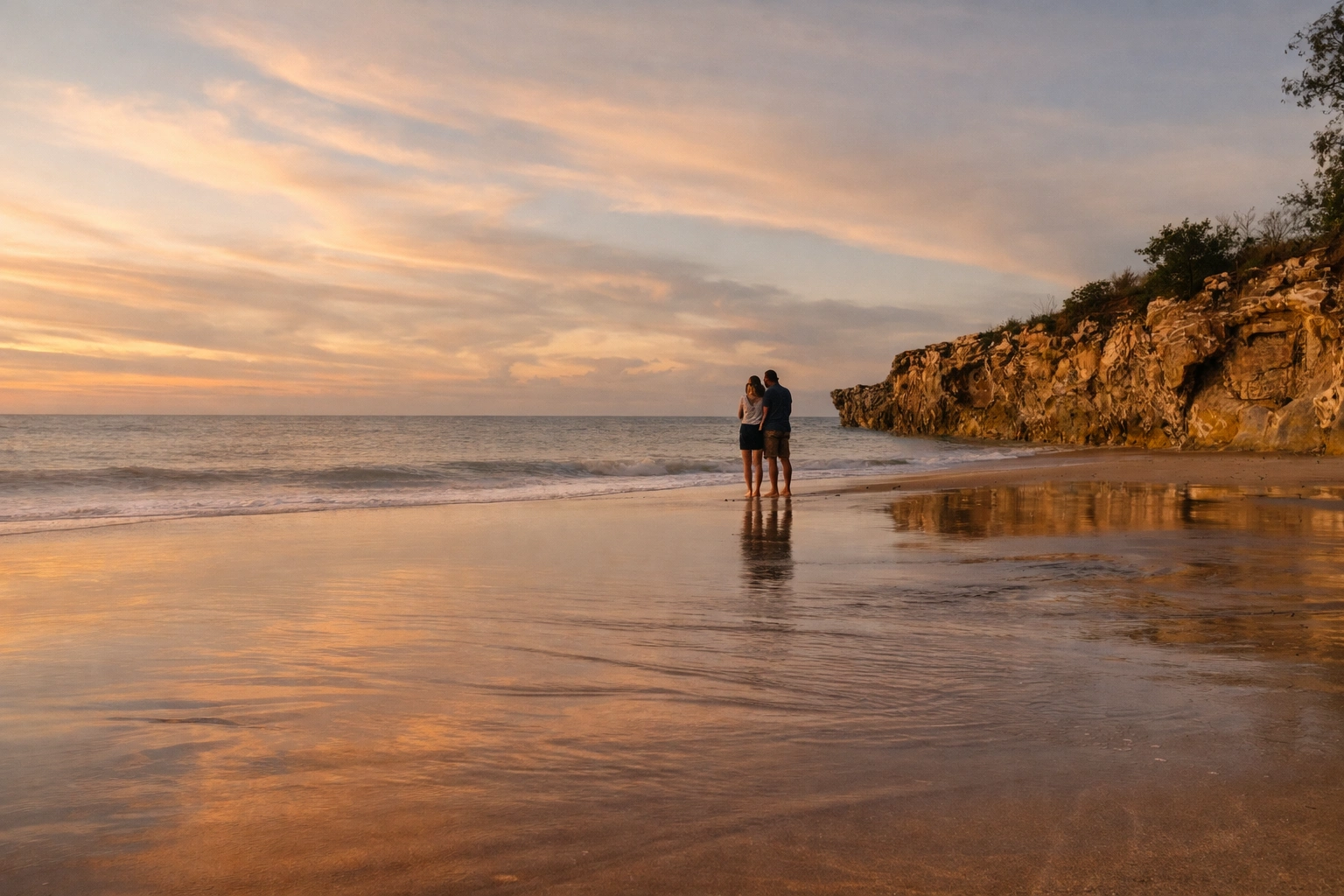
Casuarina Beach, Darwin, Northern Territory
is one of the most popular beaches in Darwin, stretching for several kilometres along the edge of the Timor Sea. The beach lies within the protected Casuarina Coastal Reserve, a natural area of coastal dunes, monsoon forest, and mangrove habitats that provide an important refuge for local wildlife.
Known for its wide open sands, shady casuarina trees, and strong sea breezes, Casuarina Beach is popular for walking, cycling, picnics, and watching spectacular tropical sunsets. The reserve also features walking trails, picnic areas, and access to nearby attractions such as Dripstone Cliffs. As with many beaches in the Top End, visitors are advised to check local conditions because marine stingers and Saltwater Crocodile can occasionally occur in the region’s coastal waters.
Australian beaches are world-famous for their scale, beauty and variety. With more than 10,000 beaches wrapping around the continent, you’ll find everything from long, open surf beaches with rolling waves to calm, turquoise bays protected by headlands. The sand is often fine and pale gold, and under the bright Australian sun it almost glows against the deep blue ocean.
Surf culture is a huge part of beach life here. From Bondi and the Gold Coast to Margaret River and Bells Beach, surfing, swimming and coastal walks are woven into everyday life. But beyond the famous names, there are countless quiet stretches of coastline where you might have the sand almost to yourself. Whether it’s sunrise over the Pacific, sunset over the Indian Ocean, or a lazy afternoon swim, Australian beaches capture that relaxed, outdoor spirit the country is known for.
This stylistic image blends elements from multiple themes into one cohesive visual scene.
Bondi Beach, New South Wales
is Australia’s most famous stretch of sand—an energetic blend of surf culture, coastal beauty, and laid-back lifestyle just minutes from Sydney’s city centre. Known for its reliable waves, golden shoreline, and the iconic Bondi Icebergs Pool, it’s a place where locals swim laps at sunrise, surfers chase breaks year-round, and visitors soak up the buzz of cafés, markets, and coastal walks. Bondi isn’t just a beach—it’s a symbol of Australia’s love affair with the ocean.
Cable Beach, Broome, Western Australia
is one of Australia’s most famous and spectacular beaches, located near the town of Broome in the far north of Western Australia. The beach stretches for about 22 kilometres along the edge of the Indian Ocean, and is renowned for its soft white sand, turquoise water, and dramatic sunsets. Its wide, flat shoreline and warm climate make it ideal for long walks, swimming, and beach driving, while the clear horizons over the ocean create some of the most photographed sunsets in Australia.
Cable Beach gets its name from the telegraph cable laid between Broome and Java in 1889, which connected Australia with the rest of the world via submarine telegraph communications. Today the beach is best known for its iconic sunset camel rides, where trains of camels walk along the shoreline as the sun sinks into the Indian Ocean. Visitors also come to watch the natural phenomenon of the Staircase to the Moon nearby in Broome, and during the wet season the area can experience spectacular tropical storms that light up the ocean horizon.
Whitehaven Beach, Whitsunday Island, Queensland
is one of Australia’s most famous and beautiful beaches, located on Whitsunday Island in the heart of the Whitsunday Islands. Stretching for about 7 kilometres, the beach is celebrated for its brilliant white sand and clear turquoise water along the edge of the Great Barrier Reef. The sand is made of almost pure silica (around 98%), giving it an incredibly bright white colour and a soft, cool feel even on hot days.
At the northern end of the beach lies Hill Inlet, where the tide shifts the fine white sand and shallow water to create stunning swirling patterns that can be best viewed from the lookout above. Because the area is protected within Whitsunday Islands National Park, the beach remains largely untouched, with no hotels or permanent development. Visitors usually arrive by boat, seaplane, or helicopter from nearby Airlie Beach or Hamilton Island, making it a pristine destination for swimming, snorkelling, and exploring one of Australia’s most iconic coastal landscapes.
Wineglass Bay, Freycinet National Park, Tasmania
is one of the most iconic coastal landscapes in Australia, located within Freycinet National Park on the east coast of Tasmania. The bay is famous for its perfect crescent shape, brilliant white sand, and the clear turquoise waters of the Tasman Sea. Surrounded by the pink granite peaks of The Hazards mountain range, the beach is often ranked among the most beautiful beaches in the world.
The best view of Wineglass Bay is from the Wineglass Bay Lookout, reached via a popular walking track that climbs through coastal bushland before revealing the stunning curved shoreline below. Visitors can continue the hike down to the beach itself or explore longer trails around the Freycinet Peninsula. The area is also rich in wildlife, with frequent sightings of wallabies, seabirds, dolphins, and even migrating whales offshore during the winter months.
Burleigh Heads Beach, Gold Coast, Queensland
is one of the most loved beaches on the Gold Coast, located in the suburb of Burleigh Heads. Known for its golden sand, clear water and world-class surf break, the beach sits beside the scenic Burleigh Head National Park, where lush rainforest meets the ocean. The combination of rolling surf, shady parklands and relaxed village atmosphere makes it a favourite with both locals and visitors.
Burleigh Heads Beach is internationally recognised among surfers for its long right-hand point break, which attracts surfers from around the world and regularly hosts major competitions. The grassy foreshore park behind the beach is lined with pandanus trees and picnic areas, making it a popular place for barbecues, markets and sunset gatherings. From the nearby headland walking tracks, visitors can enjoy spectacular coastal views and occasionally spot dolphins or migrating whales passing along the coastline.
Murray’s Beach, Booderee National Park, Jervis Bay Territory
is one of the most beautiful and sheltered beaches in Jervis Bay, located inside Booderee National Park on Australia’s south coast. The beach is famous for its clear turquoise water, soft white sand, and calm conditions, making it ideal for swimming, snorkelling and relaxing by the water. Surrounded by coastal bushland and overlooking Bowen Island, the setting feels secluded and natural despite being easily accessible by road.
The beach sits within the Jervis Bay Territory, an area known for having some of the whitest sand in the world due to its high silica content. Murray’s Beach is also a starting point for several scenic walks, including the track that leads to the ruins of the historic Cape St George Lighthouse. The area is rich in wildlife, with frequent sightings of kangaroos, seabirds, dolphins, and migrating whales offshore during the winter months, making it a favourite destination for nature lovers exploring the Jervis Bay region.
Bells Beach, Torquay, Victoria
is one of Australia’s most famous surf beaches, located on the Surf Coast near Torquay in Victoria, about 100 km southwest of Melbourne. The beach sits beneath dramatic sandstone and limestone cliffs and is renowned worldwide for its powerful, long-running right-hand surf break. When viewed from above, the sweeping curve of the coastline and deep blue Southern Ocean waves rolling toward the shore create a striking aerial scene.
Bells Beach is best known as the home of the Rip Curl Pro Bells Beach, one of the longest-running professional surfing competitions in the world, first held in 1961. Each year around Easter, elite surfers compete for the chance to “ring the Bell,” a trophy that has become a symbol of victory in the surfing world. The beach is also a key stop along the Great Ocean Road, making it a popular destination for travellers exploring Victoria’s spectacular southern coastline.
Glenelg Beach, Adelaide, South Australia
is Adelaide’s most famous seaside destination, located about 10 kilometres southwest of the city centre on the shores of Gulf St Vincent. Known for its long sandy shoreline, calm waters, and vibrant beachfront precinct, Glenelg has been a popular coastal escape since the 1800s. Its wide promenade, lined with cafés, restaurants, and shops, makes it one of the most lively and accessible beaches in Adelaide.
A standout feature of the beach is the historic Glenelg Jetty, which stretches into the gulf and provides beautiful views of the coastline, particularly at sunset. The area around Moseley Square is the heart of Glenelg’s activity, where visitors arrive via the historic Glenelg Tram Line that runs directly from the city centre to the beach. Today, Glenelg blends historic charm with a modern seaside atmosphere, making it one of South Australia’s most visited coastal attractions.
Turquoise Bay, Exmouth, Western Australia
is one of Western Australia’s most breathtaking beaches, located in Cape Range National Park near the town of Exmouth. Overlooking the spectacular Ningaloo Reef, the bay is famous for its brilliant turquoise waters, powdery white sand, and vibrant coral reef that lies just metres from the shore. From the air, the colour contrast between the deep blue ocean, bright reef flats, and pale sand makes Turquoise Bay one of the most striking coastal scenes in Australia.
The beach is particularly popular for its unique “drift snorkel” experience. Visitors enter the water at the southern end of the beach and allow the gentle current to carry them naturally along the reef, passing coral gardens and colourful marine life before exiting further down the beach. Because of the calm, clear water and easy access to the reef, Turquoise Bay is often regarded as one of the best shore-snorkelling locations in the country and a highlight of the Ningaloo Coast.
Bay of Fires, Tasmania
is one of Tasmania’s most visually striking coastal regions, stretching along the northeast coast of the island between Binalong Bay and Eddystone Point. The coastline is famous for its brilliant white beaches, crystal-clear turquoise water, and large granite boulders covered in vivid orange lichen, creating a dramatic colour contrast that makes the area instantly recognisable from both land and air.
Despite its fiery name, the bay was named in 1773 by Captain Tobias Furneaux, who observed numerous Aboriginal fires burning along the shoreline when sailing past. Today the Bay of Fires is known for its untouched wilderness, quiet beaches, and abundant wildlife, making it one of Tasmania’s most celebrated natural landscapes and a highlight for travellers exploring the state’s rugged northeast coast.
Mindil Beach (sometimes written as “Mindi”), Darwin, Northern Territory
is one of the most famous beaches in Darwin, located just a few minutes from the city centre along the Timor Sea. The beach is best known for its spectacular sunsets, where the sun drops directly into the sea, creating brilliant orange and purple skies reflected across the wet sand.
The beach is also home to the iconic Mindil Beach Sunset Market, held during the dry season from April to October. These markets attract thousands of locals and visitors who gather on the sand to enjoy international street food, live music, arts and crafts, and the famous tropical sunset. With its relaxed atmosphere, palm-fringed shoreline, and vibrant evening markets, Mindil Beach is considered one of Darwin’s most beloved coastal spots.
Wagait Beach, Northern Territory
is a quiet coastal community on the Cox Peninsula, directly across the harbour from Darwin. Overlooking the Beagle Gulf, the beach offers long stretches of sand, tropical vegetation, and a peaceful atmosphere far removed from the bustle of the city. Although it appears close to Darwin on a map, the peninsula is separated by water, so most visitors reach Wagait Beach either by a ferry crossing Darwin Harbour or by a longer drive around the peninsula.
The area has a small, friendly community and is known for its relaxed lifestyle, fishing spots, and spectacular sunsets over the Timor Sea. Because it sits in the tropical north, the beach is surrounded by mangroves and coastal bushland, and visitors need to be mindful of the region’s wildlife, including the possibility of Saltwater Crocodile in nearby waters. Wagait Beach remains one of the Northern Territory’s lesser-known coastal escapes, offering a tranquil alternative to Darwin’s more popular beaches.
Casuarina Beach, Darwin, Northern Territory
is one of the most popular beaches in Darwin, stretching for several kilometres along the edge of the Timor Sea. The beach lies within the protected Casuarina Coastal Reserve, a natural area of coastal dunes, monsoon forest, and mangrove habitats that provide an important refuge for local wildlife.
Known for its wide open sands, shady casuarina trees, and strong sea breezes, Casuarina Beach is popular for walking, cycling, picnics, and watching spectacular tropical sunsets. The reserve also features walking trails, picnic areas, and access to nearby attractions such as Dripstone Cliffs. As with many beaches in the Top End, visitors are advised to check local conditions because marine stingers and Saltwater Crocodile can occasionally occur in the region’s coastal waters.
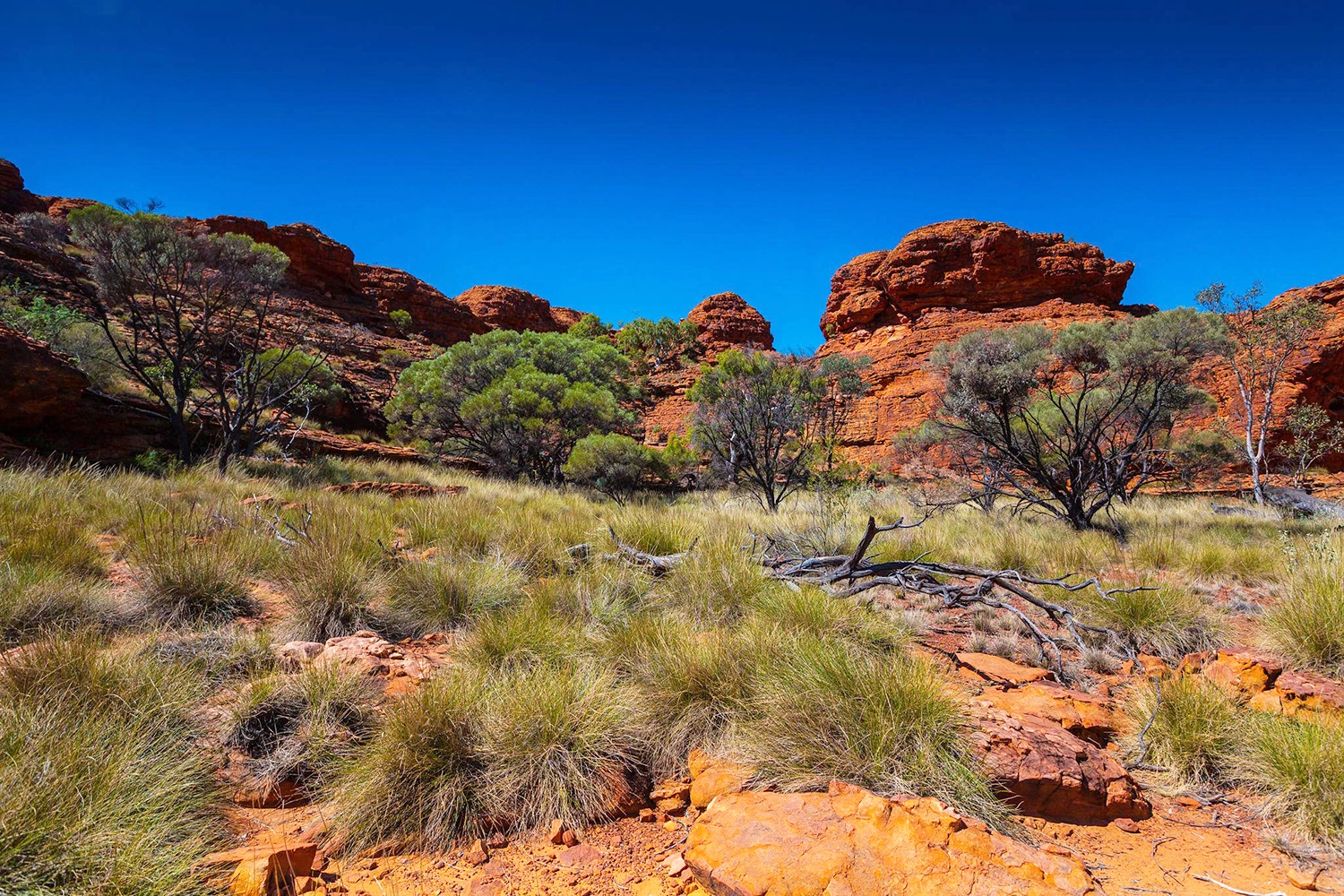
Our Rugged Outback
The rugged Australian outback is vast, raw, and unforgettable.Red earth, endless skies, and ancient landscapes tell stories millions of years old.
The Australian Outback is the vast, remote heart of the continent—a land of red earth, ancient rock, and endless horizons shaped over hundreds of millions of years. Harsh heat, scarce water, and dramatic skies define this powerful landscape, yet it supports resilient plants, unique wildlife, and the world’s oldest continuing cultures, with Aboriginal connections to Country stretching back more than 65,000 years. In its silence, scale, and raw beauty, the Outback offers a rare sense of perspective, where time feels slower and the land itself tells stories far older than human memory.
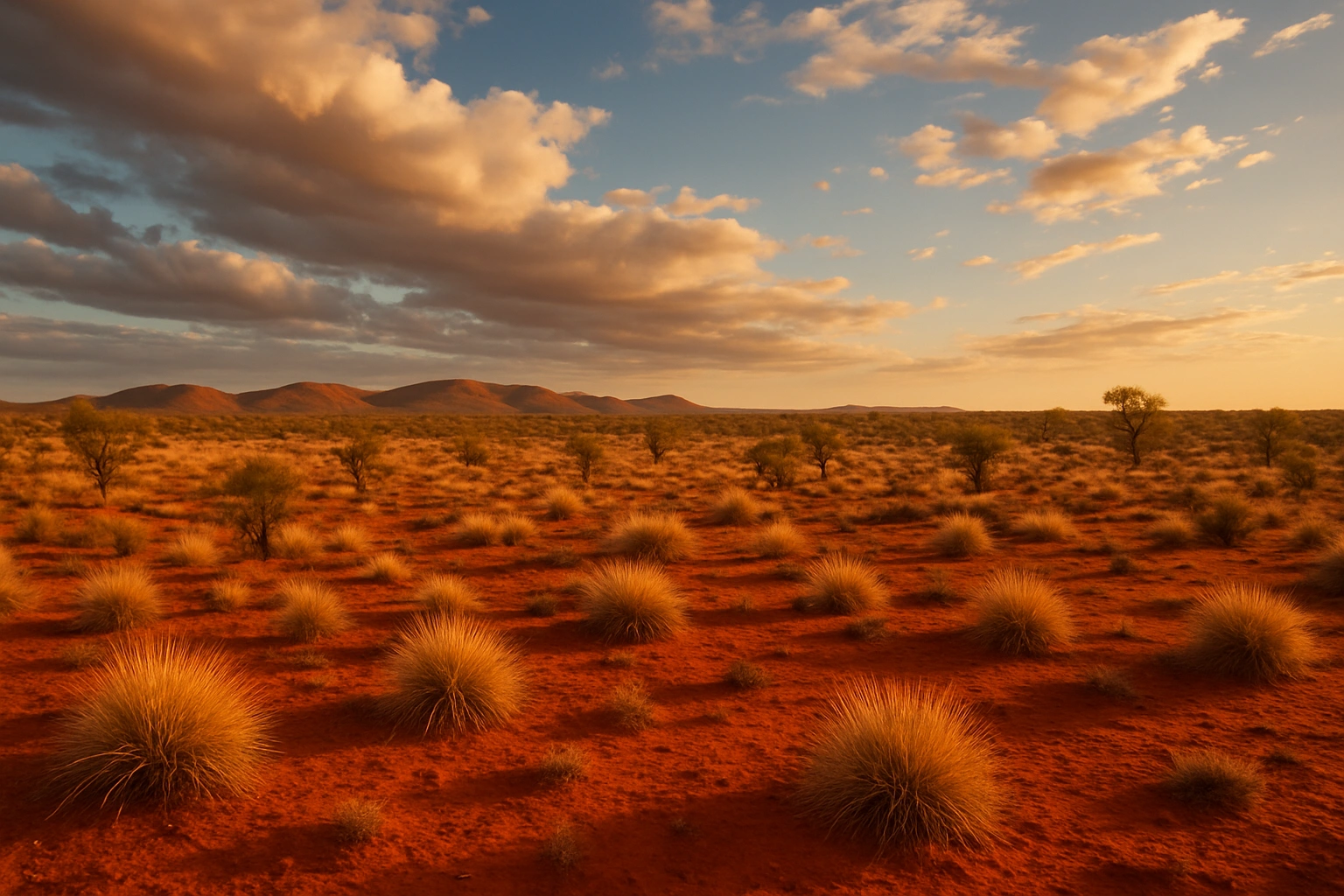
The red soil of the Australian Outback is one of the country’s most striking natural features, shaped by immense age, heat, and time. Its rich red and ochre tones come from iron-rich minerals that have slowly weathered and oxidised over millions of years, essentially “rusting” in the dry air. Because Australia is one of the oldest landmasses on Earth, with little glacial or volcanic renewal, nutrients have long been leached from the soil, leaving it sandy, low in fertility, and poor at holding water despite its bold appearance. This ancient earth defines vast regions such as Central Australia, the Pilbara, and the great desert interiors, and holds deep cultural significance for Aboriginal Australians, who have used red ochre for ceremony, art, and storytelling for tens of thousands of years. At sunrise and sunset, the iron-rich ground reflects the light, causing the Outback to glow in fiery reds and warm purples—an unmistakable symbol of Australia’s raw, timeless landscape.
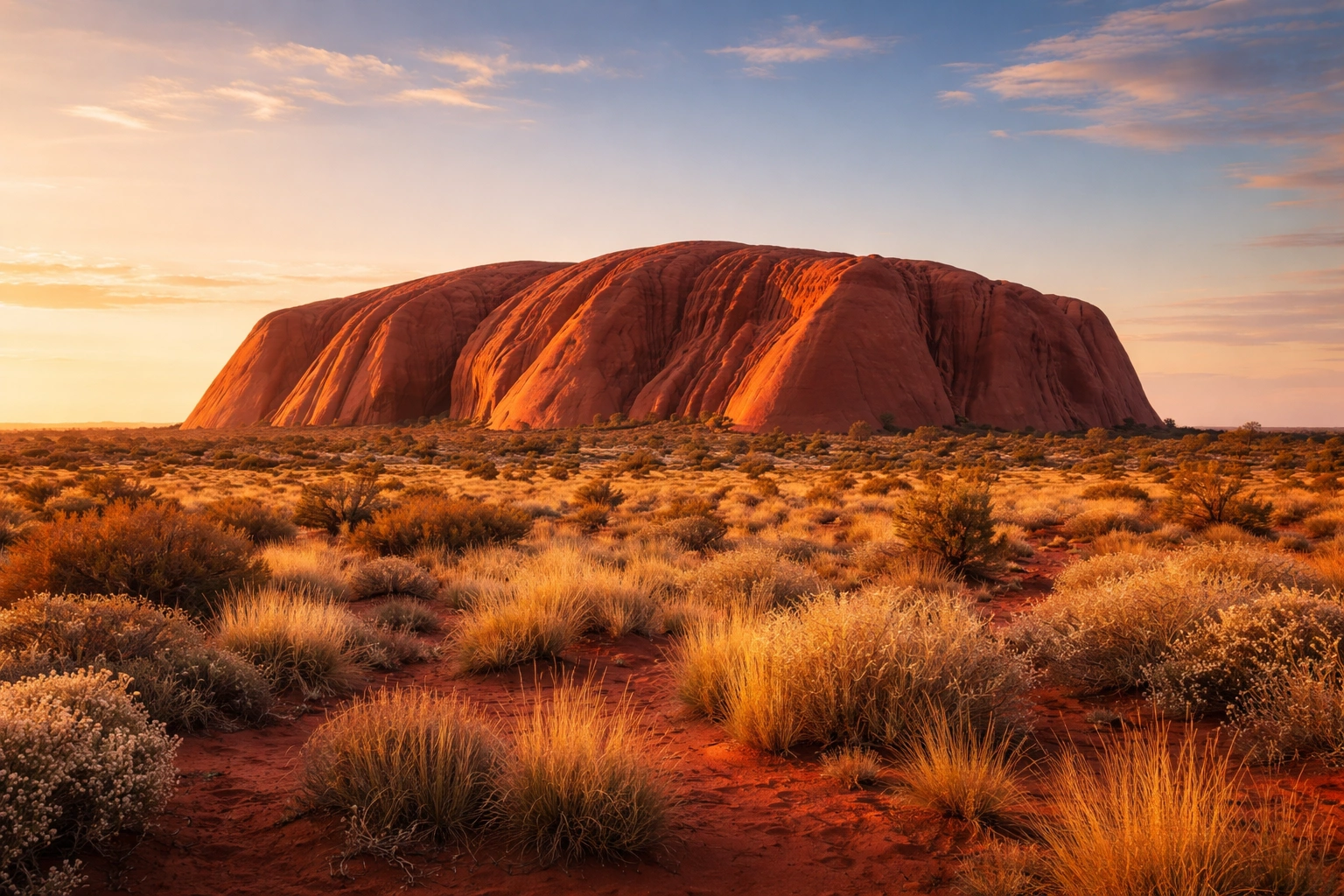
Uluru also known as Ayres Rock is one of Australia’s most powerful and sacred natural landmarks, rising 348 metres above the desert plains of Central Australia and extending deep below the surface. Formed around 550 million years ago, this immense sandstone monolith is rich in iron minerals that oxidise in the harsh Outback climate, giving Uluru its iconic deep red colour that dramatically shifts at sunrise and sunset. Far more than a geological wonder, Uluru is a living cultural landscape central to the Anangu people’s Tjukurpa—ancient law and creation stories that connect the land, people, and wildlife. Its caves, grooves, and waterholes are sacred sites, and today visitors are encouraged to experience Uluru with respect by walking around its base and learning its stories, rather than climbing it—recognising Uluru as a symbol of Australia’s deep time, spiritual heritage, and enduring connection to country.
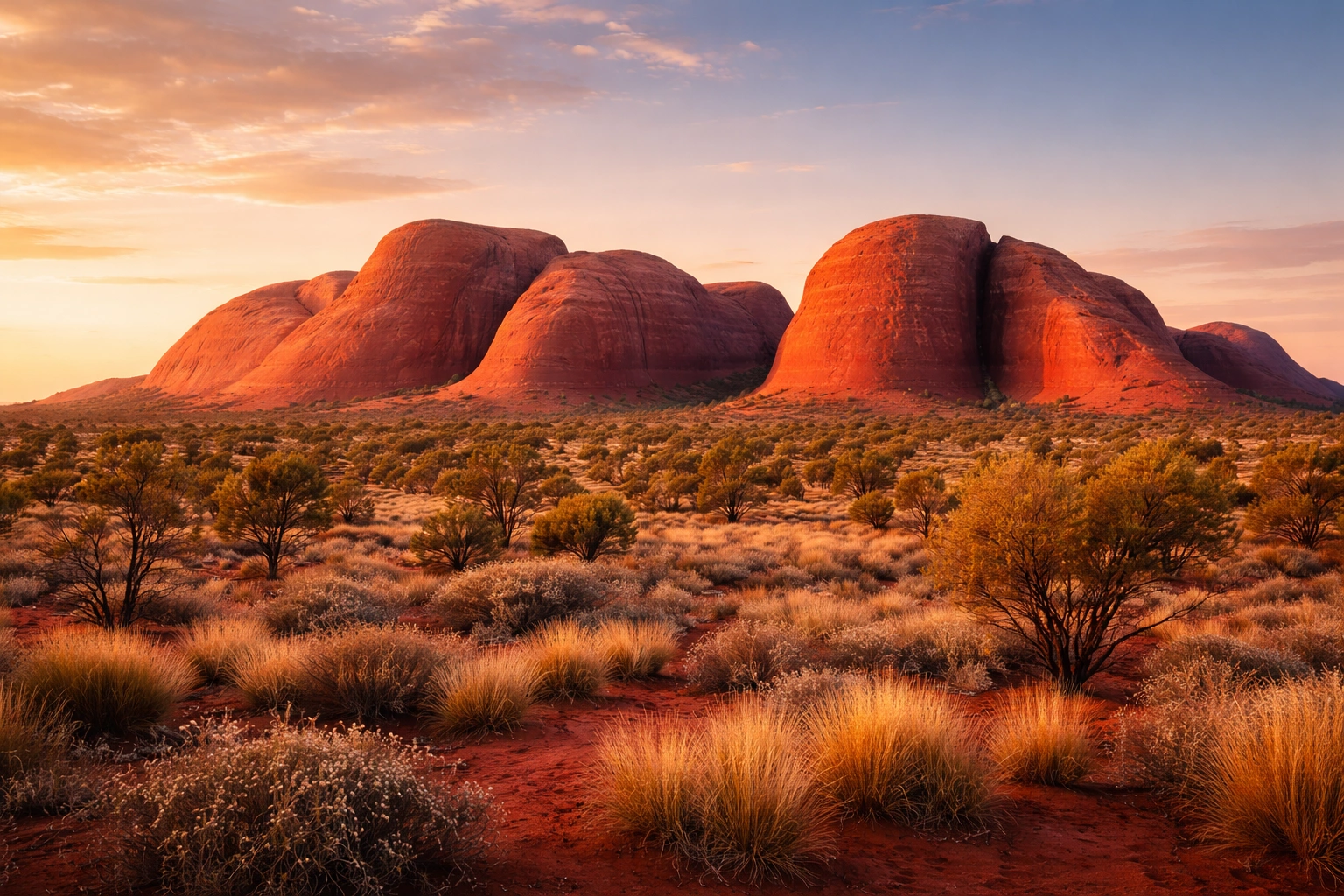
Kata Tjuta, also known as the Olgas, is a vast and powerful landscape of 36 massive sandstone domes rising from the heart of Central Australia, formed around 550 million years ago and even older than Uluru. Meaning “many heads,” Kata Tjuta feels complex and enveloping rather than solitary, with deep valleys, narrow gorges, and towering walls that glow red and orange as the light shifts through the day. The domes are made of ancient conglomerate rock, giving them a rough, heavily textured appearance shaped by time, wind, and water. For the Anangu people, Kata Tjuta is an extremely sacred place, central to Tjukurpa (traditional law and creation stories), and many areas are protected or restricted out of respect. Often described as more mysterious and spiritually intense than Uluru, the Olgas leave visitors with a deep sense of awe, stillness, and connection to Australia’s ancient land.
The Australian Outback is the vast, remote heart of the continent—a land of red earth, ancient rock, and endless horizons shaped over hundreds of millions of years. Harsh heat, scarce water, and dramatic skies define this powerful landscape, yet it supports resilient plants, unique wildlife, and the world’s oldest continuing cultures, with Aboriginal connections to Country stretching back more than 65,000 years. In its silence, scale, and raw beauty, the Outback offers a rare sense of perspective, where time feels slower and the land itself tells stories far older than human memory.
The red soil of the Australian Outback is one of the country’s most striking natural features, shaped by immense age, heat, and time. Its rich red and ochre tones come from iron-rich minerals that have slowly weathered and oxidised over millions of years, essentially “rusting” in the dry air. Because Australia is one of the oldest landmasses on Earth, with little glacial or volcanic renewal, nutrients have long been leached from the soil, leaving it sandy, low in fertility, and poor at holding water despite its bold appearance. This ancient earth defines vast regions such as Central Australia, the Pilbara, and the great desert interiors, and holds deep cultural significance for Aboriginal Australians, who have used red ochre for ceremony, art, and storytelling for tens of thousands of years. At sunrise and sunset, the iron-rich ground reflects the light, causing the Outback to glow in fiery reds and warm purples—an unmistakable symbol of Australia’s raw, timeless landscape.
Uluru also known as Ayres Rock is one of Australia’s most powerful and sacred natural landmarks, rising 348 metres above the desert plains of Central Australia and extending deep below the surface. Formed around 550 million years ago, this immense sandstone monolith is rich in iron minerals that oxidise in the harsh Outback climate, giving Uluru its iconic deep red colour that dramatically shifts at sunrise and sunset. Far more than a geological wonder, Uluru is a living cultural landscape central to the Anangu people’s Tjukurpa—ancient law and creation stories that connect the land, people, and wildlife. Its caves, grooves, and waterholes are sacred sites, and today visitors are encouraged to experience Uluru with respect by walking around its base and learning its stories, rather than climbing it—recognising Uluru as a symbol of Australia’s deep time, spiritual heritage, and enduring connection to country.
Kata Tjuta, also known as the Olgas, is a vast and powerful landscape of 36 massive sandstone domes rising from the heart of Central Australia, formed around 550 million years ago and even older than Uluru. Meaning “many heads,” Kata Tjuta feels complex and enveloping rather than solitary, with deep valleys, narrow gorges, and towering walls that glow red and orange as the light shifts through the day. The domes are made of ancient conglomerate rock, giving them a rough, heavily textured appearance shaped by time, wind, and water. For the Anangu people, Kata Tjuta is an extremely sacred place, central to Tjukurpa (traditional law and creation stories), and many areas are protected or restricted out of respect. Often described as more mysterious and spiritually intense than Uluru, the Olgas leave visitors with a deep sense of awe, stillness, and connection to Australia’s ancient land.
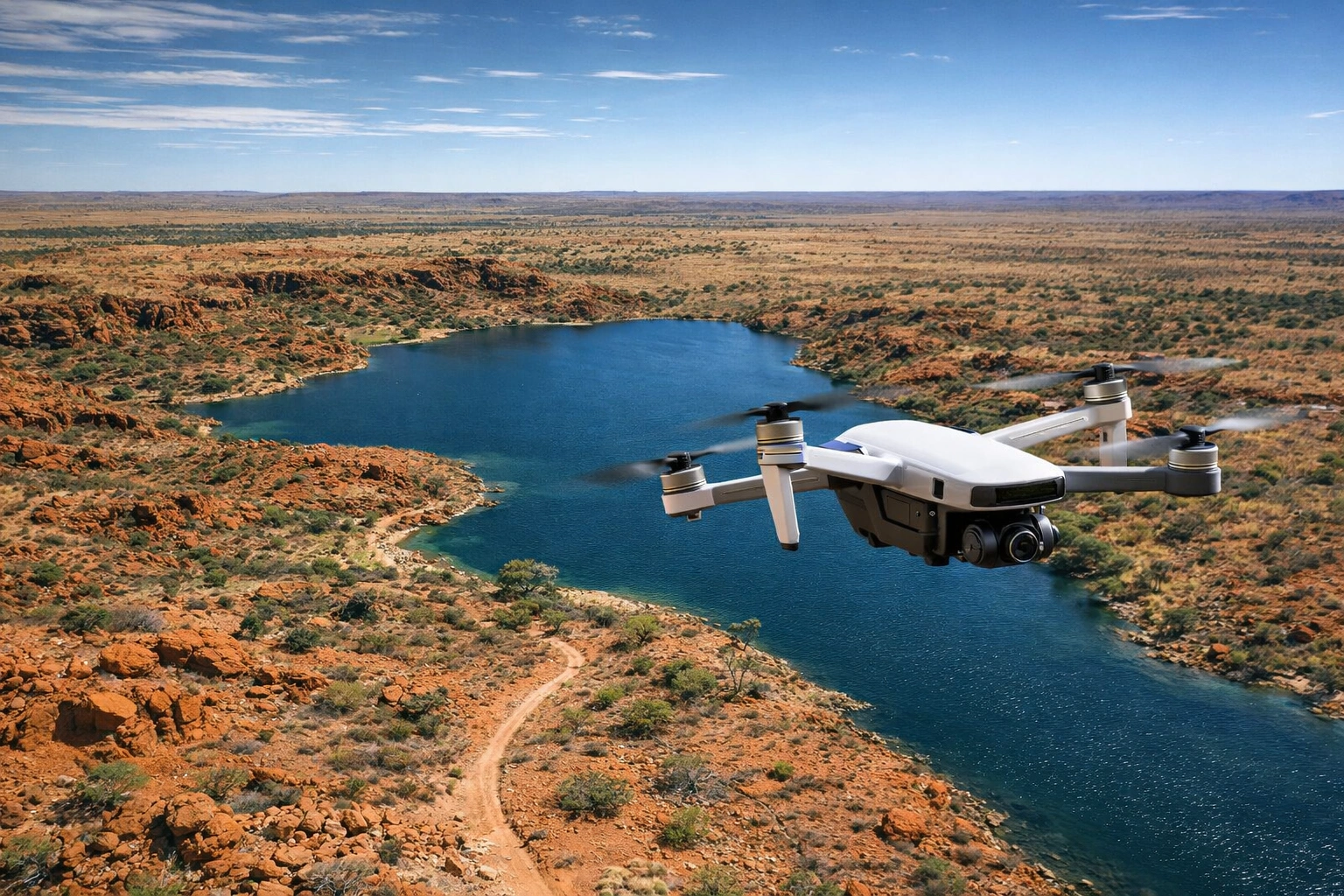
Australia From Above
Australia from a drone reveals its true scale and beauty. From sweeping coastlines to endless outback, the land stretches wild and free beneath open skies.
Seen from high above by a drone, Australia looks vast, raw and beautifully untamed. The coastline stretches endlessly, edged with bright turquoise water and long ribbons of golden sand. Inland, the colours shift dramatically — deep green forests along the east coast, patchwork farmland, and then the immense red heart of the outback dominating the centre of the continent.
From the air, you really see the scale. Snaking rivers cut through dry plains, ancient mountain ranges cast long shadows, and remote roads run straight for kilometres without a bend. Coastal cities like Sydney and Perth hug the shoreline, looking small compared to the surrounding wilderness. Australia from above feels wide, open and powerful — a land defined by space, contrast and dramatic natural beauty.
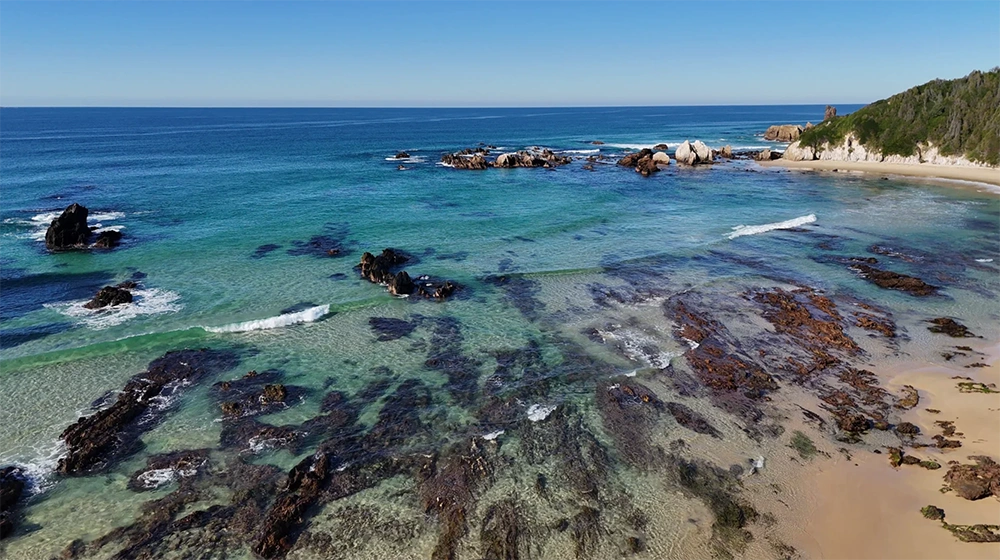
Narooma Beach, Narooma, NSW
Often called Surf Beach, is the main ocean beach in the coastal town of Narooma on the NSW South Coast. The beach sits just south of the entrance to Wagonga Inlet and looks out toward the offshore island Montague Island. It is a wide stretch of golden sand with clear blue water, backed by grassy headlands and parkland, making it a popular spot for swimming, walking, and relaxing by the sea.
The beach is patrolled during the warmer months and is popular with surfers when the swell is up. From the sand you can often see seabirds, dolphins, and occasionally migrating whales during the winter season. Narooma Beach is also known for its scenic location, with walking tracks and lookouts along the headland that provide excellent views of the coastline and Montague Island, one of the region’s most famous wildlife spots.
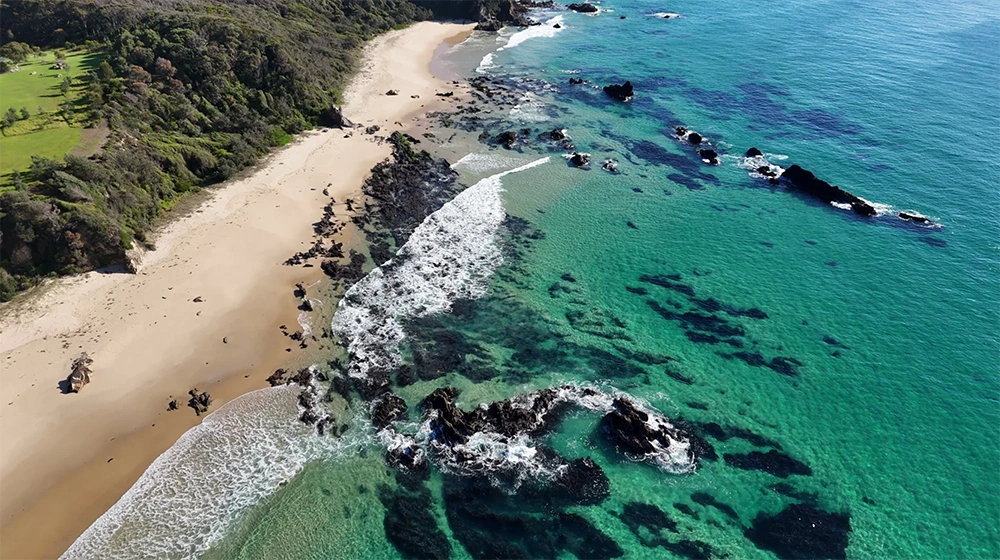
Narooma Beach, Narooma, NSW
Often called Surf Beach, is the main ocean beach in the coastal town of Narooma on the NSW South Coast. The beach sits just south of the entrance to Wagonga Inlet and looks out toward the offshore island Montague Island. It is a wide stretch of golden sand with clear blue water, backed by grassy headlands and parkland, making it a popular spot for swimming, walking, and relaxing by the sea.
The beach is patrolled during the warmer months and is popular with surfers when the swell is up. From the sand you can often see seabirds, dolphins, and occasionally migrating whales during the winter season. Narooma Beach is also known for its scenic location, with walking tracks and lookouts along the headland that provide excellent views of the coastline and Montague Island, one of the region’s most famous wildlife spots.
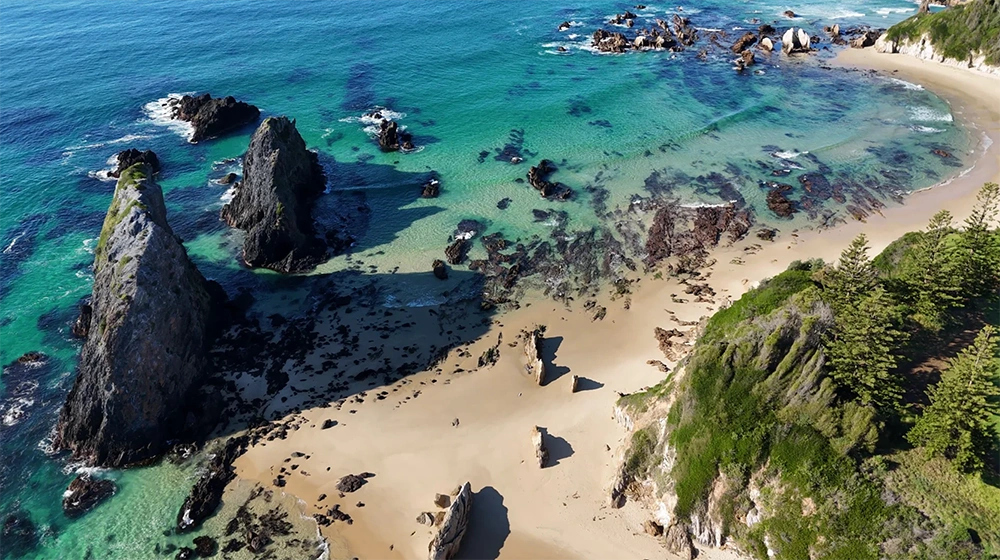
Glasshouse Rocks, Narooma, NSW
Are a striking group of coastal rock formations located just north of Narooma on the NSW South Coast. The rocks rise sharply from the ocean near Narooma Surf Beach and are known for their unusual shapes and rugged appearance. Their name comes from their resemblance to the famous volcanic peaks of the Glass House Mountains. The formations are made from ancient volcanic rock that has been sculpted over millions of years by waves, wind, and coastal erosion.
Glasshouse Rocks are a popular photography and sightseeing spot, especially at sunrise and sunset when the light highlights the dramatic cliffs and offshore stacks. The area also offers excellent coastal walks and whale-watching opportunities during migration season, when humpback whales pass along the coast. While the scenery is spectacular, the rocks and surrounding shoreline can be hazardous due to strong surf and slippery surfaces, so visitors are encouraged to enjoy the views from safe vantage points along the nearby headlands and walking paths.
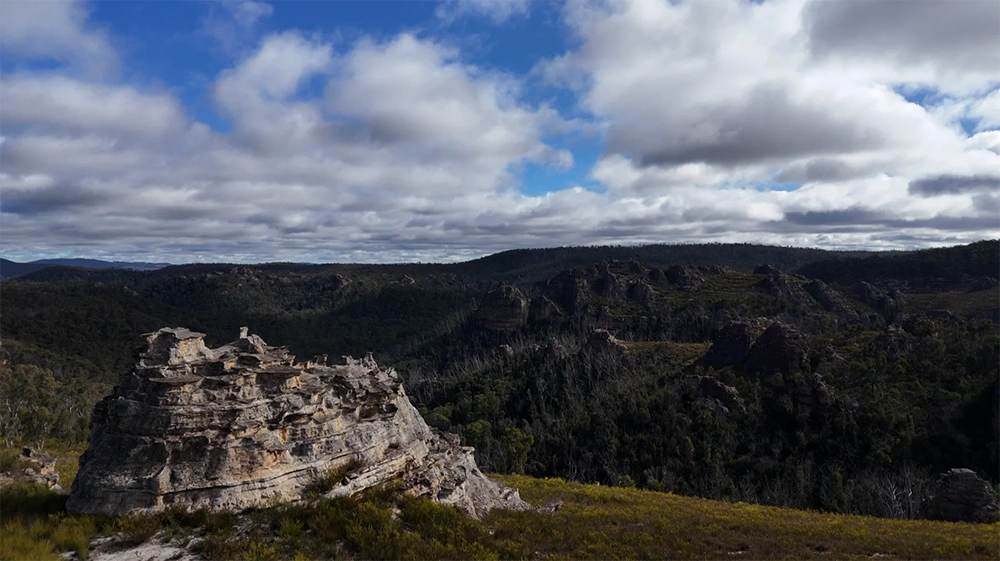
The Lost City near Newnes, NSW
Is a remarkable natural rock formation located within Wollemi National Park, part of the greater Blue Mountains World Heritage Area. The landscape features hundreds of unusual sandstone towers, domes, and pinnacles that resemble the ruins of an ancient city, which is how the site earned its name. These formations are often called “pagodas” because of their layered appearance, created over millions of years by wind, rain, and erosion acting on the sandstone plateau.
The Lost City is a popular destination for bushwalkers, photographers, and four-wheel-drive enthusiasts, as the area is accessed via unsealed roads from the old shale-mining village of Newnes. Walking tracks wind through the rocky formations, allowing visitors to explore the maze of natural towers and narrow passages. The surrounding landscape is also rich in native bushland and wildlife, making the area both geologically fascinating and scenically beautiful, with views across the rugged valleys of the Wollemi wilderness.
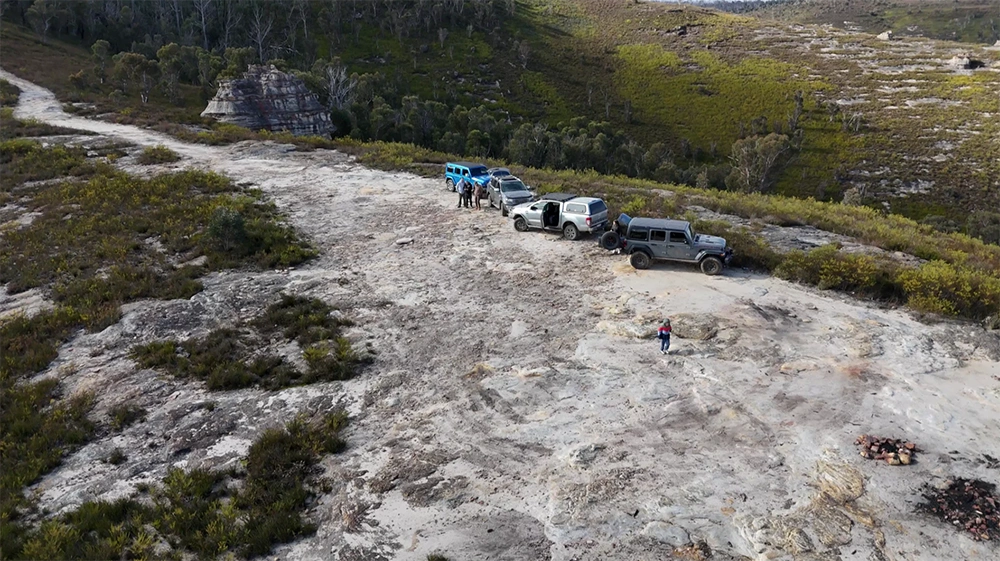
Driving a 4WD at the Lost City, near Newnes, NSW
Is one of the most popular ways to explore the remarkable sandstone formations near Newnes in Wollemi National Park. The area is accessed via the Lost City Trail, an unsealed road that winds through bushland before emerging into a landscape of unusual sandstone towers known as pagodas. The track itself is generally suitable for high-clearance vehicles, though conditions can vary depending on weather, with loose gravel, ruts, and occasional washouts.
Most visitors drive to the end of the trail where a small parking area and lookout sit among the rock formations. From there, short walks allow you to explore the pagodas up close and take in the incredible scenery that looks almost like the ruins of an ancient city. While the track is not extremely technical, drivers should still take care, especially after rain when the road can become slippery. The area is remote, so it’s wise to carry water, basic recovery gear, and check local conditions before heading out. Many travellers combine the trip with a visit to the historic shale-mining ruins at Newnes and the surrounding valleys of the Wollemi wilderness
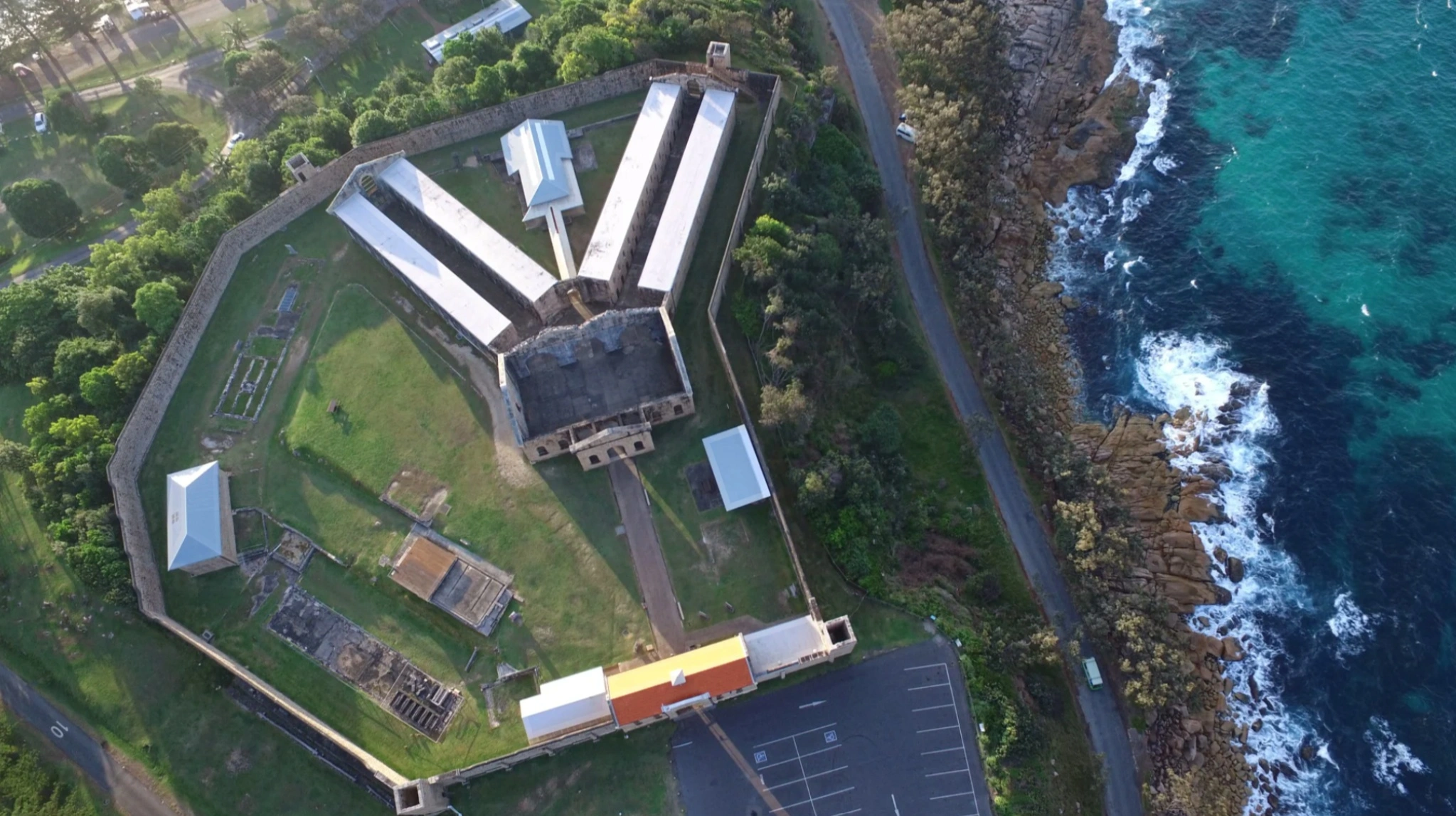
Trial Bay Gaol, South West Rocks
is a historic prison ruin located near South West Rocks within Arakoon National Park. Built in the 1870s, the gaol was originally intended to house prisoners who were constructing a breakwater at Trial Bay to create a safe harbour for ships along the treacherous Mid North Coast. However, the harbour project proved difficult and was eventually abandoned, and the prison closed in 1903 after operating for only a few decades.
During World War I, the site was reopened as an internment camp for people of German descent living in Australia. Around 500 internees were held there between 1915 and 1918. Today, the impressive sandstone ruins overlook the ocean and are one of the most unusual historic sites on the NSW coast. Visitors can walk through the remaining cell blocks, towers, and courtyards, while the surrounding area offers camping, swimming at nearby beaches, and coastal walking tracks, making it both a historical landmark and a scenic destination.
Seen from high above by a drone, Australia looks vast, raw and beautifully untamed. The coastline stretches endlessly, edged with bright turquoise water and long ribbons of golden sand. Inland, the colours shift dramatically — deep green forests along the east coast, patchwork farmland, and then the immense red heart of the outback dominating the centre of the continent.
From the air, you really see the scale. Snaking rivers cut through dry plains, ancient mountain ranges cast long shadows, and remote roads run straight for kilometres without a bend. Coastal cities like Sydney and Perth hug the shoreline, looking small compared to the surrounding wilderness. Australia from above feels wide, open and powerful — a land defined by space, contrast and dramatic natural beauty.
Narooma Beach, Narooma, NSW
Often called Surf Beach, is the main ocean beach in the coastal town of Narooma on the NSW South Coast. The beach sits just south of the entrance to Wagonga Inlet and looks out toward the offshore island Montague Island. It is a wide stretch of golden sand with clear blue water, backed by grassy headlands and parkland, making it a popular spot for swimming, walking, and relaxing by the sea.
The beach is patrolled during the warmer months and is popular with surfers when the swell is up. From the sand you can often see seabirds, dolphins, and occasionally migrating whales during the winter season. Narooma Beach is also known for its scenic location, with walking tracks and lookouts along the headland that provide excellent views of the coastline and Montague Island, one of the region’s most famous wildlife spots.
Narooma Beach, Narooma, NSW
Often called Surf Beach, is the main ocean beach in the coastal town of Narooma on the NSW South Coast. The beach sits just south of the entrance to Wagonga Inlet and looks out toward the offshore island Montague Island. It is a wide stretch of golden sand with clear blue water, backed by grassy headlands and parkland, making it a popular spot for swimming, walking, and relaxing by the sea.
The beach is patrolled during the warmer months and is popular with surfers when the swell is up. From the sand you can often see seabirds, dolphins, and occasionally migrating whales during the winter season. Narooma Beach is also known for its scenic location, with walking tracks and lookouts along the headland that provide excellent views of the coastline and Montague Island, one of the region’s most famous wildlife spots.
Glasshouse Rocks, Narooma, NSW
Are a striking group of coastal rock formations located just north of Narooma on the NSW South Coast. The rocks rise sharply from the ocean near Narooma Surf Beach and are known for their unusual shapes and rugged appearance. Their name comes from their resemblance to the famous volcanic peaks of the Glass House Mountains. The formations are made from ancient volcanic rock that has been sculpted over millions of years by waves, wind, and coastal erosion.
Glasshouse Rocks are a popular photography and sightseeing spot, especially at sunrise and sunset when the light highlights the dramatic cliffs and offshore stacks. The area also offers excellent coastal walks and whale-watching opportunities during migration season, when humpback whales pass along the coast. While the scenery is spectacular, the rocks and surrounding shoreline can be hazardous due to strong surf and slippery surfaces, so visitors are encouraged to enjoy the views from safe vantage points along the nearby headlands and walking paths.
The Lost City near Newnes, NSW
Is a remarkable natural rock formation located within Wollemi National Park, part of the greater Blue Mountains World Heritage Area. The landscape features hundreds of unusual sandstone towers, domes, and pinnacles that resemble the ruins of an ancient city, which is how the site earned its name. These formations are often called “pagodas” because of their layered appearance, created over millions of years by wind, rain, and erosion acting on the sandstone plateau.
The Lost City is a popular destination for bushwalkers, photographers, and four-wheel-drive enthusiasts, as the area is accessed via unsealed roads from the old shale-mining village of Newnes. Walking tracks wind through the rocky formations, allowing visitors to explore the maze of natural towers and narrow passages. The surrounding landscape is also rich in native bushland and wildlife, making the area both geologically fascinating and scenically beautiful, with views across the rugged valleys of the Wollemi wilderness.
Driving a 4WD at the Lost City, near Newnes, NSW
Is one of the most popular ways to explore the remarkable sandstone formations near Newnes in Wollemi National Park. The area is accessed via the Lost City Trail, an unsealed road that winds through bushland before emerging into a landscape of unusual sandstone towers known as pagodas. The track itself is generally suitable for high-clearance vehicles, though conditions can vary depending on weather, with loose gravel, ruts, and occasional washouts.
Most visitors drive to the end of the trail where a small parking area and lookout sit among the rock formations. From there, short walks allow you to explore the pagodas up close and take in the incredible scenery that looks almost like the ruins of an ancient city. While the track is not extremely technical, drivers should still take care, especially after rain when the road can become slippery. The area is remote, so it’s wise to carry water, basic recovery gear, and check local conditions before heading out. Many travellers combine the trip with a visit to the historic shale-mining ruins at Newnes and the surrounding valleys of the Wollemi wilderness
Trial Bay Gaol, South West Rocks
is a historic prison ruin located near South West Rocks within Arakoon National Park. Built in the 1870s, the gaol was originally intended to house prisoners who were constructing a breakwater at Trial Bay to create a safe harbour for ships along the treacherous Mid North Coast. However, the harbour project proved difficult and was eventually abandoned, and the prison closed in 1903 after operating for only a few decades.
During World War I, the site was reopened as an internment camp for people of German descent living in Australia. Around 500 internees were held there between 1915 and 1918. Today, the impressive sandstone ruins overlook the ocean and are one of the most unusual historic sites on the NSW coast. Visitors can walk through the remaining cell blocks, towers, and courtyards, while the surrounding area offers camping, swimming at nearby beaches, and coastal walking tracks, making it both a historical landmark and a scenic destination.
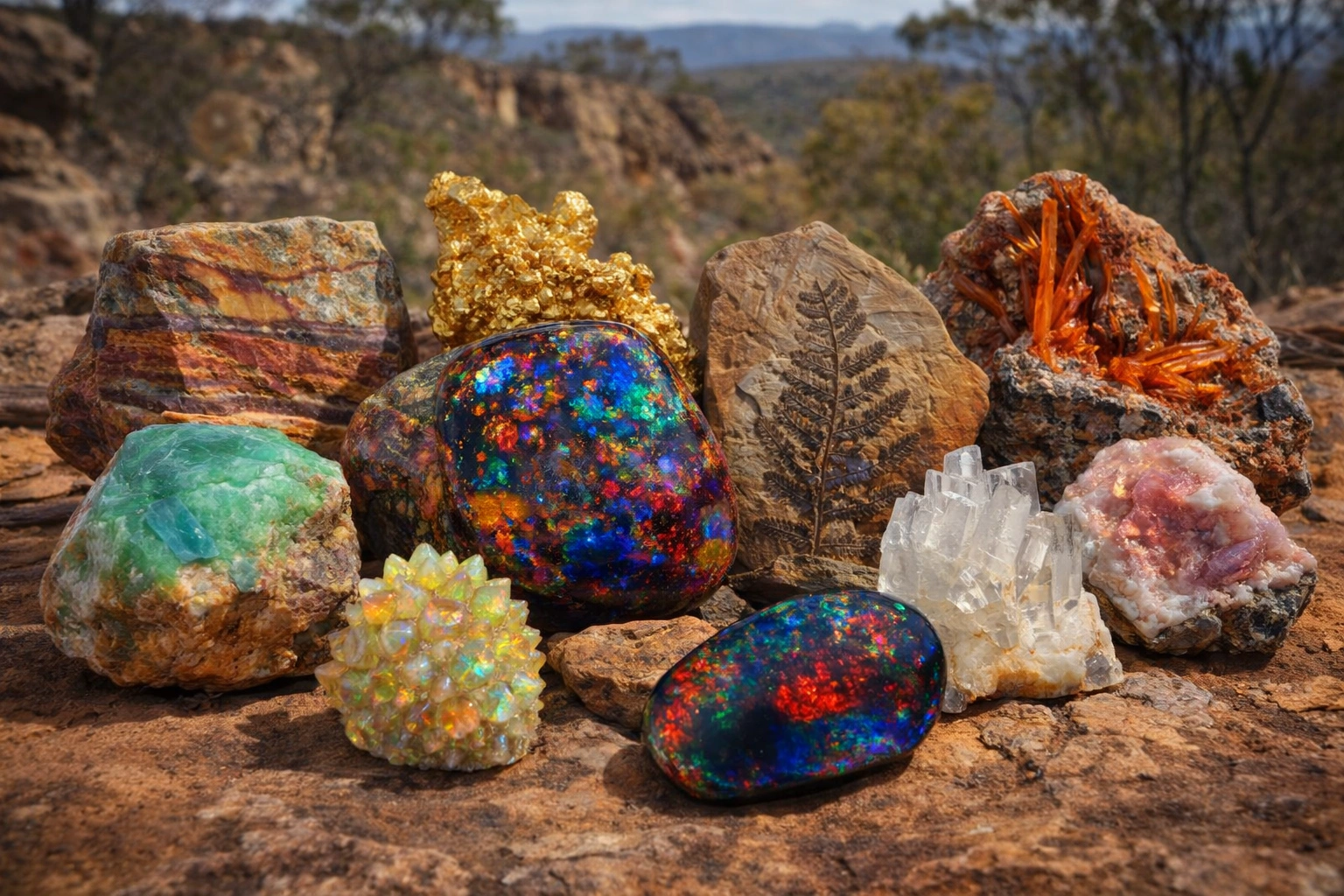
Our Rocks and Minerals
Australia’s rocks and minerals tell an ancient story.From glowing opals to rugged stone formations, they reveal the deep time and raw strength of the land.
Australia is one of the most geologically diverse countries on Earth, with ancient rock formations dating back billions of years. Much of the continent sits on incredibly old cratons — stable pieces of Earth’s crust — which is why Australia is so rich in minerals and natural resources.
The country is famous for iron ore from Western Australia’s Pilbara region, gold (especially from Victoria and WA), bauxite, copper, lithium and uranium. Iconic rock formations like Uluru are made of sandstone and tell geological stories stretching back hundreds of millions of years.
Australia is also known for unique minerals and gemstones, including opal, sapphires and rare pink diamonds once mined at Argyle in WA. These resources have shaped Australia’s economy and history, making mining one of the nation’s most significant industries.
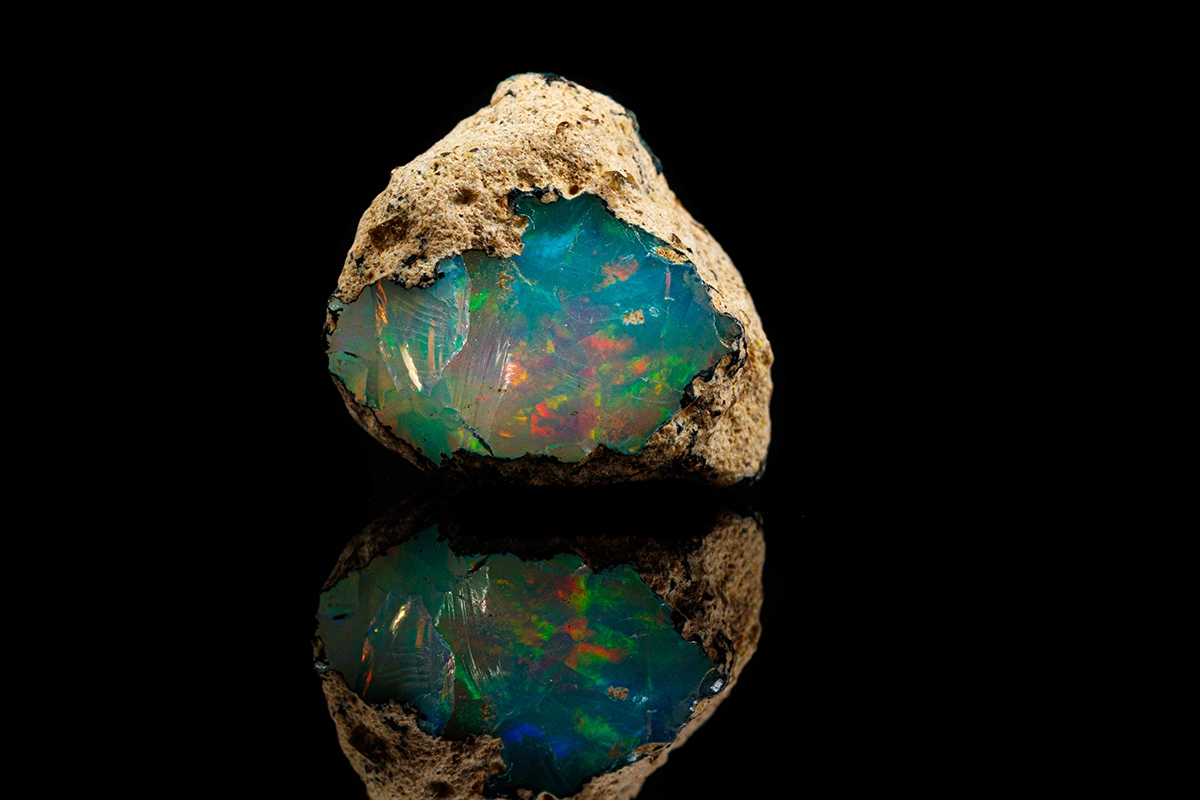
Australia produces around 90–95% of the world’s precious opal, making it the global heart of this shimmering gemstone. Opal forms when silica-rich water seeps into cracks in rock and slowly hardens over millions of years, creating the famous “play-of-colour” effect — flashes of red, green, blue and gold that shift in the light.
The country is home to several famous opal fields, including Lightning Ridge (renowned for rare black opal), Coober Pedy in South Australia, White Cliffs in New South Wales, and Queensland’s boulder opal region. Each produces opal with its own character and colour style.
Australian opal isn’t just a gemstone — it’s part of the country’s identity, even recognised as Australia’s national gemstone.
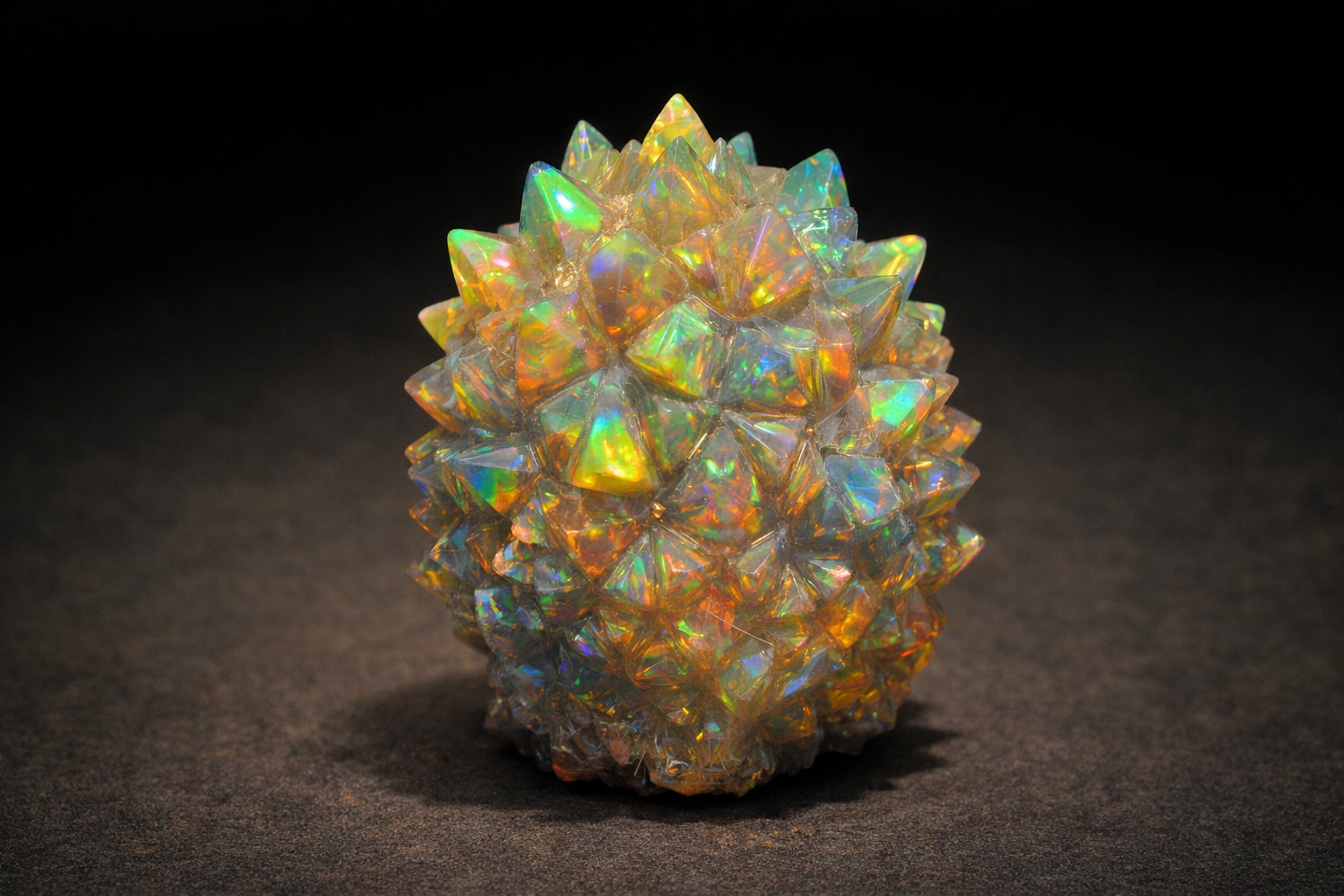
Pineapple opal is one of the rarest and most unusual opal formations found in Australia, discovered in the historic opal mining town of White Cliffs in far-western New South Wales. Instead of forming in solid seams like most opals, this variety grows in tight crystal clusters that resemble the textured surface of a pineapple — hence the name.
These formations occur when precious opal replaces a mineral called ikaite, creating a striking geometric pattern. Pineapple opal is extremely rare and highly prized by collectors because of its unique structure and the soft pastel play-of-colour it can display. White Cliffs itself is famous for its underground dugout homes and early opal discoveries dating back to the late 1800s, making it a special part of Australia’s mining history.
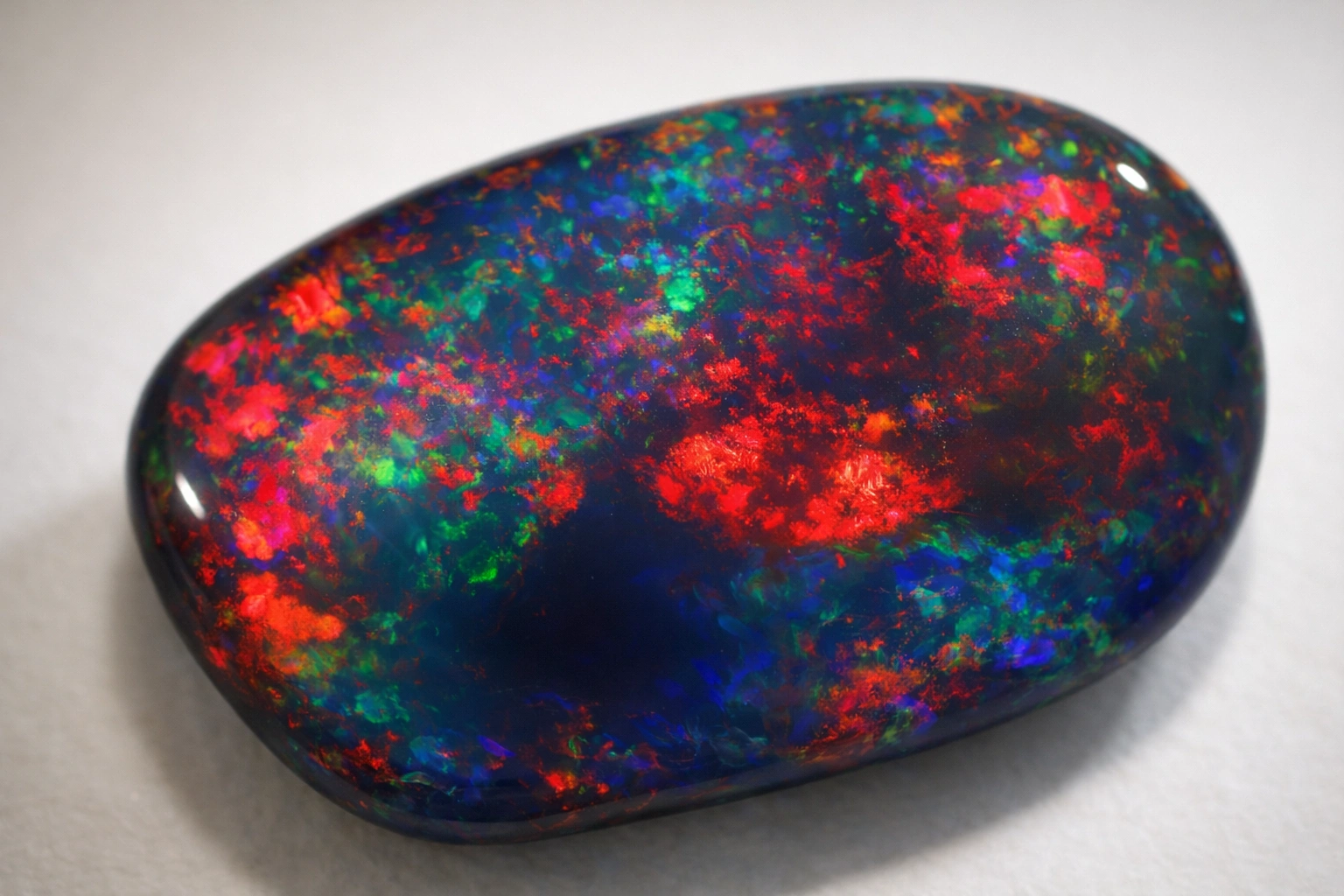
Australian black opal is the rarest and most valuable type of opal in the world, famous for its dark body tone that makes the colours blaze intensely against it. Unlike lighter opals, black opal’s deep background allows flashes of red, blue, green and purple to appear more vivid and dramatic.
The vast majority of black opal comes from Lightning Ridge in northern New South Wales, which is considered the global capital of this gemstone. Formed over millions of years when silica-rich water filled cracks in ancient rock, black opal’s colour play is created by tiny silica spheres that refract light.
Because high-quality stones with strong red fire are extremely rare, black opal can command very high prices, making it one of Australia’s most prized natural treasures.
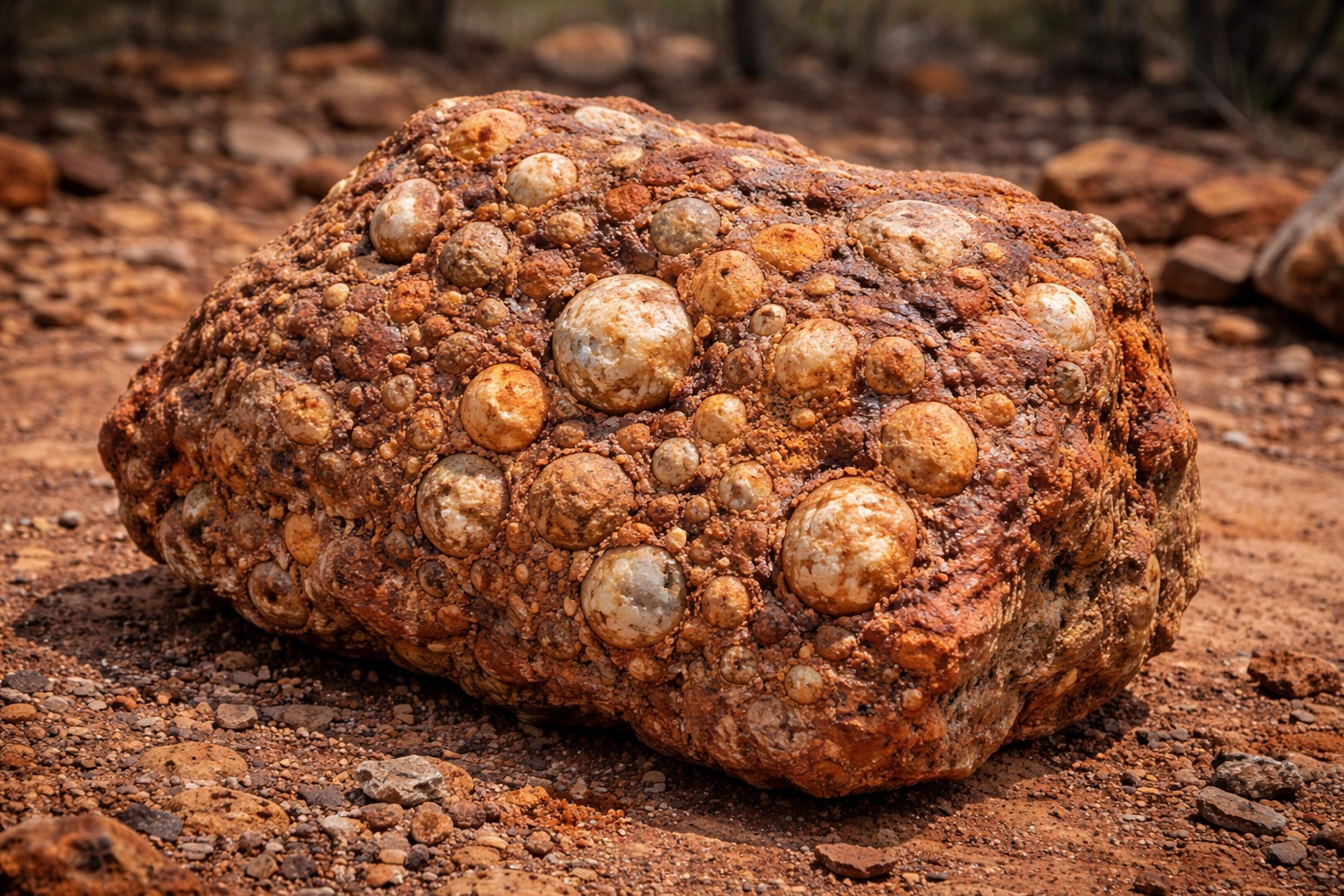
Bauxite is the primary ore used to produce aluminium, and Australia is one of the world’s largest producers and exporters of it. The ore forms in tropical and subtropical climates where intense weathering breaks down rocks over millions of years, leaving behind aluminium-rich material near the surface — which makes it relatively easy to mine.
Major deposits are found in Queensland (notably around Weipa), the Northern Territory and Western Australia. After mining, bauxite is refined into alumina and then smelted into aluminium, which is used in everything from aircraft and cars to drink cans and construction materials.
Bauxite plays a huge role in Australia’s economy, contributing billions of dollars in exports each year and supporting thousands of jobs across mining and refining regions.
Australia is one of the most geologically diverse countries on Earth, with ancient rock formations dating back billions of years. Much of the continent sits on incredibly old cratons — stable pieces of Earth’s crust — which is why Australia is so rich in minerals and natural resources.
The country is famous for iron ore from Western Australia’s Pilbara region, gold (especially from Victoria and WA), bauxite, copper, lithium and uranium. Iconic rock formations like Uluru are made of sandstone and tell geological stories stretching back hundreds of millions of years.
Australia is also known for unique minerals and gemstones, including opal, sapphires and rare pink diamonds once mined at Argyle in WA. These resources have shaped Australia’s economy and history, making mining one of the nation’s most significant industries.
Australia produces around 90–95% of the world’s precious opal, making it the global heart of this shimmering gemstone. Opal forms when silica-rich water seeps into cracks in rock and slowly hardens over millions of years, creating the famous “play-of-colour” effect — flashes of red, green, blue and gold that shift in the light.
The country is home to several famous opal fields, including Lightning Ridge (renowned for rare black opal), Coober Pedy in South Australia, White Cliffs in New South Wales, and Queensland’s boulder opal region. Each produces opal with its own character and colour style.
Australian opal isn’t just a gemstone — it’s part of the country’s identity, even recognised as Australia’s national gemstone.
Pineapple opal is one of the rarest and most unusual opal formations found in Australia, discovered in the historic opal mining town of White Cliffs in far-western New South Wales. Instead of forming in solid seams like most opals, this variety grows in tight crystal clusters that resemble the textured surface of a pineapple — hence the name.
These formations occur when precious opal replaces a mineral called ikaite, creating a striking geometric pattern. Pineapple opal is extremely rare and highly prized by collectors because of its unique structure and the soft pastel play-of-colour it can display. White Cliffs itself is famous for its underground dugout homes and early opal discoveries dating back to the late 1800s, making it a special part of Australia’s mining history.
Australian black opal is the rarest and most valuable type of opal in the world, famous for its dark body tone that makes the colours blaze intensely against it. Unlike lighter opals, black opal’s deep background allows flashes of red, blue, green and purple to appear more vivid and dramatic.
The vast majority of black opal comes from Lightning Ridge in northern New South Wales, which is considered the global capital of this gemstone. Formed over millions of years when silica-rich water filled cracks in ancient rock, black opal’s colour play is created by tiny silica spheres that refract light.
Because high-quality stones with strong red fire are extremely rare, black opal can command very high prices, making it one of Australia’s most prized natural treasures.
Bauxite is the primary ore used to produce aluminium, and Australia is one of the world’s largest producers and exporters of it. The ore forms in tropical and subtropical climates where intense weathering breaks down rocks over millions of years, leaving behind aluminium-rich material near the surface — which makes it relatively easy to mine.
Major deposits are found in Queensland (notably around Weipa), the Northern Territory and Western Australia. After mining, bauxite is refined into alumina and then smelted into aluminium, which is used in everything from aircraft and cars to drink cans and construction materials.
Bauxite plays a huge role in Australia’s economy, contributing billions of dollars in exports each year and supporting thousands of jobs across mining and refining regions.
This is Australia
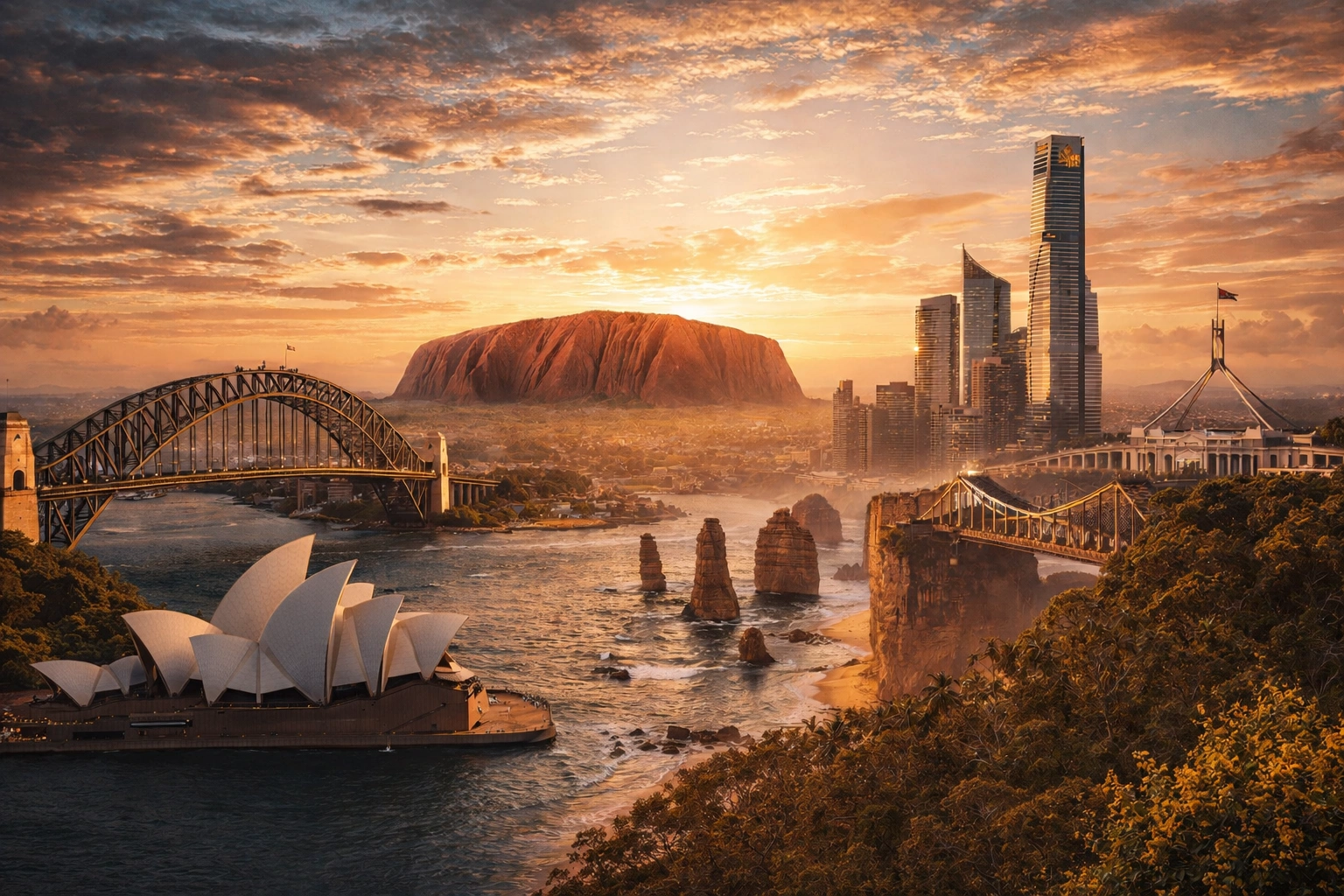
Famous Australian Icons
Australia’s icons reflect both its ancient roots and modern identity, blending natural wonders with human achievement.
Australia’s world-famous built icons are bold, distinctive and instantly recognisable — often sitting right against dramatic natural backdrops. The Sydney Opera House is probably the most iconic, its sail-like white shells rising from Sydney Harbour. Right beside it stands the mighty Sydney Harbour Bridge, a steel arch that has become just as symbolic of the city. In Melbourne, landmarks like Flinders Street Station and the Melbourne Cricket Ground reflect Australia’s deep sporting and cultural traditions.
Beyond the East Coast, other standout structures shape the national identity. Parliament House in Canberra blends modern architecture with symbolic design, while the Story Bridge in Brisbane and the Bell Tower in Perth give their cities unique skylines. From historic colonial buildings to striking contemporary designs, Australia’s built icons combine engineering, culture and landscape — often set against ocean, harbour or wide open sky, which makes them feel even more dramatic from above.
This stylistic image blends elements from multiple themes into one cohesive visual scene.
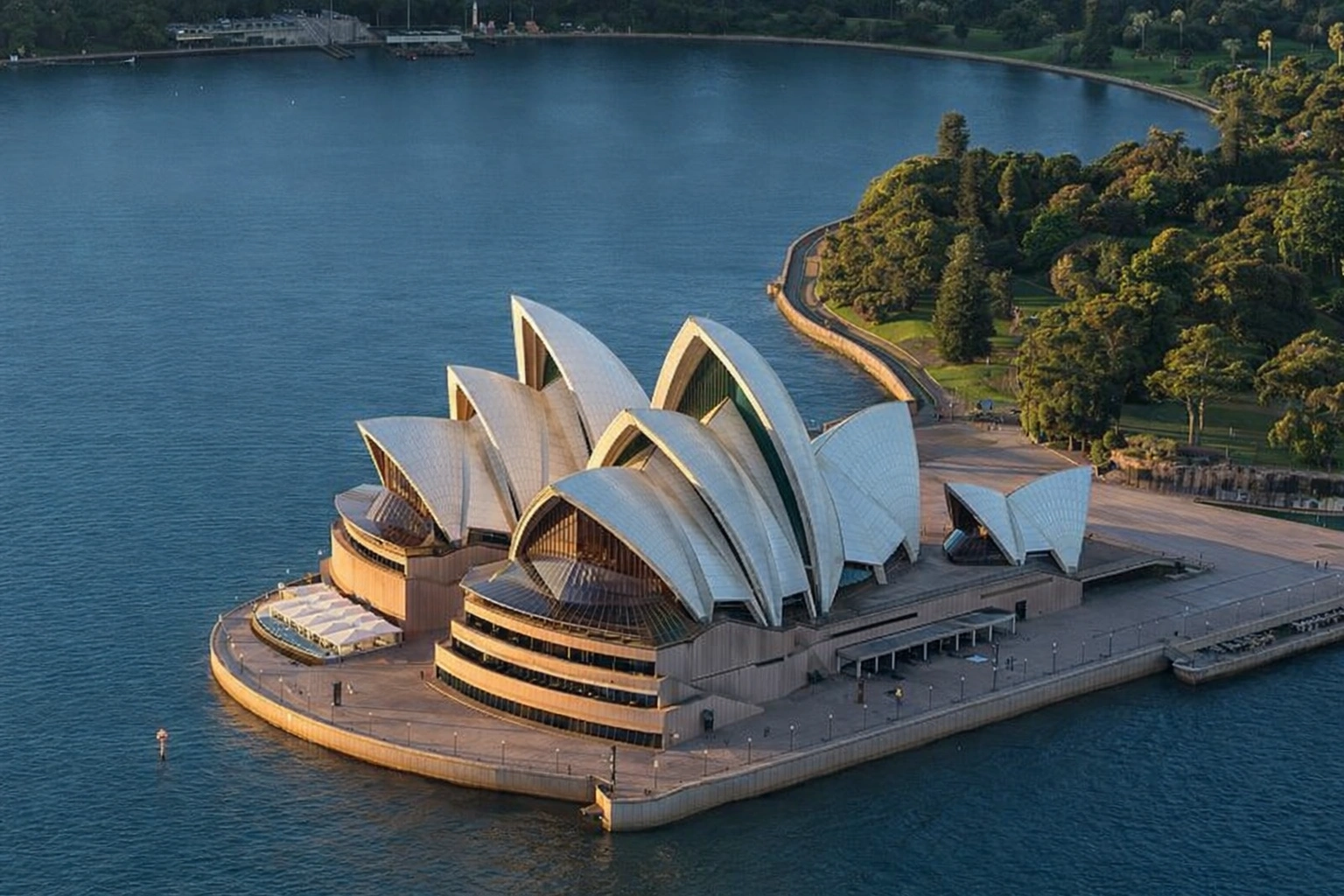
Sydney Opera House, New South Wales
is Australia’s most iconic building and one of the most recognisable landmarks in the world. Opened in 1973 and designed by Danish architect Jørn Utzon, its soaring white sail-like shells were inspired by nature—often said to echo yacht sails, shells, or waves on Sydney Harbour. Perched on Bennelong Point, the building is both a masterpiece of modern architecture and a symbol of Australia’s creative confidence on the global stage. Inside, it is a world-class performing arts centre, hosting opera, theatre, music, and dance across multiple venues. In 2007, it was recognised as a UNESCO World Heritage site, celebrated not just for its beauty, but for its bold engineering and lasting cultural impact—making it a powerful emblem of modern Australia, set against one of the world’s most beautiful harbours.
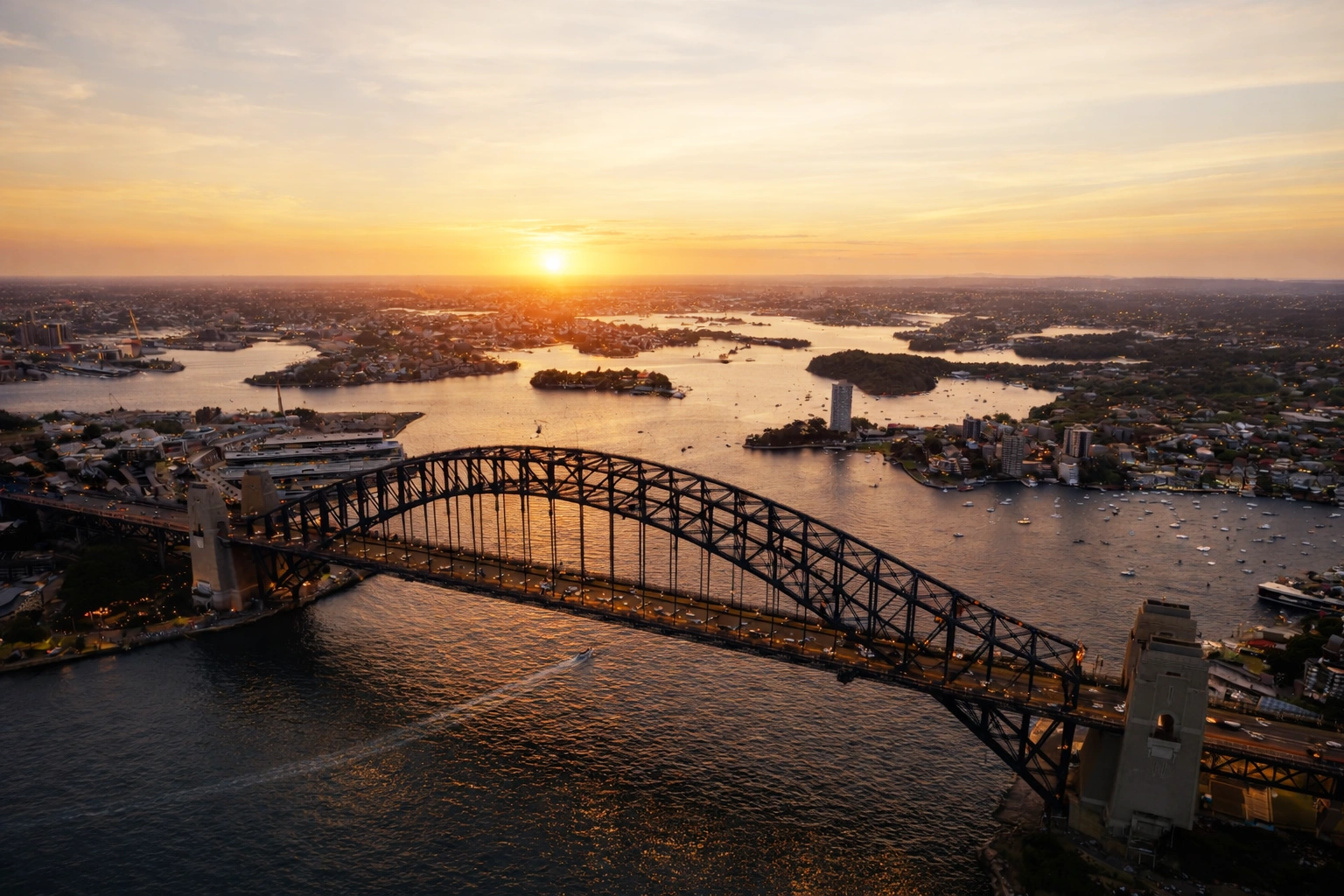
Sydney Harbour Bridge, New South Wales
is one of Australia’s most recognisable landmarks and a true icon of Sydney. Opened in 1932, it connects the Sydney CBD with the North Shore, spanning the sparkling waters of Sydney Harbour in one massive steel arch. Locals affectionately call it “The Coathanger” because of its distinctive curved shape.
The bridge is about 1,149 metres long and rises 134 metres above the harbour at its highest point. It carries cars, trains, buses, bicycles and pedestrians, making it a vital transport link as well as a tourist attraction. For those wanting a bit more adventure, the BridgeClimb experience allows visitors to walk right to the top for incredible panoramic views of the city and the nearby Sydney Opera House.
Beyond its engineering achievement, the bridge plays a huge cultural role in Australia, especially during New Year’s Eve when it becomes the centrepiece of Sydney’s world-famous fireworks display. It’s more than just a bridge — it’s a symbol of the city itself.
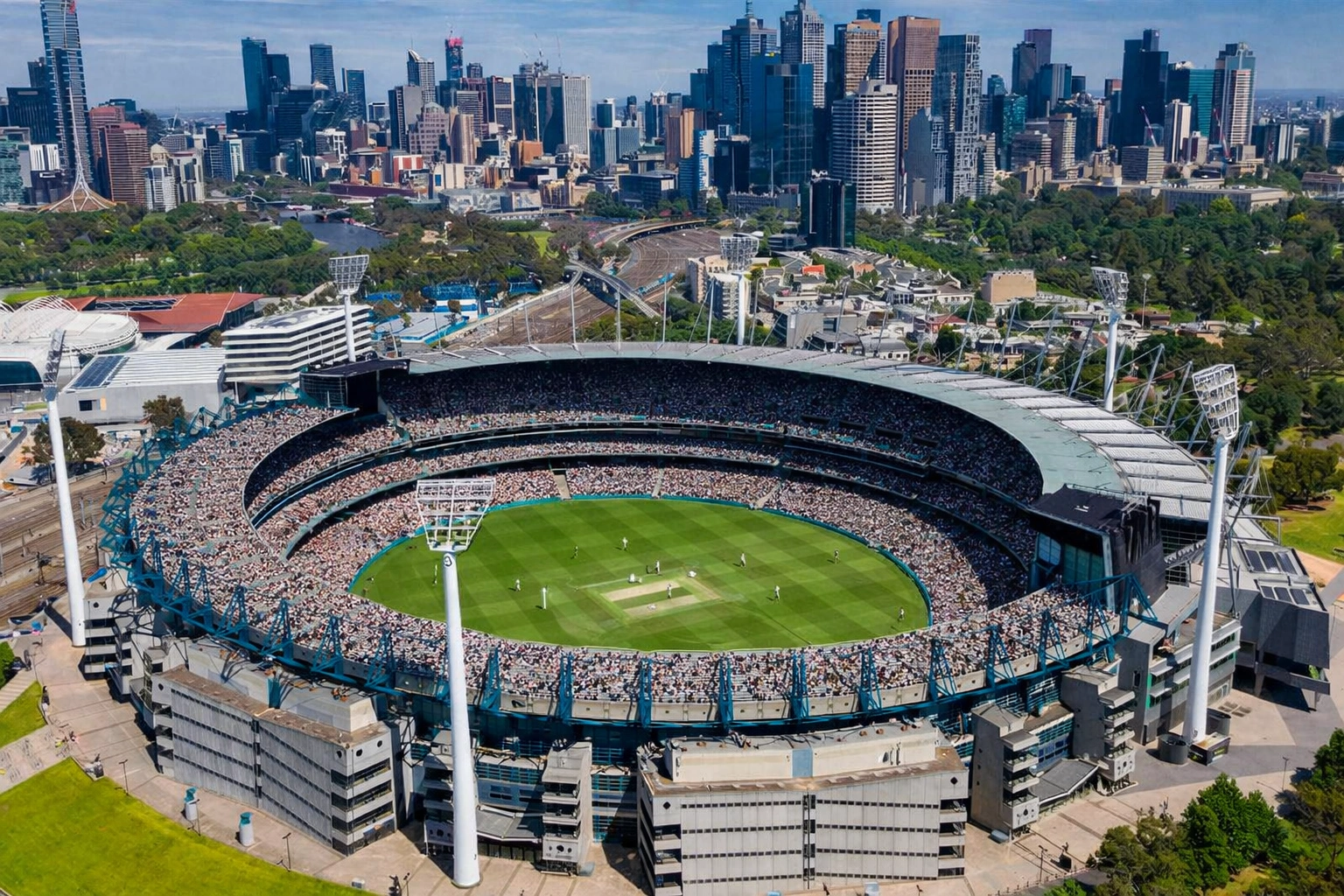
Melbourne Cricket Ground, Victoria
Better known as the MCG — is the spiritual home of Australian sport. Opened in 1853, it’s one of the oldest and most famous cricket stadiums in the world. Sitting just east of Melbourne’s CBD, the “G” can hold around 100,000 spectators, making it the largest stadium in Australia and one of the biggest in the Southern Hemisphere.
It’s most famous for hosting cricket, including the Boxing Day Test and historic Ashes matches, but it’s also the heart of Australian Rules Football. The AFL Grand Final is played there every year, drawing massive crowds and national attention. Beyond sport, the MCG has hosted Olympic events (1956), major concerts and countless iconic sporting moments. For many Australians, the MCG isn’t just a stadium — it’s a landmark woven into the country’s sporting identity.

Flinders Street Station. Victoria
is one of Melbourne’s most recognisable landmarks and a true icon of the city. Opened in 1910, its grand dome, arched entrance and row of clocks above the main doors have made it a classic meeting spot for generations — “meet me under the clocks” is practically a Melbourne tradition. The building’s distinctive yellow façade and green copper dome stand out against the modern city skyline behind it.
More than just a beautiful façade, Flinders Street Station is the busiest suburban railway station in Australia, serving hundreds of thousands of commuters each week. It sits right on the edge of the Yarra River, opposite Federation Square, making it a central hub for both transport and tourism. Blending Edwardian architecture with everyday city life, Flinders Street Station is both a working railway station and a piece of living Melbourne history.
This stylistic image blends elements from multiple themes into one cohesive visual scene.
Australia’s world-famous built icons are bold, distinctive and instantly recognisable — often sitting right against dramatic natural backdrops. The Sydney Opera House is probably the most iconic, its sail-like white shells rising from Sydney Harbour. Right beside it stands the mighty Sydney Harbour Bridge, a steel arch that has become just as symbolic of the city. In Melbourne, landmarks like Flinders Street Station and the Melbourne Cricket Ground reflect Australia’s deep sporting and cultural traditions.
Beyond the East Coast, other standout structures shape the national identity. Parliament House in Canberra blends modern architecture with symbolic design, while the Story Bridge in Brisbane and the Bell Tower in Perth give their cities unique skylines. From historic colonial buildings to striking contemporary designs, Australia’s built icons combine engineering, culture and landscape — often set against ocean, harbour or wide open sky, which makes them feel even more dramatic from above.
This stylistic image blends elements from multiple themes into one cohesive visual scene.
Sydney Opera House, New South Wales
is Australia’s most iconic building and one of the most recognisable landmarks in the world. Opened in 1973 and designed by Danish architect Jørn Utzon, its soaring white sail-like shells were inspired by nature—often said to echo yacht sails, shells, or waves on Sydney Harbour. Perched on Bennelong Point, the building is both a masterpiece of modern architecture and a symbol of Australia’s creative confidence on the global stage. Inside, it is a world-class performing arts centre, hosting opera, theatre, music, and dance across multiple venues. In 2007, it was recognised as a UNESCO World Heritage site, celebrated not just for its beauty, but for its bold engineering and lasting cultural impact—making it a powerful emblem of modern Australia, set against one of the world’s most beautiful harbours.
Sydney Harbour Bridge, New South Wales
is one of Australia’s most recognisable landmarks and a true icon of Sydney. Opened in 1932, it connects the Sydney CBD with the North Shore, spanning the sparkling waters of Sydney Harbour in one massive steel arch. Locals affectionately call it “The Coathanger” because of its distinctive curved shape.
The bridge is about 1,149 metres long and rises 134 metres above the harbour at its highest point. It carries cars, trains, buses, bicycles and pedestrians, making it a vital transport link as well as a tourist attraction. For those wanting a bit more adventure, the BridgeClimb experience allows visitors to walk right to the top for incredible panoramic views of the city and the nearby Sydney Opera House.
Beyond its engineering achievement, the bridge plays a huge cultural role in Australia, especially during New Year’s Eve when it becomes the centrepiece of Sydney’s world-famous fireworks display. It’s more than just a bridge — it’s a symbol of the city itself.
Melbourne Cricket Ground, Victoria
Better known as the MCG — is the spiritual home of Australian sport. Opened in 1853, it’s one of the oldest and most famous cricket stadiums in the world. Sitting just east of Melbourne’s CBD, the “G” can hold around 100,000 spectators, making it the largest stadium in Australia and one of the biggest in the Southern Hemisphere.
It’s most famous for hosting cricket, including the Boxing Day Test and historic Ashes matches, but it’s also the heart of Australian Rules Football. The AFL Grand Final is played there every year, drawing massive crowds and national attention. Beyond sport, the MCG has hosted Olympic events (1956), major concerts and countless iconic sporting moments. For many Australians, the MCG isn’t just a stadium — it’s a landmark woven into the country’s sporting identity.
Flinders Street Station. Victoria
is one of Melbourne’s most recognisable landmarks and a true icon of the city. Opened in 1910, its grand dome, arched entrance and row of clocks above the main doors have made it a classic meeting spot for generations — “meet me under the clocks” is practically a Melbourne tradition. The building’s distinctive yellow façade and green copper dome stand out against the modern city skyline behind it.
More than just a beautiful façade, Flinders Street Station is the busiest suburban railway station in Australia, serving hundreds of thousands of commuters each week. It sits right on the edge of the Yarra River, opposite Federation Square, making it a central hub for both transport and tourism. Blending Edwardian architecture with everyday city life, Flinders Street Station is both a working railway station and a piece of living Melbourne history.
This stylistic image blends elements from multiple themes into one cohesive visual scene.

We Invented That
Australia has produced major inventions like the cochlear implant by Graeme Clark and Wi-Fi technology developed by CSIRO.
Australia has a surprisingly strong track record when it comes to inventions that changed the world. In 1954, Australian engineer Mervyn Richardson created the iconic Hills Hoist rotary clothesline — a backyard staple that became a cultural symbol. Even bigger on the global stage, Australian radiologist Graeme Clark developed the multi-channel cochlear implant, restoring hearing to hundreds of thousands of people worldwide. In medicine too, breakthroughs like the cervical cancer vaccine were developed by researchers including Ian Frazer, dramatically reducing HPV infections and saving lives across the globe.
Australia has also punched above its weight in everyday tech and lifesaving innovation. The modern black box flight recorder was developed by scientist David Warren, revolutionising aviation safety. Wi-Fi technology was significantly advanced by Australian researchers at CSIRO, technology now used in billions of devices. From surf lifesaving reels to polymer banknotes that are harder to counterfeit, Australian inventions reflect a mix of practicality, ingenuity and solving real-world problems — very on-brand for a country known for adapting to tough environments and thinking outside the box.

Plastic (Polymer) Bank Notes
Australia was the first country in the world to introduce polymer (plastic) banknotes — launching them in 1988 for the Bicentenary. Instead of paper, they’re made from a special plastic polymer developed by the Reserve Bank of Australia and CSIRO scientists.
Why they’re a big deal:
• 💧 Waterproof – You can literally put them through the wash • 🔒 Harder to counterfeit – Clear windows + complex security features • 🧼 More hygienic – They don’t absorb grime like paper • ♻️ Longer lasting – They last 2–3 times longer than paper notes
That clear see-through window? That was world-leading tech when it launched — and now loads of countries (UK, Canada, NZ and more) copied the idea.
Current Australian Notes
Today’s colourful series features major historical figures:
$5 – Queen Elizabeth II (soon transitioning to a new Indigenous design)
$10 – Banjo Paterson & Dame Mary Gilmore
$20 – Mary Reibey
$50 – David Unaipon
$100 – Dame Nellie Melba & Sir John Monash
They’re also different sizes depending on value — which is brilliant for accessibility.
Fun fact: if you hold one up to the light, you’ll see micro-printing so tiny you’d need a magnifying glass. Australia basically turned money into high-tech art.

📶 Wi-Fi
Alright, here’s a quiet Australian flex you can drop at any BBQ: Wi-Fi has Australian origins.
In the 1990s, scientists at CSIRO (Commonwealth Scientific and Industrial Research Organisation) cracked a way to clean up radio signals bouncing around indoors — a problem called “multipath interference.” Their breakthrough made high-speed wireless networking actually reliable inside homes and offices. That core tech became part of the global Wi-Fi standard.
Basically… without that work, your laptop, phone, smart TV, and half your house wouldn’t be chatting wirelessly the way they do now.
Why it mattered
• 📡 Turned messy radio reflections into usable data • 🏠 Made fast wireless internet practical indoors • 🌍 Became part of the global 802.11 standard • 💰 Earned Australia billions in licensing revenue
CSIRO even won major legal cases in the US to protect the patents — so this isn’t just folklore, it’s documented tech history.
Fun little twist: Wi-Fi itself isn’t short for anything. It was a marketing name (like Hi-Fi), not “Wireless Fidelity” as people often think.
Rotary Clothesline (Hills Hoist)
The iconic rotary clothesline — better known as the Hills Hoist — is peak Aussie backyard culture. It was developed in the late 1940s by Lance Hill in Adelaide and quickly became a staple in suburban Australia. If you grew up here, chances are you’ve spun around on one as a kid (not officially recommended… but we all did it).
What made it special?
• 🌬️ It spins with the wind to dry clothes faster • ☀️ Perfect for Australia’s sunny climate • 💪 Sturdy galvanised steel frame • 🏡 Became a symbol of the classic Aussie quarter-acre block
At one point, it was estimated that nearly every Australian backyard had one. It’s not just a clothesline — it’s part of the cultural furniture of suburban life.

Google Maps
was actually built on technology developed by an Australian startup called Where 2 Technologies, founded in Sydney by brothers Lars and Jens Rasmussen (plus Noel Gordon and Stephen Ma). Google acquired the company in 2004, and that Sydney team became the foundation of Google Maps.
So while Google Maps itself isn’t technically “Australian,” the core technology and much of the early development absolutely came from Aussie brains. The Rasmussen brothers were key architects of the product, and the original concept was developed right here in Australia before Google turned it into the global giant we know today.
Honestly? That’s a pretty solid Australian tech legacy.

✈️ Black Box Flight Recorder
Despite the name, a “black box” isn’t black at all — it’s bright orange so investigators can find it quickly in wreckage or underwater. It’s one of aviation’s most important safety inventions, and yes… it has strong Australian roots.
The modern flight recorder was developed in the 1950s by Australian scientist Dr David Warren after a series of mysterious jet crashes. He realised that recording cockpit conversations and flight data could help investigators understand what went wrong. At first, airlines weren’t keen on the idea (pilots worried about being monitored), but it eventually became mandatory worldwide.
What’s Inside?
A commercial aircraft actually carries two recorders:
• Flight Data Recorder (FDR) – Records speed, altitude, engine performance, control inputs (thousands of parameters in modern jets). • Cockpit Voice Recorder (CVR) – Records pilot conversations and cockpit sounds.
They’re built to survive:
🔥 Extreme fire 💥 Massive impact 🌊 Deep ocean pressure 🔊 And they emit a “ping” underwater for about 30 days
Fun fact: They’re designed to survive crashes at over 3,000 g’s of force. Absolute tanks.
It’s one of Australia’s most globally impactful inventions — saved countless lives by improving aviation safety standards.
The cochlear implant,
often called the “bionic ear,” is one of Australia’s most important medical inventions. It is a device that can provide a sense of sound to people who are profoundly deaf or severely hard of hearing by bypassing damaged parts of the inner ear and directly stimulating the auditory nerve.
The modern cochlear implant was pioneered by Australian scientist Graeme Clark at the University of Melbourne during the 1970s. After many years of research and testing, the first successful multi-channel cochlear implant was implanted in a patient in 1978, marking a major breakthrough in hearing technology. This invention later led to the creation of the Australian company Cochlear Limited, which became a world leader in implantable hearing devices.
How it WorksA cochlear implant has two main parts:
External processor worn behind the ear that captures sound with a microphone.
Internal implant surgically placed under the skin with an electrode array inserted into the cochlea.
The device works in several steps:
A microphone picks up sound.
The sound processor converts it into digital signals.
The signals are sent to the implanted receiver.
Electrodes stimulate the auditory nerve inside the cochlea.
The brain interprets these signals as sound.
Unlike hearing aids, which simply amplify sound, cochlear implants replace the function of damaged parts of the inner ear.
Impact
The cochlear implant has transformed the lives of hundreds of thousands of people worldwide, especially children born with severe hearing loss. It allows many recipients to understand speech, hear environmental sounds, and communicate more easily.
Today, cochlear implants are used in over 180 countries, making the bionic ear one of Australia’s most significant contributions to global medicine and biomedical engineering.
✅ Fun fact: The inspiration for the device reportedly came when Graeme Clark observed how grass stems could carry electrical signals, helping him design a flexible electrode that could safely fit inside the delicate cochlea.
The wine cask
commonly known in Australia as the “goon bag,” is an Australian invention that revolutionised how wine is packaged and stored. It was invented in 1965 by South Australian winemaker Thomas Angove of Angove Family Winemakers. His design placed wine inside a plastic bladder fitted with a tap, which was then placed inside a cardboard box.
The key innovation was the airtight plastic bag that collapses as wine is poured. This prevents air from entering the container, allowing the wine to stay fresh for weeks after opening, unlike traditional bottles that oxidise quickly.
Why It Was a Big Deal
The wine cask changed the wine industry because it:
Reduced packaging costs compared to glass bottles
Made wine lighter and easier to transport
Allowed wine to stay fresh much longer after opening
Made wine more affordable for everyday drinking
Because of its convenience and low cost, the cask became extremely popular in Australia and later spread worldwide as “bag-in-box wine.”
Cultural Impact in Australia
The wine cask also became part of Australian culture, especially among younger drinkers and travellers, earning the nickname “goon bag.” The empty bladder is even famously reused for the Australian backyard game “Goon of Fortune,” where people spin the bag on a rotary clothesline.
Today, bag-in-box packaging is used globally not only for wine but also for juice, soft drinks, and cooking oils, making the Australian wine cask one of the country’s most practical and influential everyday inventions.
Australia has a surprisingly strong track record when it comes to inventions that changed the world. In 1954, Australian engineer Mervyn Richardson created the iconic Hills Hoist rotary clothesline — a backyard staple that became a cultural symbol. Even bigger on the global stage, Australian radiologist Graeme Clark developed the multi-channel cochlear implant, restoring hearing to hundreds of thousands of people worldwide. In medicine too, breakthroughs like the cervical cancer vaccine were developed by researchers including Ian Frazer, dramatically reducing HPV infections and saving lives across the globe.
Australia has also punched above its weight in everyday tech and lifesaving innovation. The modern black box flight recorder was developed by scientist David Warren, revolutionising aviation safety. Wi-Fi technology was significantly advanced by Australian researchers at CSIRO, technology now used in billions of devices. From surf lifesaving reels to polymer banknotes that are harder to counterfeit, Australian inventions reflect a mix of practicality, ingenuity and solving real-world problems — very on-brand for a country known for adapting to tough environments and thinking outside the box.
Plastic (Polymer) Bank Notes
Australia was the first country in the world to introduce polymer (plastic) banknotes — launching them in 1988 for the Bicentenary. Instead of paper, they’re made from a special plastic polymer developed by the Reserve Bank of Australia and CSIRO scientists.
Why they’re a big deal:
• 💧 Waterproof – You can literally put them through the wash • 🔒 Harder to counterfeit – Clear windows + complex security features • 🧼 More hygienic – They don’t absorb grime like paper • ♻️ Longer lasting – They last 2–3 times longer than paper notes
That clear see-through window? That was world-leading tech when it launched — and now loads of countries (UK, Canada, NZ and more) copied the idea.
Current Australian Notes
Today’s colourful series features major historical figures:
$5 – Queen Elizabeth II (soon transitioning to a new Indigenous design)
$10 – Banjo Paterson & Dame Mary Gilmore
$20 – Mary Reibey
$50 – David Unaipon
$100 – Dame Nellie Melba & Sir John Monash
They’re also different sizes depending on value — which is brilliant for accessibility.
Fun fact: if you hold one up to the light, you’ll see micro-printing so tiny you’d need a magnifying glass. Australia basically turned money into high-tech art.
📶 Wi-Fi
Alright, here’s a quiet Australian flex you can drop at any BBQ: Wi-Fi has Australian origins.
In the 1990s, scientists at CSIRO (Commonwealth Scientific and Industrial Research Organisation) cracked a way to clean up radio signals bouncing around indoors — a problem called “multipath interference.” Their breakthrough made high-speed wireless networking actually reliable inside homes and offices. That core tech became part of the global Wi-Fi standard.
Basically… without that work, your laptop, phone, smart TV, and half your house wouldn’t be chatting wirelessly the way they do now.
Why it mattered
• 📡 Turned messy radio reflections into usable data • 🏠 Made fast wireless internet practical indoors • 🌍 Became part of the global 802.11 standard • 💰 Earned Australia billions in licensing revenue
CSIRO even won major legal cases in the US to protect the patents — so this isn’t just folklore, it’s documented tech history.
Fun little twist: Wi-Fi itself isn’t short for anything. It was a marketing name (like Hi-Fi), not “Wireless Fidelity” as people often think.
Rotary Clothesline (Hills Hoist)
The iconic rotary clothesline — better known as the Hills Hoist — is peak Aussie backyard culture. It was developed in the late 1940s by Lance Hill in Adelaide and quickly became a staple in suburban Australia. If you grew up here, chances are you’ve spun around on one as a kid (not officially recommended… but we all did it).
What made it special?
• 🌬️ It spins with the wind to dry clothes faster • ☀️ Perfect for Australia’s sunny climate • 💪 Sturdy galvanised steel frame • 🏡 Became a symbol of the classic Aussie quarter-acre block
At one point, it was estimated that nearly every Australian backyard had one. It’s not just a clothesline — it’s part of the cultural furniture of suburban life.
Google Maps
was actually built on technology developed by an Australian startup called Where 2 Technologies, founded in Sydney by brothers Lars and Jens Rasmussen (plus Noel Gordon and Stephen Ma). Google acquired the company in 2004, and that Sydney team became the foundation of Google Maps.
So while Google Maps itself isn’t technically “Australian,” the core technology and much of the early development absolutely came from Aussie brains. The Rasmussen brothers were key architects of the product, and the original concept was developed right here in Australia before Google turned it into the global giant we know today.
Honestly? That’s a pretty solid Australian tech legacy.
✈️ Black Box Flight Recorder
Despite the name, a “black box” isn’t black at all — it’s bright orange so investigators can find it quickly in wreckage or underwater. It’s one of aviation’s most important safety inventions, and yes… it has strong Australian roots.
The modern flight recorder was developed in the 1950s by Australian scientist Dr David Warren after a series of mysterious jet crashes. He realised that recording cockpit conversations and flight data could help investigators understand what went wrong. At first, airlines weren’t keen on the idea (pilots worried about being monitored), but it eventually became mandatory worldwide.
What’s Inside?
A commercial aircraft actually carries two recorders:
• Flight Data Recorder (FDR) – Records speed, altitude, engine performance, control inputs (thousands of parameters in modern jets). • Cockpit Voice Recorder (CVR) – Records pilot conversations and cockpit sounds.
They’re built to survive:
🔥 Extreme fire 💥 Massive impact 🌊 Deep ocean pressure 🔊 And they emit a “ping” underwater for about 30 days
Fun fact: They’re designed to survive crashes at over 3,000 g’s of force. Absolute tanks.
It’s one of Australia’s most globally impactful inventions — saved countless lives by improving aviation safety standards.
The cochlear implant,
often called the “bionic ear,” is one of Australia’s most important medical inventions. It is a device that can provide a sense of sound to people who are profoundly deaf or severely hard of hearing by bypassing damaged parts of the inner ear and directly stimulating the auditory nerve.
The modern cochlear implant was pioneered by Australian scientist Graeme Clark at the University of Melbourne during the 1970s. After many years of research and testing, the first successful multi-channel cochlear implant was implanted in a patient in 1978, marking a major breakthrough in hearing technology. This invention later led to the creation of the Australian company Cochlear Limited, which became a world leader in implantable hearing devices.
How it WorksA cochlear implant has two main parts:
External processor worn behind the ear that captures sound with a microphone.
Internal implant surgically placed under the skin with an electrode array inserted into the cochlea.
The device works in several steps:
A microphone picks up sound.
The sound processor converts it into digital signals.
The signals are sent to the implanted receiver.
Electrodes stimulate the auditory nerve inside the cochlea.
The brain interprets these signals as sound.
Unlike hearing aids, which simply amplify sound, cochlear implants replace the function of damaged parts of the inner ear.
Impact
The cochlear implant has transformed the lives of hundreds of thousands of people worldwide, especially children born with severe hearing loss. It allows many recipients to understand speech, hear environmental sounds, and communicate more easily.
Today, cochlear implants are used in over 180 countries, making the bionic ear one of Australia’s most significant contributions to global medicine and biomedical engineering.
✅ Fun fact: The inspiration for the device reportedly came when Graeme Clark observed how grass stems could carry electrical signals, helping him design a flexible electrode that could safely fit inside the delicate cochlea.
The wine cask
commonly known in Australia as the “goon bag,” is an Australian invention that revolutionised how wine is packaged and stored. It was invented in 1965 by South Australian winemaker Thomas Angove of Angove Family Winemakers. His design placed wine inside a plastic bladder fitted with a tap, which was then placed inside a cardboard box.
The key innovation was the airtight plastic bag that collapses as wine is poured. This prevents air from entering the container, allowing the wine to stay fresh for weeks after opening, unlike traditional bottles that oxidise quickly.
Why It Was a Big Deal
The wine cask changed the wine industry because it:
Reduced packaging costs compared to glass bottles
Made wine lighter and easier to transport
Allowed wine to stay fresh much longer after opening
Made wine more affordable for everyday drinking
Because of its convenience and low cost, the cask became extremely popular in Australia and later spread worldwide as “bag-in-box wine.”
Cultural Impact in Australia
The wine cask also became part of Australian culture, especially among younger drinkers and travellers, earning the nickname “goon bag.” The empty bladder is even famously reused for the Australian backyard game “Goon of Fortune,” where people spin the bag on a rotary clothesline.
Today, bag-in-box packaging is used globally not only for wine but also for juice, soft drinks, and cooking oils, making the Australian wine cask one of the country’s most practical and influential everyday inventions.